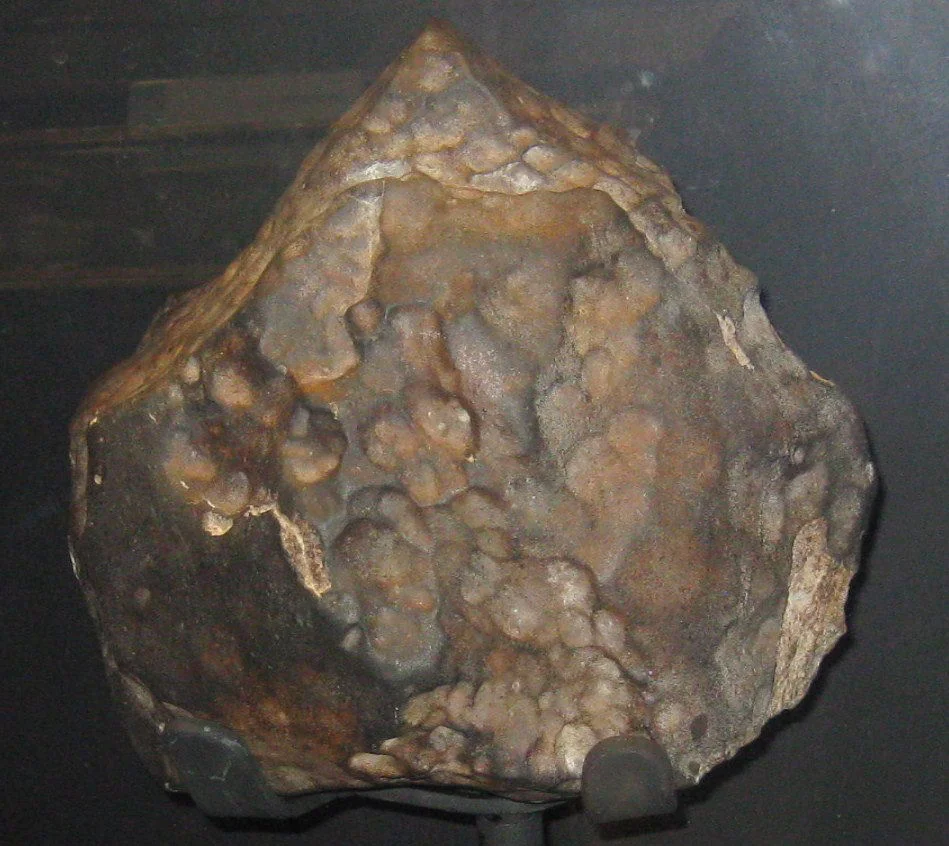

Tenham (meteorite)
On a spring night in 1879, the sky over a stretch of western Queensland filled with streaking light. People watching saw bright meteors racing roughly west to east, and somewhere out past the Tenham sheep station, near a place called South Gregory, stones began to fall. Around 300 of them came down across a strip of country some 20 kilometres long and 5 wide. Nobody wrote down the exact date. The pieces lay in the dry red dirt, scattered and ignored, until station hands started picking them up in the early 1930s. Those plain dark rocks turned out to be a doorway to the centre of the Earth.
A Visitor From the Asteroid Belt
The Tenham stones are chondrites, fragments of an ancient asteroid that never grew into a planet, and they carry a high load of organic compounds along with silicates, oxides, and sulfides. What makes them priceless is where they fell. The Channel Country is bone-dry and remote, so once the meteorites hit the ground, the slow chemistry of weathering barely touched them. When scientists finally examined the stones, they were studying material almost as fresh as the moment it left space. That preservation made Tenham one of the most intensively studied meteorites on Earth, a clean sample of the early solar system delivered, by chance, to an outback paddock.
Pressure Written in Stone
The asteroid that birthed the Tenham stones met a violent end. Somewhere in space it was struck by another body, and the collision drove shock waves through the rock at staggering pressures and temperatures near 2,000 degrees Celsius. Those shock waves left dark veins threading through the stones, and inside the veins, ordinary minerals were crushed and reborn into dense new forms that can only exist when squeezed almost beyond imagining. Geologists realised these veins were a natural laboratory. The same brutal pressures that reshaped the meteorite are the pressures found hundreds of kilometres down inside the Earth, in a region no drill will ever reach.
Naming the Unreachable
In 1969, a purple mineral was identified in the Tenham shock veins, appearing as rounded grains no wider than a hair, the high-pressure form of olivine. It was named ringwoodite after the Australian National University geologist A. E. Ringwood, who had argued such a substance must exist deep underground but had only ever made it in the laboratory. Here it was at last, the real thing, forged not by a machine but by a collision in space. Tenham kept giving. Another high-pressure mineral, akimotoite, was confirmed in the stones in the 1990s. Then, in 2014, came the biggest prize of all: bridgmanite, finally accepted as a named mineral from a Tenham specimen after decades in which scientists could describe it in theory but never officially name it, because no one had a natural sample to point to. Bridgmanite is thought to make up the bulk of Earth's lower mantle, which makes it the most abundant mineral on the entire planet. The most common stuff in the world, and these outback stones were where science first caught it in nature.
The Sky as a Drill Core
There is a beautiful irony in Tenham. To study the deep Earth, you cannot go down; the mantle starts far below the deepest borehole ever sunk and stays out of reach. So geologists go up instead, reading the interior of our own planet in rocks that fell from the sky. A collision between asteroids, hundreds of millions of kilometres away and long before humans existed, briefly recreated the conditions of Earth's mantle and froze them into a few hundred stones. Those stones landed near a Queensland sheep run, waited half a century to be noticed, and then handed us minerals we could not otherwise have seen. The ground beneath your feet, miles down, is mostly made of something first found in a meteorite.
From the Air
The strewn field lies at roughly 25.73°S, 142.95°E, in the South Gregory district of western Queensland, southeast of Windorah on the flat Mulga and gibber plains of the Channel Country. The nearest aerodrome is Windorah Airport (ICAO YWDH) to the northwest; Quilpie (YQLP) sits further southeast and Birdsville (YBDV) far to the west. There is nothing to mark the fall from the air, only open red country, but the surrounding plains offer extraordinary visibility and dark, transparent night skies, fitting for a place defined by what once came down out of them. A daytime overflight at 2,000–4,000 ft AGL shows the subtle channels and claypans that make this corner of the outback so dry, and so good at keeping its meteorites pristine.
Nearby Stories
- Thylungra 8.7 km away
- Cooper Floodplain below Windorah 15 km away
- Windorah Solar Farm 26 km away
- Canterbury, Queensland 53 km away
- Hell Hole Gorge National Park 76 km away
- Eromanga Refinery 81 km away
- Yapunyah waterhole 88 km away
- Lake Yamma Yamma 97 km away