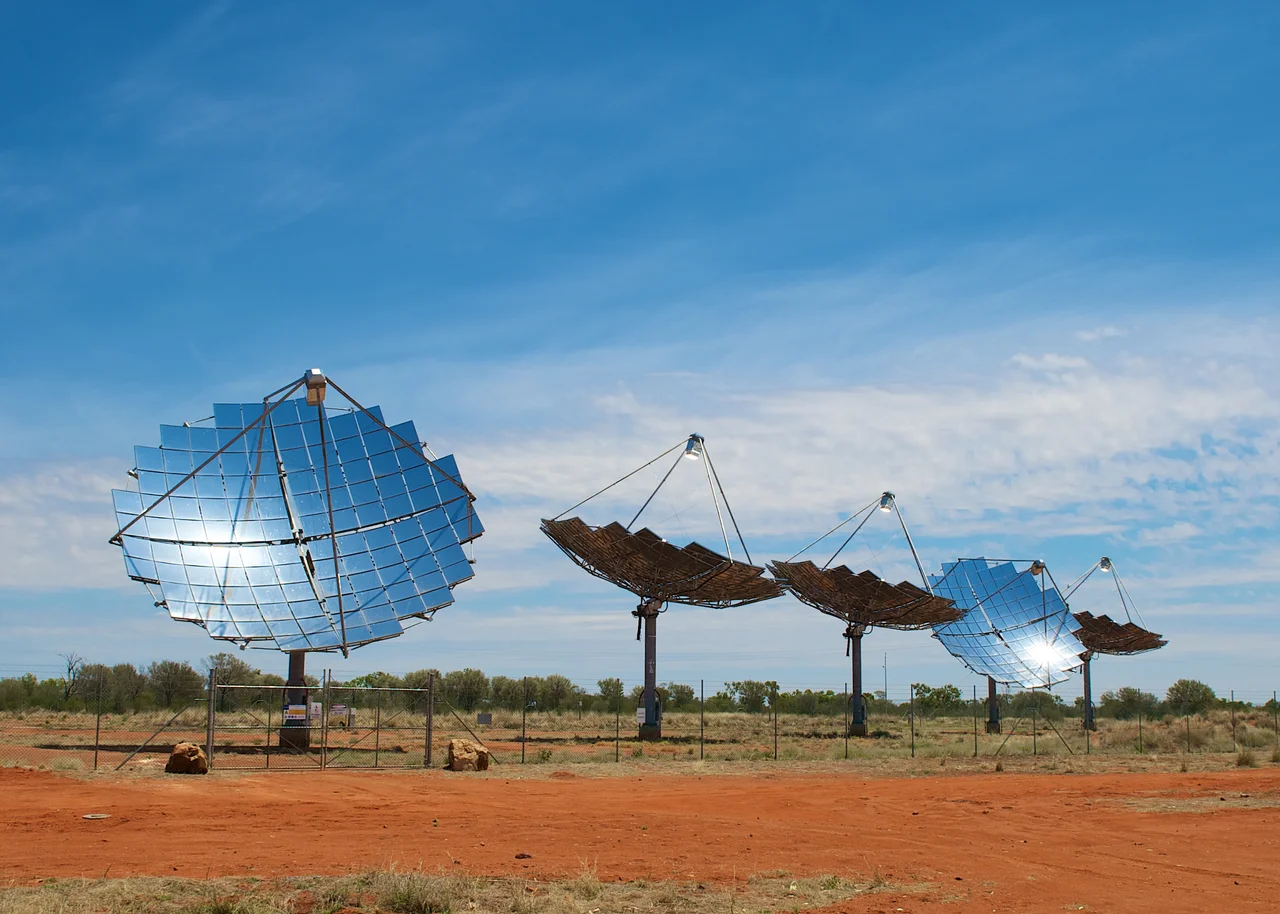

Windorah Solar Farm
For most of its life, the town of Windorah ran on the rhythm of a fuel truck. Diesel hauled hundreds of kilometres across the Channel Country fed the generators that kept the lights on for its hundred or so residents, out where the Cooper Creek braids into a maze of channels in far western Queensland. Then, in December 2008, something strange appeared on the flat horizon: five silver dishes on thirteen-metre masts, turning slowly to follow the sun. Windorah had become the first town in Queensland to run, at least by day, on light.
A Field of Mirrors
Each dish was a mosaic of 112 square mirrors, every one of them 1.1 metres across, angled to gather sunlight and throw it onto a single bright point. Built and installed by the Melbourne company Solar Systems, the reflectors sat atop tall masts and could pivot a full 360 degrees, swinging through the day so that the desert sun was always square in their faces. On a clear afternoon the array produced around 180 kilowatts, enough on sunny days to cover the town's entire daytime demand. The generators didn't disappear; they simply waited. Solar and diesel were stitched together into one system, the first time Ergon Energy had married the two, and the dishes drank in light for as much as ten months of the year.
The Arithmetic of Distance
In the outback, energy is mostly a problem of geography. Windorah sits in the Channel Country, the maze of braided watercourses where Cooper Creek spreads across the plain, and it is hundreds of kilometres from anywhere. Every litre of diesel burned in town first had to be trucked across that distance, which made each kilowatt-hour expensive and the supply line long and fragile. A washed-out road or a wet season could threaten it. The mirrors changed that arithmetic. The farm was expected to save up to 100,000 litres of diesel a year, fuel that would otherwise have rolled in by road. The dishes never carried the whole load, and on overcast days the old generators took back over. But the principle was proven on the simplest of terms: a remote town, far from any grid, leaning on the one resource the Channel Country has in overwhelming abundance. Out here, where rain is rare and the sky is enormous, sunlight is the surplus, and for a town used to importing every watt, that was a genuinely new idea.
What the Sun Couldn't Outrun
Solar technology, though, moves fast, and the dishes that looked futuristic in 2008 aged quickly. Cheap photovoltaic panels overtook the elegant, complicated concentrators, and the array eventually stopped meeting the town's needs. The reflectors that had become a landmark on Windorah's skyline were retired and dismantled, an experiment that had served its decade and then quietly closed. Yet the story didn't end there: Ergon Energy committed to building a new solar farm on the same patch of red earth. The mirrors are gone, but the idea they tested remains, replaced by the panels they helped make ordinary.
Why Windorah Mattered
It would be easy to file the Windorah dishes away as a costly trial that didn't last, and in narrow terms that is true. But small towns like this one are where ideas get their first hard test, far from anywhere, with real consequences if they fail. For a few years, a town that had known nothing but diesel watched its meters spin on sunlight alone through the middle of the day. The people who flicked on a light at noon in Windorah were, briefly, living in a future that the rest of the country would only catch up to later. That is worth more than the kilowatts it generated.
From the Air
The site sits at roughly 25.41°S, 142.66°E, just outside the tiny town of Windorah in Queensland's Channel Country, where Cooper Creek spreads into a web of braided channels that are unmistakable from the air after rain. The nearest aerodrome is Windorah Airport (ICAO YWDH), a short hop to the north. Quilpie (YQLP) lies to the southeast and Birdsville (YBDV) far to the west. This is some of Australia's clearest, emptiest airspace, with vast visibility and few visual references beyond the channels themselves; a low pass at 1,500–3,000 ft AGL on a sunny morning gives the best light on the flat, red Mulga-and-gibber plain.
Nearby Stories
- Canterbury, Queensland 16 km away
- Tanbar Station 23 km away
- Welford Homestead 31 km away
- Tenham (meteorite) 40 km away
- Great Artesian Basin 47 km away
- Welford National Park 52 km away
- Thylungra 60 km away
- Palparara 66 km away