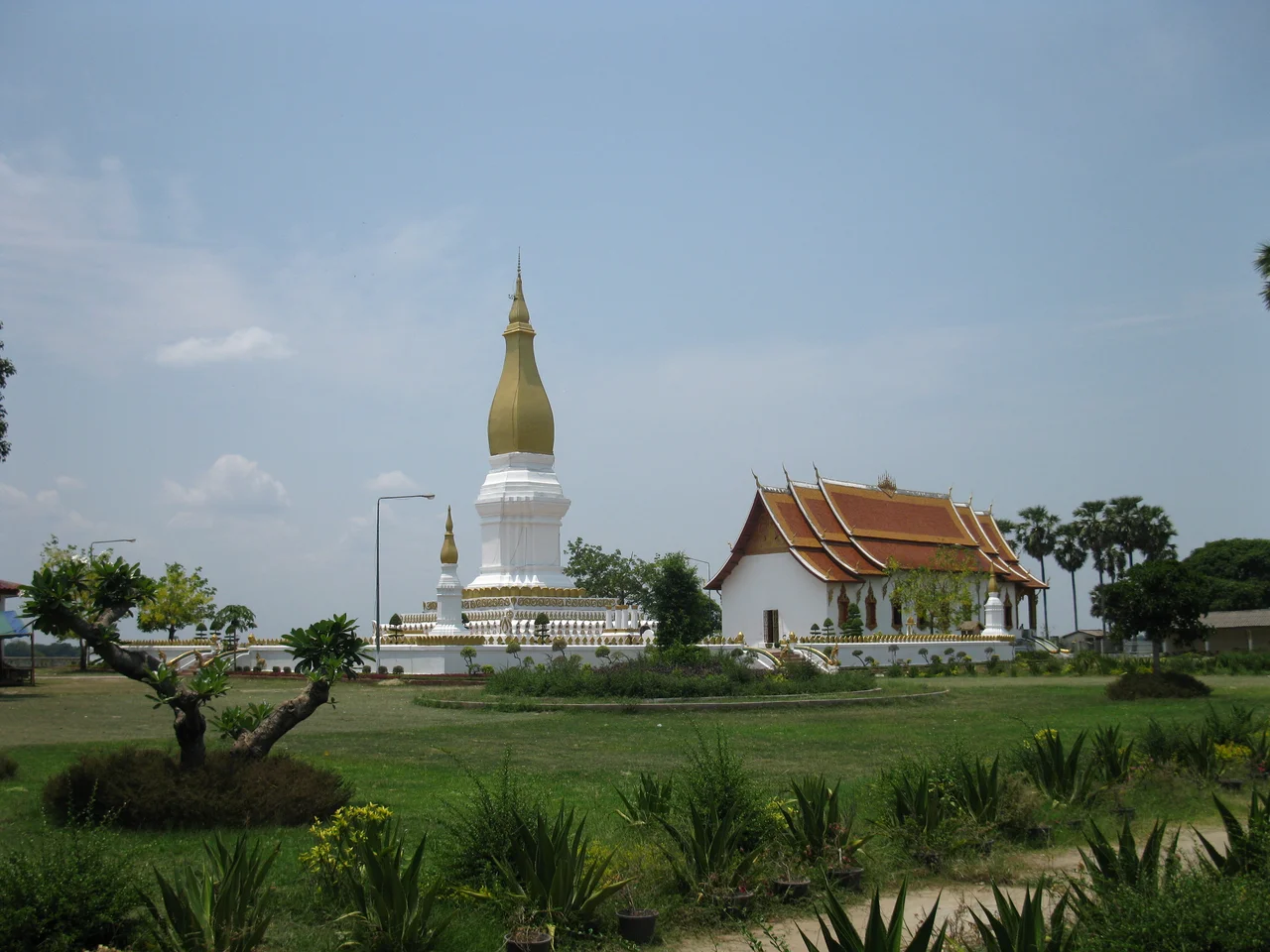

That Sikhottabong
Three stupas stand within a hundred kilometres of one another along the middle Mekong, and all three make the same enormous claim: that somewhere inside the brickwork lies a physical piece of the Buddha. One is That Inhang at Savannakhet. One is Wat Phra That Phanom, on the Thai bank. The third rises from a riverside terrace just south of Thakhek in Laos, whitewashed and gilded, its spire tapering into a shape that Lao builders describe as a banana flower. It is called That Sikhottabong, and it is named for a kingdom that most people have never heard of.
Sri Gotapura
Long before Lan Xang, before Vientiane meant anything, this stretch of the Mekong held a cluster of loosely connected city-states — Fa Daet in what is now Kalasin, Muang Sua at Luang Prabang, Chantaburi where Vientiane stands today, and near present-day Thakhek a place called Sri Gotapura, which Lao tradition renders as Sikhottabong. By the eighth century it was reckoned the strongest of them, controlling trade up and down the middle river. These states were not politically unified but they shared a culture, and it was through them that Theravada Buddhism, carried by missionaries from Sri Lanka, took root across the region. Thakhek itself kept the old name for centuries: during the Lan Xang era the town was known variously as Sikhottabong, Muang Kabong and Lakhon.
Built for a King
The founding story is a royal one, told the way such stories usually are. King Nanthasene raised the stupa for King Soummitham, and the relics of the Buddha are said to have been consecrated within it. Whether the archaeology supports the legend is a question the legend has never much cared about. What matters, and what has mattered here for a very long time, is that people believe the site is charged — that the ground under the terrace is not ordinary ground. Across the river at That Phanom, the parallel tradition names the relic precisely: the Phra Uranghathat, the Buddha's breastbone, brought there by his disciple Mahakasyapa and five hundred arhats. Different stupas, the same conviction, held on both banks of a border that did not exist when the stories started.
Setthathirath's Century
The building you see now is not the original. That Sikhottabong was refurbished in the sixteenth century under King Setthathirath, who ruled Lan Xang from 1548 to 1571 and left more monuments behind him than almost any Lao monarch since. He moved the capital from Luang Prabang to Vientiane in 1560 and gave that city Pha That Luang and the Haw Phra Kaew; he built Wat Xieng Thong in the old capital; and he held Lan Xang together through a decade of Burmese invasions, forcing Bayinnaung's withdrawal in 1565 and leaving his kingdom the last independent Tai state standing. In 1571 he was murdered in a conspiracy on the southern frontier. His restoration work at Thakhek outlived him by four and a half centuries.
The Banana Flower
The stupa rises to 29 metres on a square, tiered base, and the detail that visitors remember is the finial — the pinnacle narrows and swells into a form deliberately modelled on the bud of a banana flower, a motif drawn from the plant that grows in every village yard in Laos. Whitewash and gold leaf catch hard afternoon light off the river. The complex sits directly on the Mekong bank, and the water is part of the experience: the current moving past, the low Thai shore visible opposite, and in the dry months a wide apron of sand between the temple wall and the channel.
The Third Month
The great festival at That Sikhottabong falls in the third month of the lunar calendar, when pilgrims arrive to circle the stupa, offer candles and alms, and stay for the fair that grows up around any Lao temple festival worth attending. Nothing about the stupa's permanence should be taken for granted. On 11 August 1975, after an earthquake in March and a spell of heavy rain, its sister across the river at That Phanom — all 53 metres of it — collapsed completely at 7:38 in the evening. Donations poured in from ordinary people on both banks, and it was rebuilt by March 1979. That is the pattern here. These stupas are not artefacts kept behind glass; they are maintained, restored, and if necessary rebuilt from the ground, because the communities around them are not finished using them.
From the Air
That Sikhottabong stands at 17.4360°N, 104.7405°E, on the Lao bank of the Mekong a short way outside central Thakhek, in Khammouane Province. Look for a bright white and gold spire on a riverside terrace, isolated from the town and set against green riverbank vegetation — at 29 metres it is small, so plan on 1,000 to 2,000 ft AGL to pick it out. Two larger features frame it: the Third Thai–Lao Friendship Bridge about 6 km upriver to the north, and the karst towers of Khammouane rising abruptly a few kilometres inland to the east. Thakhek Airport (THK / VLTK) lies just north; Nakhon Phanom (KOP / VTUW) sits across the border on the Thai bank. The international boundary follows the river, so an orbit here will cross it — Lao airspace applies to the temple side. Clearest conditions are November through February; March and April bring agricultural haze, and the wet season from May to September raises the river and buries the sand flats that make the terrace so visible in the dry months.
Nearby Stories
- Renu Nakhon District 21 km away
- Khammouane Province 23 km away
- Tham Kong Lo 29 km away
- Arem language 53 km away
- Ban Chiang 75 km away
- National Route 9 (Vietnam) 87 km away
- Vientiane 153 km away
- Si Thep Historical Park 367 km away