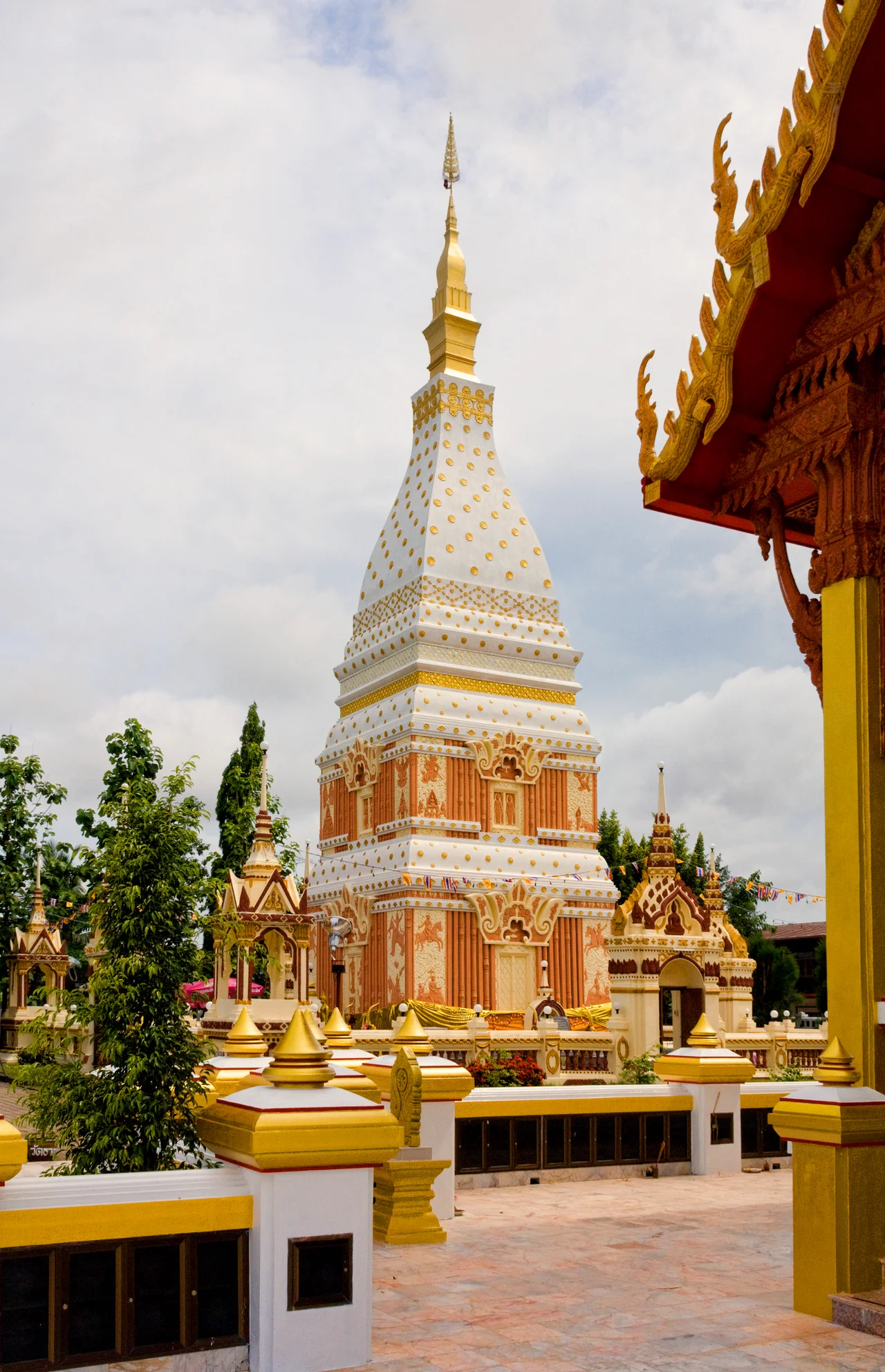

Renu Nakhon District
In the fan store at the King Power Stadium in Leicester, among the replica shirts and the scarves, there has been a rack of blue sportswear that came a very long way. The dye in it was grown, cut and fermented in Ban Na Kham, a village of Renu Nakhon district in northeastern Thailand, where twenty-two artisans spin cotton into yarn by hand and colour it with indigo they harvest themselves. The blue they get, known locally as kram, happens to be very close to Leicester City's blue. The club is owned by King Power, a Thai company, and the Indigo Collection went on sale in May 2018 to considerably more interest than anyone in the village had expected.
Green in the Vat, Blue in the Air
Natural indigo is not a dye you buy and stir in. The plant has to be cut, steeped until it ferments, beaten to aerate the liquor, and kept alive in the vat like a sourdough starter, fed and watched and coaxed back when it sulks. Cotton dipped in it comes out green and turns blue in the air as it oxidises, and depth of shade is a matter of repeating the dip many times over. None of that scales the way a factory scales, which is precisely the point of the twenty-two women and men doing it in Ban Na Kham. Indigo work of this kind runs right across Isan and it is usually a household craft, sold at local markets. Getting it onto a shelf in the English Midlands took a chain of ownership that would have been unimaginable to the people who taught the technique.
Brought Across the River
The people of Renu Nakhon are Phu Thai, a Tai group whose homeland lay far to the northeast in the country of the Sip Song Chu Tai, spread across what is now northern Vietnam, Laos and southern China. They did not arrive here by choice. During the reign of Rama III, Siam set about hollowing out the Lao territories on the eastern bank of the Mekong, and in 1834 a Siamese commander operating from Nakhon Phanom raised troops to cross the river and move whole communities west. Renu Nakhon was constituted as a mueang in 1844 with roughly 2,648 inhabitants, placed under the authority of Nakhon Phanom. Those numbers describe families who had been walked out of their valleys under escort and told where they would live now. Their descendants have held the district ever since.
A Language That Remembers the Route
Phu Thai is still spoken here, and it is not simply Isan with an accent. It belongs to the Southwestern Tai family and had roughly 156,000 speakers in Thailand as of the early 1990s, concentrated around Mukdahan and Khamcha-i and scattered through Nakhon Phanom, Kalasin and Sakon Nakhon. What makes it interesting is the mirror on the far bank. Phu Thai communities also live in Khammouane and Savannakhet provinces in Laos, and there is remarkably little difference between the Lao and Thai varieties, which is exactly what you would expect of a single population split by a forced migration only six or seven generations back. In Thailand the language is now under steady pressure from Isan, the way small languages usually are. The dances, performed each year in May and June, have proved more durable than the grammar.
The Name That Was Taken Away
Administratively, Renu Nakhon has had an unusual career. The old mueang was converted into a district in 1907 during the thesaphiban reforms that reorganised the whole Siamese provincial system. Ten years later, in 1917, the district was renamed That Phanom after the great stupa on the Mekong, and the name Renu Nakhon vanished from the map for half a century. It came back on 1 May 1970, when a minor district was carved out of That Phanom with three subdistricts, Renu, Phon Thong and Tha Lat, and it was raised to full district status on 21 August 1975. Today it covers 254 square kilometres, holds around 46,000 people across eight subdistricts and 91 villages, and is ringed by Mueang Nakhon Phanom, That Phanom, Na Kae and Pla Pak.
A Smaller Great Stupa, and a Song
At the centre of the district stands Wat Phra That Renu Nakhon, whose chedi was raised in 1918 and modelled on Phra That Phanom, the enormous original down on the Mekong to the southeast. This one reaches about 35 metres and holds scriptures and gold Buddha images; the temple also keeps Phra Sung, a Buddha image weighing 1,200 kilograms. And then there is the other thing Renu Nakhon is famous for in Thailand, which is a song. 'Nao Lom Thi Renu', or 'Cold Wind in Renu', is a luk thung country number that has been popular since 1970 and has been recorded again by singer after singer. For millions of Thais who will never come here, the district is a place in a lyric about weather and longing, which is not the worst way for a small place to be remembered.
From the Air
Renu Nakhon district centres on 17.056 N, 104.680 E, in the Mekong lowlands of Nakhon Phanom province, about 15 km inland from the river. From the air this is flat rice country: a mosaic of paddy bunds, farm ponds and village groves, with the white chedi of Wat Phra That Renu Nakhon marking the district town. Use the Mekong itself as the primary reference, running northwest to southeast a short distance east, with the karst hills of Lao Khammouane beyond it. Detail resolves best between 1,500 and 3,000 ft AGL. Nakhon Phanom Airport (VTUW) lies roughly 30 km north, Sakon Nakhon (VTUI) about 70 km west, and Savannakhet in Laos (VLSK) about 120 km southeast. The dry season from November to February brings crisp visibility and genuinely cool mornings; from February into April, agricultural burning can cut visibility sharply, and the southwest monsoon between May and October delivers strong afternoon buildups.
Nearby Stories
- That Sikhottabong 16 km away
- Khammouane Province 25 km away
- Second Thai–Lao Friendship Bridge 34 km away
- Nguồn Language 52 km away
- National Route 9 (Vietnam) 64 km away
- Ban Chiang 76 km away
- Vientiane 178 km away
- Si Thep Historical Park 348 km away