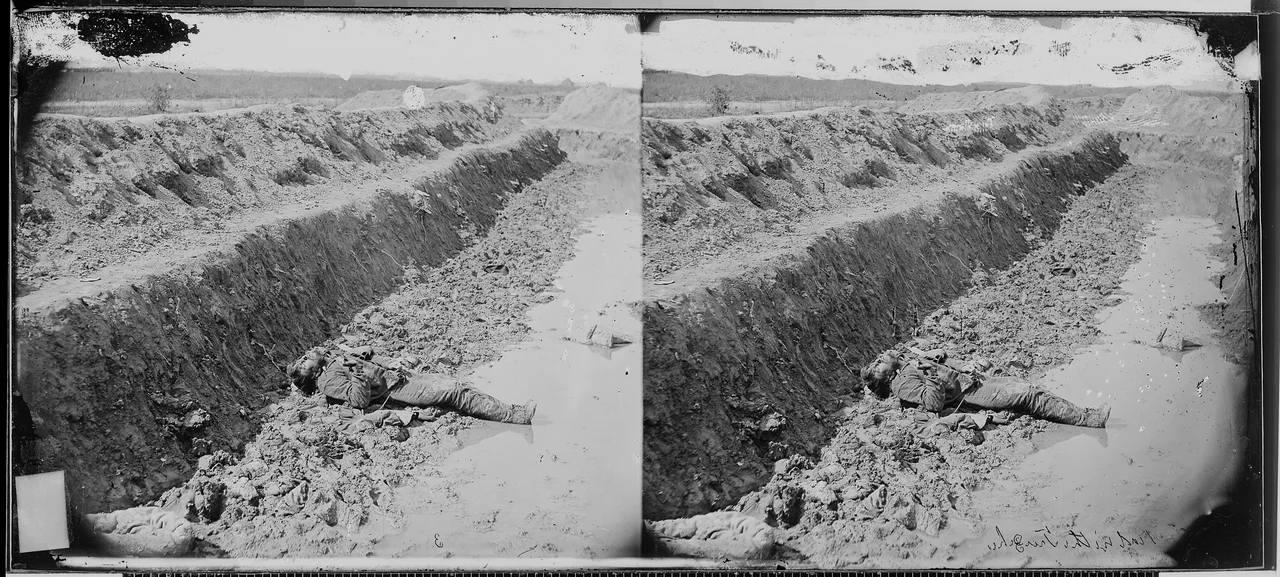
Third Battle of Petersburg
At 4:40 a.m. on Sunday, April 2, 1865, a single signal gun fired from the Union lines southwest of Petersburg. Behind it, twelve thousand men of Horatio Wright's Sixth Corps stood waiting in the dark, lying down in the cold mud so their silhouettes would not give them away. When the gun went off they rose and ran. By dawn they had broken through the Confederate earthworks that had held Grant's army at bay for nine months. By nightfall, Robert E. Lee's army was on the road west. Seven days later the war was over.
The Breakthrough at Boydton Line
The Sixth Corps assault hit a thinly held section of the Boydton Plank Road line just before sunrise. The Confederate defenders, stretched along entrenchments thirty miles long, simply did not have enough men to hold everywhere. Wright's men carried the works, swept inward, and split the Confederate Third Corps in two. Lieutenant General A.P. Hill, who had commanded that corps since its creation in May 1863, rode out to rally his men and was shot dead by two Pennsylvania stragglers who refused his demand to surrender. Hill had been thirty-nine years old. He had fought beside Lee since the Seven Days. Lee, when told, said quietly that he was glad Hill did not have to live to see the end.
Fort Gregg's Two Hours
The Confederate Alamo of Petersburg was Fort Gregg, a small earthwork redoubt two miles west of the city. About 300 Confederates, mostly Mississippians from Harris's Brigade and artillerymen, held it against assault by roughly 5,000 men of John Gibbon's XXIV Corps. The fight lasted nearly two hours. The defenders fired until their muskets fouled, then threw bricks and swung clubbed rifles when the Union troops reached the parapet. When the fort finally fell, only about thirty Confederate defenders were unwounded. Their stand bought Lee the daylight he needed to organize the evacuation of Petersburg and Richmond. The men who held Fort Gregg knew, almost certainly, that they were dying so that other men could live to march westward.
Lee's Telegram
At about 10:30 a.m. Lee sent a telegram to Jefferson Davis in Richmond. He had been at services at St. Paul's Episcopal that morning when the message reached him; the legend that he was handed it during the liturgy is partly true, partly compressed for memory. The wire was direct: My lines are broken in three places. Richmond must be evacuated this evening. Davis left the church, packed the Confederate treasury onto a train, and was gone before dark. By 8:00 p.m., the Confederate government and what remained of the Army of Northern Virginia were streaming westward toward Amelia Court House, where Lee hoped to find rations. The rations would not be there.
Grant Meets Lincoln
On the morning of April 3, Union troops entered Petersburg and Richmond. Grant had ordered a furious bombardment to begin at 5:00 a.m. that day in preparation for another assault, but at 3:00 a.m. his commanders had discovered the Confederate works empty. There would be no further fight for Petersburg. Lincoln, who had come down from Washington to City Point on the James River to be near the front, met Grant at a captured house in Petersburg later that morning. They sat on the porch and talked for about ninety minutes. Then Lincoln returned to City Point, and Grant rode west to catch up with Sheridan, who was already pressing hard after the fleeing Confederate columns. The retreat that would end at Appomattox Court House had begun.
What the Casualty Lists Hide
The official numbers for April 2 are roughly 3,900 Union casualties and an unknown but smaller number of Confederate losses, with thousands more taken prisoner as the lines collapsed. The numbers hide what the fighting actually was. A.P. Hill, killed almost casually by two privates who did not know who he was. The 300 defenders of Fort Gregg, almost all of them dead or wounded by the end. The men of both armies who had been in the trenches since June, eating less every month, watching their friends die of cold and dysentery as much as bullets, and who now suddenly found themselves either chasing or running. The Petersburg lines, the longest continuous fortifications ever built in North America to that point, had finally broken because there were not enough Confederate soldiers left to hold them.
From the Air
The breakthrough sector lies roughly at 37.18 N, 77.48 W, southwest of downtown Petersburg between modern US-460 and I-85. Pamplin Historical Park preserves the actual ground where the Sixth Corps assault crossed the Confederate works; Fort Gregg's site is preserved within Petersburg National Battlefield's western unit. Nearest field is Dinwiddie County Airport (KPTB), 6 miles east-southeast. Cruise at 3,000 to 5,000 feet to trace the surviving earthworks. Richmond International (KRIC) is 26 miles north-northeast.
Nearby Stories
- Francisco's Fight 4.2 km away
- Southside (Richmond, Virginia) 6.5 km away
- Surry County, Virginia 11 km away
- Nat Turner's Rebellion 36 km away
- Suffolk, Virginia 39 km away
- Fork Union Military Academy 40 km away
- Long Grass Plantation 48 km away
- Battle of Gwynn's Island 63 km away