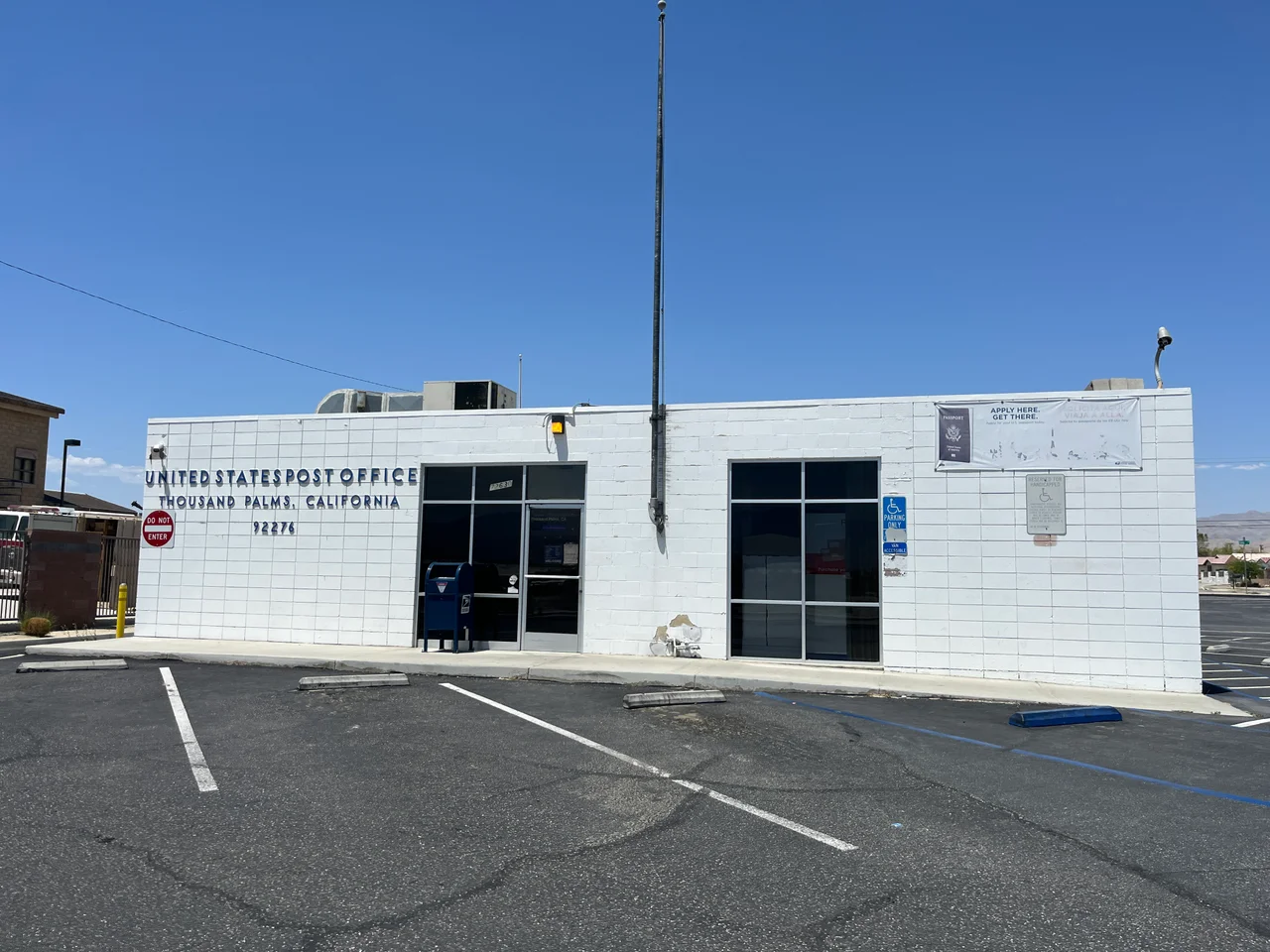

Thousand Palms
Beneath the Coachella Valley's sun-bleached surface, something remarkable is happening: groundwater squeezed up along the San Andreas Fault feeds a forest of California fan palms in the middle of the desert. Thousand Palms takes its name from those trees, and the community that grew around them carries a quiet sense of being perched between worlds — between the ordinary sprawl of the valley floor and one of California's most extraordinary natural preserves.
Fault Lines and Fan Palms
The Coachella Valley Preserve stretches across 20,000 acres just east of town, and its existence is geological in origin. Where the San Andreas Fault fractures the earth, water forced upward through the cracks creates oases in terrain that would otherwise be too arid to support tall trees. California fan palms — Washingtonia filifera — cluster around these seeps in groves that feel ancient and improbable, their shaggy skirts of dead fronds rattling in the wind. The 1,000 Palms Oasis, accessible on foot from the preserve's trailhead, is the most visited of these groves. What visitors encounter there is not just shade but evidence of a living fault system, one that shapes the landscape across thousands of years, pushing water up from depths where it would otherwise remain invisible.
A Refuge Within a Refuge
The preserve functions as critical habitat for species found nowhere else in the world. The Coachella Valley fringe-toed lizard depends on the fine, wind-blown sand dunes that form here, and it has been listed as threatened under federal law and endangered under California's. Desert pupfish, a species that has persisted since the Pleistocene, survive in the oasis pools — tiny fish, no larger than a young goldfish, that tolerate salinity levels fatal to most freshwater species. Over 183 bird species use the preserve during migration and breeding seasons, drawn by the water and dense palm canopy. The Nature Conservancy, which helped establish the preserve, manages it in partnership with other agencies to balance visitor access against the needs of species with nowhere else to go.
Edom, Then Thousand Palms
The community wasn't always called Thousand Palms. From 1913 to 1939 it went by Edom, a name with biblical resonance but no obvious local connection. The current name arrived when the palms themselves became the community's primary identity — a marketing decision that turned out to be accurate. Today roughly 7,900 people live in the unincorporated area, and the town carries the character of a place that grew without planning: scattered residential neighborhoods, a few commercial strips along Ramon Road, and the constant reminder that the desert is not far. The Salton Sea shimmers on clear days to the southeast, and the San Jacinto Mountains rise dramatically to the west, their peaks catching snow in winter even as the valley floor stays warm.
The Arena at the Edge of the Dunes
In 2022, something new appeared at the eastern edge of town: Acrisure Arena, an 11,000-seat venue that opened in December of that year and immediately became the home of the Coachella Valley Firebirds, the AHL affiliate of the Seattle Kraken. The first hockey game played there drew a sellout crowd of 10,087 — remarkable for a sport with little historical footprint in desert California. The arena occupies 43 acres between Interstate 10 and the Classic Club golf course, and it has already hosted major touring acts alongside its hockey seasons. The juxtaposition of a gleaming modern arena against a backdrop of sand dunes and palm oases captures something essential about Thousand Palms: a place still figuring out what it wants to be, holding its wild landscapes and its new development in the same frame.
From the Air
Located at 33.817°N, 116.387°W in the eastern Coachella Valley, Thousand Palms is easily identifiable from cruising altitude by the distinctive pale dune fields of the Coachella Valley National Wildlife Refuge and the fan palm oases that appear as dark-green clusters against the surrounding desert. Acrisure Arena is visible as a large white-roofed structure near I-10. Nearest airports: KTRM (Jacqueline Cochran Regional, 15 miles southeast), KPSP (Palm Springs International, 18 miles west). Best viewed at 5,000–8,000 feet on approach from the west; the contrast between irrigated valley agriculture and protected dune habitat is striking from this altitude. Afternoon thermals are common over the valley floor.
Nearby Stories
- Pioneertown, California 7.2 km away
- North Shore, California 11 km away
- Wonder Valley, California 11 km away
- Cholla Cactus Garden 12 km away
- Toro Peak 12 km away
- Tenaja Fire 20 km away
- San Bernardino Train Disaster 26 km away
- Bell Canyon 42 km away