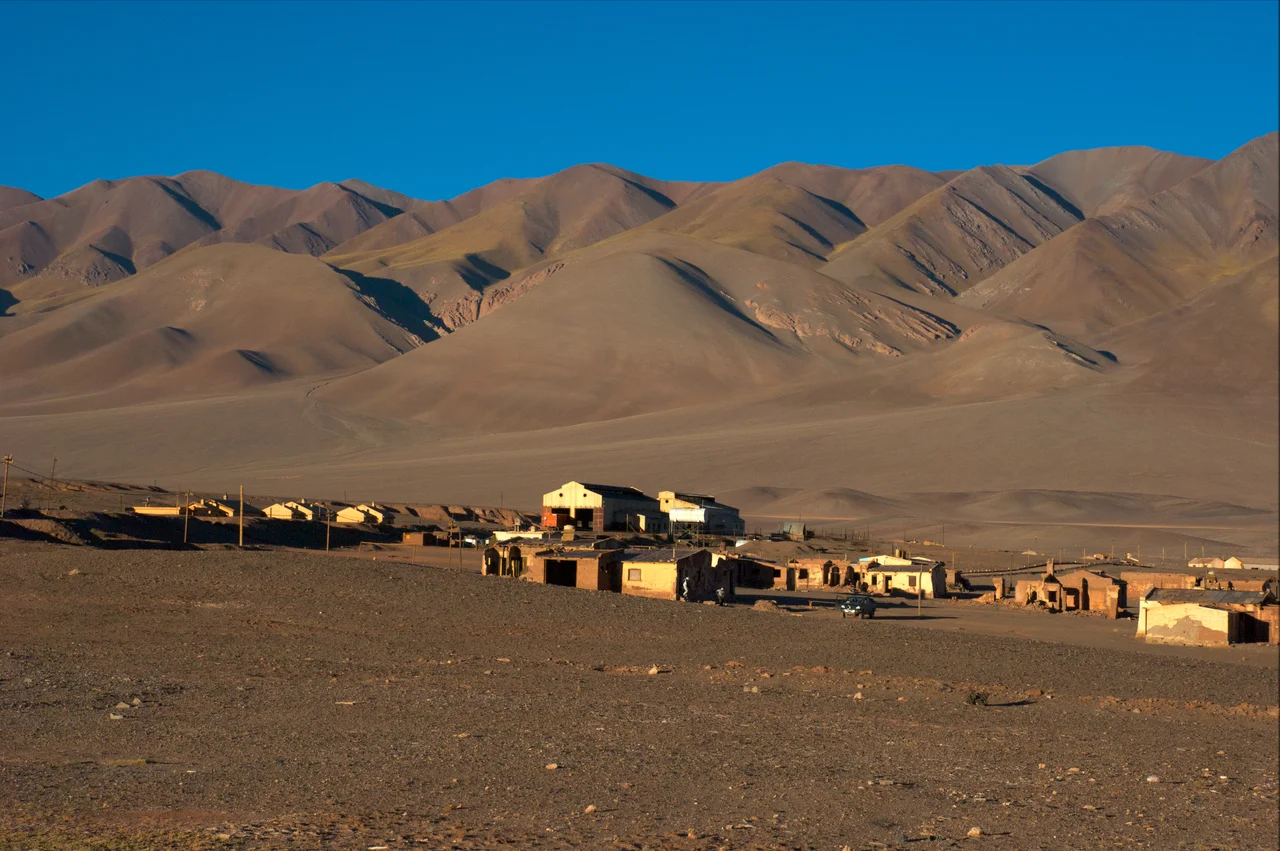

Tolar Grande
Four kilometers from a town that almost ceased to exist, there are pools of impossibly blue water set into the white crust of the desert. The locals call them Ojos de Mar - eyes of the sea - though the nearest ocean is hundreds of kilometers and a wall of Andes away. They sit at around 3,500 meters in the Puna de Atacama, and in 2009 scientists found something extraordinary living in them: stromatolites, mounded colonies of microbes among the oldest forms of life on Earth, thriving here at one of the highest elevations anyone has documented. The village that watches over them is Tolar Grande, and its own story is nearly as improbable as theirs.
A Town at the End of the Line
Tolar Grande sits in the middle of the Puna de Atacama, roughly 357 kilometers from the city of Salta and just 170 from the Chilean frontier at the Socompa pass. The climate is the high desert distilled to its harshest: almost no rain, mild summers, brutal winters, and a daily temperature swing that can reach thirty degrees Celsius between a single dawn and afternoon. This is not a place one passes through. The village covers an enormous municipal territory of 13,785 square kilometers - nearly half of the vast Los Andes department - across which scarcely anyone lives. To stand in its plaza is to feel the scale of the emptiness pressing in from every direction.
Five Thousand, Then Almost None
It was not always so quiet. In the 1940s Tolar Grande was a railway town in full cry, the end of a branch line driven through the mountains to link Salta with the Chilean port of Antofagasta. Perhaps five thousand people lived here then, most of them working the railroad. Nearby, the La Casualidad mine pulled sulfur from the earth at Mina Julia and freighted it down to the Tolar Grande station to be shipped onward. Then it all unraveled. The mine closed, the railway project stalled, the branch shut down, and the people drained away - leaving only a stubborn few who would not abandon the town as its livelihood disappeared around them.
Bringing the Village Back
By the early twenty-first century, local authorities set out to reverse the long emptying-out. Through deliberate policy aimed at halting emigration, the population was coaxed back upward; by 2015 it stood at roughly 210 people. It is a small number against the immensity of the Puna, but it represents a real turning - a town choosing not to become a ruin. The same impulse drew the world's attention to the Ojos de Mar after their stromatolites were identified, and in 2011 the Salta provincial government declared the site a protected area. Tolar Grande began to find a second life not in sulfur or railroads, but in the strange beauty of the land that surrounds it.
Cones, Salt, and Silence
The landscape around Tolar Grande looks borrowed from another planet. To the south spreads the Salar de Arizaro, one of the largest salt flats on Earth, an expanse of blinding white crust laid down over millions of years. Rising from it, some eighty kilometers out, is the Cono de Arita - a nearly perfect pyramid of rock and salt about one hundred and twenty meters tall, so symmetrical it looks built rather than born. There are dunes the color of rust, hills banded in mineral reds and greens, and over it all a silence broken only by wind. For travelers willing to cross the Puna to reach it, Tolar Grande is less a destination than a threshold into one of the most surreal corners of the Andes.
From the Air
Tolar Grande lies at roughly 24.59°S, 67.40°W in the Puna de Atacama of far western Salta Province, at about 3,500 meters elevation near the Salar de Arizaro and about 170 km from the Chilean border at Socompa. From the air the country is unmistakable: vast white salt flats, rust-colored dunes, isolated volcanic cones - including the pyramid-like Cono de Arita rising from the Arizaro - and the tiny blue Ojos de Mar lagoons about 4 km from the village. The nearest major airport is Martín Miguel de Güemes International (ICAO: SASA) at Salta, a long 357 km to the east. The high desert offers extraordinary clarity and visibility, but the extreme altitude, sparse settlement, and fierce diurnal winds make this genuinely remote, demanding terrain.
Nearby Stories
- Large Latin American Millimeter Array 34 km away
- San Antonio de los Cobres 59 km away
- Llullaillaco 72 km away
- Los Cardones National Park 73 km away
- Cerro Tuzgle 89 km away
- Salar de Atacama 103 km away
- Cachi 123 km away
- Salar de Pedernales 205 km away