
Tornadoes of 1965
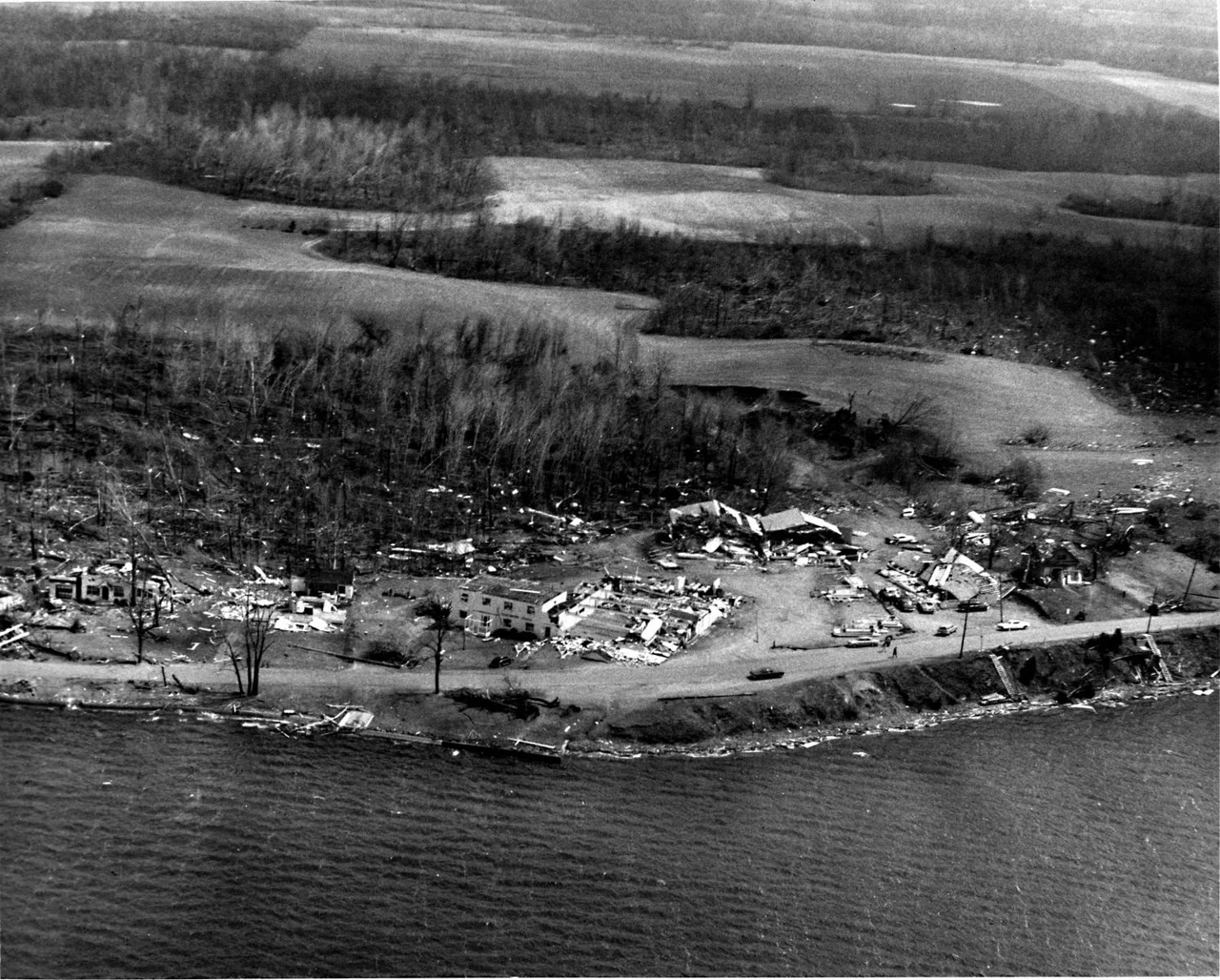
On April 11, 1965, churches across the American Midwest were full. It was Palm Sunday, the start of Holy Week, and millions of Christians were inside their sanctuaries waving palm fronds when the sky outside turned a color none of them had a word for. Over the next 16 hours and 35 minutes, 55 tornadoes - at least 18 of them rated F4 on the Fujita scale - tore through Iowa, Wisconsin, Illinois, Indiana, Michigan, and Ohio. Some witnesses reported twin funnels rotating around each other. At one point, all nine counties in the Northern Indiana office's jurisdiction were under tornado warning simultaneously, the first blanket warning in the U.S. Weather Bureau's history. Two hundred and sixty-six people would not see the end of the day.
A Year That Started Loud
1965 picked up where 1964 had left off, on track to become the most active tornado year on record at the time. By year's end, 31 violent tornadoes - F4s and F5s - would touch down across the United States, also a record. Eighteen of those violent tornadoes came during the Palm Sunday outbreak. The May 8 F5 that struck Gregory, South Dakota, would prove to be the strongest tornado of the year, the kind of storm that pulls pavement off roads and grass out of dirt. But it was the Palm Sunday outbreak - the second-largest single outbreak in U.S. history at that point, surpassed only later by the 1974 Super Outbreak - that defined 1965 in the public memory.
Palm Sunday Afternoon
The first cell developed in eastern Iowa around 1 p.m. Within hours, supercells were lining up across the warm sector ahead of a powerful cold front. The damage swath ran roughly 450 miles long, from Cedar County, Iowa, to Cuyahoga County, Ohio, with another major path from Kent County, Michigan, down to Montgomery County, Indiana. At least four "double funnel" or "twin funnel" tornadoes were photographed - F4 monsters with parallel vortices revolving around each other, captured most famously in a photograph taken near Dunlap, Indiana. The Weather Bureau, lacking radar coverage in many areas and operating with warning systems that depended on telephone trees and AM radio, struggled to keep pace. In rural Indiana, sirens never sounded. In Michigan and Ohio, warnings arrived after the funnels had already touched ground.
The People Inside the Numbers
266 dead is a number. The dead were people. They were farm families sitting down to Palm Sunday dinner in Pittsfield, Michigan, when their house was lifted off its foundation. They were a congregation of more than a hundred children at the Midway Trailer Court near Dunlap, Indiana, when a quarter-mile-wide F4 leveled the park. They were grandparents in nursing homes in Toledo. They were truck drivers caught on the interstate. 137 of the dead were in Indiana, making Palm Sunday 1965 the deadliest tornado outbreak in Indiana history - a record that still stands. Another 3,662 people were injured, 1,795 of them in Indiana. Some survivors spent years in physical therapy. Some lost spouses and children in a single afternoon. The reason so many were caught unprepared was, in part, that they had been in church when the warnings should have reached them. Holy Week began with a wound that for many families would never fully heal.
What the Outbreak Changed
Palm Sunday 1965 forced the U.S. Weather Bureau to reckon with how badly its warning system had failed. The recommendations that came out of the post-event review - faster communication between forecast offices and local emergency managers, better public sirens, a more aggressive use of radio and television - reshaped severe weather forecasting through the late 1960s and early 1970s. The Bureau also began the slow project of building out NEXRAD radar coverage, which would eventually transform tornado warning from a regional patchwork to a national system. The outbreak became one of the case studies that meteorologists use to teach the difference between tornado watch and tornado warning, and it is still taught today. The rest of 1965 added more violence - the May 5-8 sequence killed 17, the November outbreaks killed several more - but Palm Sunday remained, and remains, the year's defining event.
Why a North Carolina Coordinate
Tornado outbreaks belong to the Great Plains and the Midwest more than to the Atlantic coastal plain, but 1965 reached the East as well. The October 7-8 outbreak included an F3 tornado that killed one person and injured four in North Carolina. Hurricane Betsy spawned an F2 in Mecklenburg County, North Carolina, in September. Tornadoes are less frequent in the coastal plain than in Indiana or Oklahoma, but they happen here, and the people of the Carolinas know the slow afternoon sky-darkening that means a supercell is coming. 1965 was a national year of wind, and the coast did not entirely escape it.
From the Air
This story commemorates a year of tornadoes that hit much of the central and eastern United States. The 1965 Palm Sunday outbreak ran roughly between 41 N latitude (Cedar County, Iowa) and 39 N (Cincinnati area), centered over Indiana. From cruise altitude over the Midwest on a spring afternoon, the textbook severe-weather setup is visible: warm moist Gulf air rising into colder upper-level winds, towering cumulus building northward, an arc of supercells along a dryline or cold front. Coordinates here (35 N, 77.22 W) mark eastern North Carolina, where the October 1965 NC tornado occurred. Best memorialized from any altitude with a window seat and a clear sky.
Nearby Stories
- Swansboro 13 km away
- Harkers Island, North Carolina 15 km away
- Beulaville, North Carolina 18 km away
- 1961 Goldsboro B-52 Crash 23 km away
- Battle of Washington 26 km away
- Pender County, North Carolina 37 km away
- Crystal Coast 43 km away
- Lake Mattamuskeet 45 km away