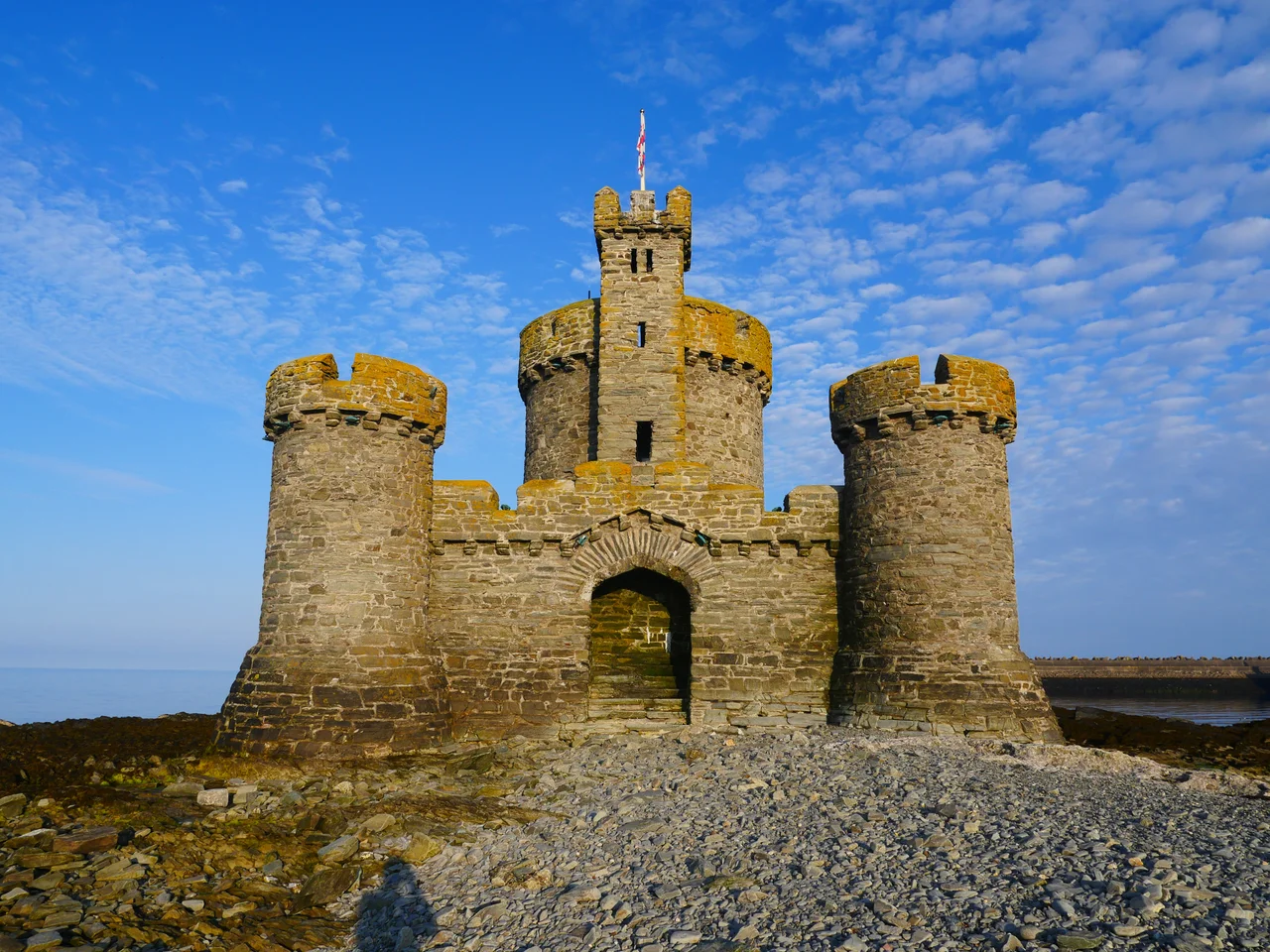

Tower of Refuge
In the early hours of 20 November 1830, the steamer RMS St George struck Conister Rock in Douglas Bay and began to break up. Sir William Hillary rowed out into the storm and helped pull the crew alive from the wreck. He had been organising rescues from this same rock for years, and the St George disaster gave him a singular idea: if the sea was going to keep putting sailors on this stone, then the stone should give them somewhere to wait for help. Two years later, masons were laying the foundations of a small castle in the middle of Douglas Bay.
A Rock with a Reputation
St Mary's Isle, more commonly called Conister Rock, was a notorious hazard. It crouches a few hundred metres offshore in the centre of Douglas Bay, half-submerged at high tide, partially exposed at low water - exactly the kind of obstacle that has destroyed ships since people first sailed into this harbour. The rock had belonged for many years to the Quane family. In 1832 Captain John Quane, then Attorney General of the Isle of Man, presented the rock as a gift to Sir William Hillary in his capacity as President of the Isle of Man District of what was then called the National Institution for the Preservation of Life from Shipwreck. That organisation would later become the Royal National Lifeboat Institution. Hillary did not merely accept the rock - he set about turning it into something useful.
A Castle for the Shipwrecked
Hillary contributed a substantial share of the construction costs himself and raised public subscriptions for the rest. The architect was John Welch, a respected local figure. The total cost came to £254 and 12 shillings - a modest sum even by the standards of the day, but enough to raise a stone-built castellated tower that has stood on its rock for nearly two centuries. The idea was simple and humane: a sailor wrecked on Conister Rock could climb the few feet up to the tower, take shelter inside its walls, and wait for the lifeboat. The tower contained provisions, including drinking water. It was not glamorous. It was not large. But it meant that being thrown onto this rock no longer had to mean dying of cold and exposure within sight of the Douglas waterfront.
The Rock Keeps Its Habits
The tower could not change the geology. Ships kept finding the rock anyway. In 1867 the schooner Thomas Parker was driven onto Conister in a storm. On 2 July 1930, the Isle of Man Steam Packet Company vessel RMS Mona ran ashore in broad daylight. After the Mona incident the authorities took unusual action: they painted the seaward side of the tower with whitewash, and painted the outer face of the Victoria Pier white too, hoping that brighter landmarks might help mariners place themselves more accurately in the bay. There is something quietly poignant about the persistence of the danger. The tower stood, the lifeboats answered, and still the sea kept depositing ships on this small unyielding piece of rock.
Walks and Custodianship
At low water on spring tides it has always been possible to walk out to Conister Rock from the Douglas shore, though the route is awkward and occasionally treacherous. During restoration work in the early 2000s, a makeshift causeway was constructed to allow construction plant onto the rock; that improved access has since enabled a series of community walks organised by Douglas Town Centre Management to raise money for the RNLI. The tower itself remains in the custodianship of the Royal National Lifeboat Institution, the organisation Hillary helped to found. For rowing boats in summer it has always been a destination of choice from the promenade. For the lifeboat service, it is something more: an early monument to the principle that even when you cannot prevent disaster, you can still prepare for it.
From the Air
The Tower of Refuge stands at 54.150°N, 4.469°W on Conister Rock, roughly 250 metres offshore from Douglas Promenade in the centre of Douglas Bay. It is one of the most distinctive small structures visible from the air anywhere on the Isle of Man - a tiny castellated landmark on a flat sea. Ronaldsway Airport (EGNS) is approximately 6 nautical miles south. Best viewed at 1,000-2,000 feet AGL in clear conditions; at low tide the rock and its causeway pattern are dramatic from above.
Nearby Stories
- St Bees Lighthouse 15 km away
- Celtic Array 22 km away
- Kirkmaiden 23 km away
- Isle of Whithorn 23 km away
- Seascale Lifeboat Station 31 km away
- German submarine U-1024 36 km away
- SS Georgetown Victory 40 km away
- Blackpool Illuminations 56 km away