
Trà Kiệu
Look closely at a roof tile from Trà Kiệu and you will see a face staring back. Not the pattern of weaving or cord-impressed texture that marks the earliest layers of the site, but a human face — eyes, nose, mouth — pressed into fired clay sometime around the third century CE. Who made these tiles, and why they started putting faces on them, is a question archaeologists have argued over for a century. The answer matters, because it goes to the heart of who built this city in the Thu Bồn river valley and what kind of kingdom they were building.
The Lion City
The name Simhapura translates from Sanskrit as 'Lion City.' It is the name scholars believe the Cham people gave to their capital, the city that is now a quiet village called Trà Kiệu, 18 kilometers inland from Hội An, roughly halfway between that ancient trading port and the great temple complex of Mỹ Sơn. The Thu Bồn river valley here is lush and broad, sheltered by hills; it was good land for a capital. People have lived on this site since the first or second century CE, though Cham influence doesn't appear clearly in the archaeological record until the mid-to-late fourth century. By that point, the rectangular perimeter walls that still define the site's outline were being raised in brick — a distinctly Cham construction technique. Those walls remain the most visible evidence of what once stood here.
Faces on the Tiles
The ceramic record tells the story in two phases. The earlier phase, Trà Kiệu I, yields utilitarian pottery: ovoid jars, cord-marked vessels, dishes, pedestal cups, and roof tiles bearing textile impressions — the texture of cloth pressed into wet clay before firing. Then something changes. In Trà Kiệu II, the textile impressions disappear from the eave tiles and faces appear in their place. Japanese researcher Nishimura Masanari compared these face-motif tiles to similar tiles excavated from Lũng Khê in northern Vietnam and from Nanjing, China, and noted a key difference: the northern tiles combine faces with lotus motifs, a Buddhist symbol, while Trà Kiệu's tiles show faces alone. His conclusion was that Buddhism had less purchase at Trà Kiệu than at those other sites — that the city's spiritual orientation leaned Hindu. The alternative theory proposes something more specific: that an Indian mask maker arrived at Trà Kiệu and popularized the face motif as a craft tradition. Either way, the tiles are a portrait of religious influence traveling across the ancient Indian Ocean world.
Capital of the Champa Kingdom
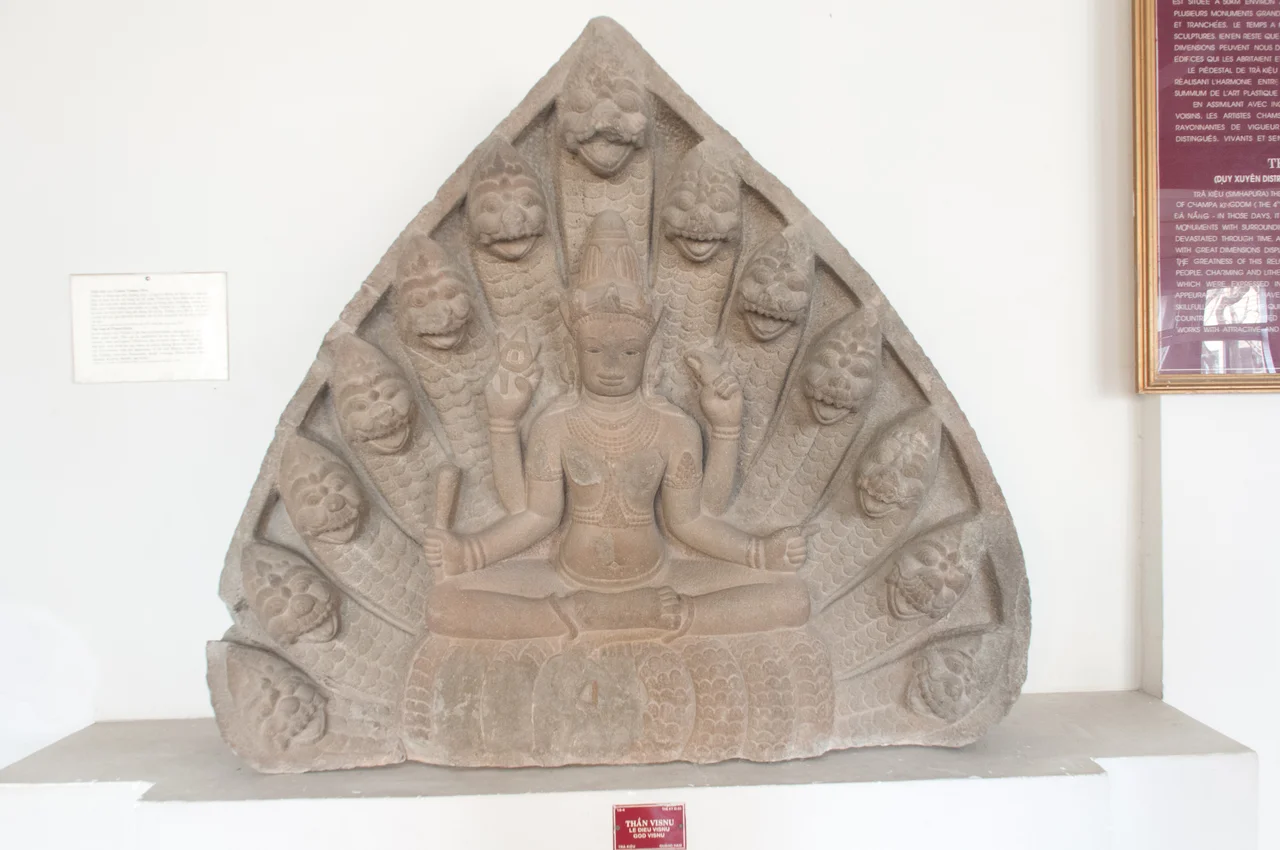
Whether Simhapura was the capital of the Champa Kingdom, a separate Lin Yi polity, or something in between remains contested. Leonard Aurousseau, working from ancient Chinese records of a fifth-century invasion, proposed that Trà Kiệu was the capital of Lin Yi, a polity distinct from Champa. His own researcher, J.-Y. Claeys, flew over the site in 1927 and conducted excavations that ultimately undermined this theory. Scholar Andrew David Hardy later suggested that 'Lin Yi' was simply a Chinese catch-all term for hostile Vietnamese polities north of Cham territory — that China attached the name to whatever frontier kingdom gave it trouble, eventually including the expanding Champa itself. Most Vietnamese archaeologists today conclude that Simhapura was indeed the Cham royal capital. The Trà Kiệu Pedestal — a tenth-century stone platform supporting a massive lingam and ablutionary cistern, carved with rows of apsaras (celestial nymphs) and gandharvas (divine musicians) — survives in the Da Nang Museum of Cham Sculpture as evidence of the sophisticated Hindu court culture that once flourished here.
A Village with a Long Memory
Trà Kiệu's history did not stop with the Cham. In 1885, during the Cần Vương anti-French resistance movement, the Catholic residents of the village successfully defended it against siege, an event they attributed to a Marian apparition. Thirteen years later, a shrine to Our Lady of Trà Kiệu was built atop Bửu Châu — Jade Hill — the same hill that overlooks the ancient citadel ramparts. An annual religious festival has been held there since 1971. The hill thus holds two kinds of sacred history simultaneously: the Cham citadel below and the Catholic shrine above, both legible in the same landscape. Today the village is also served by a station on Vietnam's North–South railway, a thread of modern connection running through one of the most layered archaeological sites in Southeast Asia.
From the Air
Trà Kiệu (Simhapura) sits at 15.82°N, 108.23°E in the Thu Bồn river valley, approximately 18 km west-inland from Hội An and 30 km south of Da Nang. From the air at 3,000–5,000 feet, the flat valley floor is clearly visible, with the low rectangular outline of the ancient ramparts discernible when light and vegetation cooperate. Jade Hill (Bửu Châu) rises visibly above the surrounding rice paddies. The nearest airport is Da Nang International (VVDN), approximately 30 km to the north-northeast. Mỹ Sơn Sanctuary lies a further 20 km to the southwest. Approach the valley from the east for the best low-altitude view of the site and the river.
Nearby Stories
- Hải Vân Tunnel 1.7 km away
- Chàm Islands 7.1 km away
- War of the Flags 12 km away
- Chu Lai Air Base 28 km away
- Tomb of Tự Đức 29 km away
- A Sầu Valley 55 km away
- Dong Ampham National Biodiversity Conservation Area 62 km away
- Battle of the Paracel Islands 322 km away