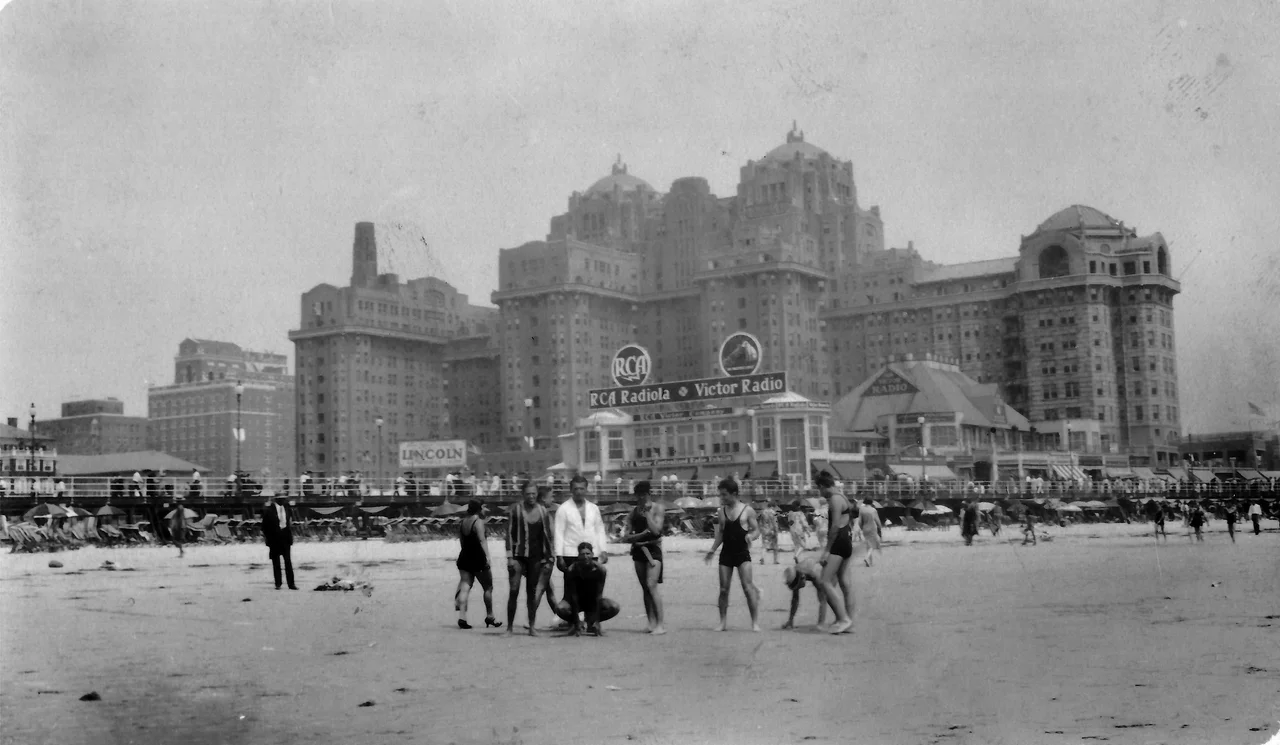

Traymore Hotel
The bathtubs had four faucets. Hot city water, cold city water, hot ocean water, cold ocean water - guests of the Traymore Hotel could fill the tub with whatever combination they pleased. There was a fifth faucet on the sink, for ice water. This was 1915, in a hotel one writer would soon call the Taj Mahal of Atlantic City - sixty years before Donald Trump appropriated the same nickname for his own boardwalk casino a mile up the beach. The Traymore had yellow-tiled domes, tan brick walls, ocean views from nearly every room, and the most expensive water plumbing on the Eastern Seaboard. It came down in five weeks of controlled implosions starting April 27, 1972 - at the time, the largest building ever brought down by Jack Loizeaux's Controlled Demolition. Most of the lot is still a parking space.
Uncle Al's Estate
In 1879, a small ten-room wooden cottage opened as a boarding house at Illinois Avenue and the Boardwalk. Its steadiest customer was a wealthy Marylander known to everyone as Uncle Al Harvey, who had named his Maryland estate Traymore after his ancestral village in Ireland. The boarding house borrowed his name. The first Traymore lasted five years before a January 1884 winter storm leveled it. The owners rebuilt larger, stronger, and with the era's modern amenities: indoor plumbing, private bathrooms, a buffer lawn between the building and the boardwalk that saved it from the September 1889 storm. The hotel stayed open year-round. By 1898 it had reached over 450 rooms - then the largest in Atlantic City. In 1906, owner Daniel White brought in the Philadelphia firm of Price and McLanahan to build a new tower out to the boardwalk.
Price's Masterwork
By 1914, Daniel White's half-brother Josiah White III had hired the same architects to design the Blenheim across Ohio Avenue - one of the first reinforced concrete hotels in the world. Daniel White was not about to be outdone by family. He commissioned Price and McLanahan to demolish the wooden Traymore and replace it with a massive concrete competitor, built directly behind the 1906 tower and designed so that hotel wings jutted out further from the central tower to give more guests ocean views. Architect William Lightfoot Price worked through the autumn and winter of 1914-15. The new Traymore opened in June 1915, finished in tan brick with yellow-tiled domes that became, instantly, the most recognizable silhouette on the Atlantic City Boardwalk. White commissioned a 25-story tower extension that would have made the Traymore one of the tallest hotels in America. World War I disrupted financing and the tower was never built. By 1924, the hotel was being described in print as the Taj Mahal of Atlantic City - a nickname that would migrate to a different building sixty-six years later.
England General
During World War II, the United States Army took over forty-seven Atlantic City hotels and turned the boardwalk into a basic training facility called Camp Boardwalk. The Traymore and the adjacent Chalfonte-Haddon Hall were merged operationally into a single facility renamed England General Hospital, named for Lieutenant Colonel Thomas Marcus England, who had researched yellow fever with Walter Reed in Cuba in 1900. The hospital opened on April 28, 1944, with the Traymore serving as its convalescent reconditioning section. Soldiers recovering from wounds spent weeks in rooms where summer guests had once watched the surf. The last patients left in June 1946, the Traymore was returned to its owners, and it reopened for the 1947 season - but the Atlantic City it returned to was beginning to change.
Decline by Air Conditioning
The Traymore stayed popular through the 1950s. In 1954, the architect Samuel Juster of New York City designed new outdoor and indoor swimming pools that briefly made the hotel competitive again. But the larger forces working against Atlantic City were beyond anything the Traymore could solve. Home air conditioning meant that middle-class Americans no longer needed to flee East Coast summers for the seashore. Cheap commercial aviation meant that vacationers who had once spent two weeks at the Jersey Shore could now afford a week in Miami Beach or the Caribbean. The boardwalk's premier hotels emptied year by year. By the late 1960s the Traymore was operating at a deep loss. The owners decided to demolish it despite a preservation campaign that argued for its protection as an architectural landmark. The hotel was empty by 1971. Bob Rafelson filmed several exterior shots of the Traymore for The King of Marvin Gardens that year, just months before the building came down.
The Largest Implosion
On April 27, 1972, Jack Loizeaux's Maryland firm Controlled Demolition began the first of four planned implosions of the Traymore. By the end of May the building was rubble. The Traymore briefly held the Guinness World Record for largest controlled demolition by volume - at nearly 6.5 million cubic feet, it was the largest structure (though not the tallest) ever brought down by implosion. The 1980 Louis Malle film Atlantic City, starring Burt Lancaster, opens with footage of the Traymore's domes collapsing in clouds of dust, set against a melancholy score. The film's whole premise - that the Atlantic City of yesterday was being destroyed to make way for the casino city of tomorrow - drew its power from those opening images. The reality was less poetic. New Jersey voters had rejected statewide casino legalization in 1974. Casino gambling in Atlantic City was approved only in November 1976. The Traymore came down four full years before any of that was decided - not because it stood in the way of the future, but because it had simply run out of money. Caesars bought the land in the late 1970s and used it as a parking lot. Most of the Traymore site remains a parking lot today. Pinnacle Entertainment proposed building a new casino on the combined Traymore and Sands parcels in the late 2000s, but the 2008 financial crisis killed the project. The yellow domes live on only in the opening credits of HBO's Boardwalk Empire, which reconstructed the 1920 Atlantic City skyline in CGI - Marlborough-Blenheim, Traymore, the long-lost silhouette of a city that built itself, in steel and tile and Portland cement, on the prospect that summer would last forever.
From the Air
The Traymore Hotel formerly stood at 39.3555°N, 74.432°W on the Boardwalk between Park Place and Illinois Avenue. The site is now part of the Caesars Atlantic City parking complex - a flat, paved parcel between Caesars to the east and the cleared former Sands site to the west. From altitude, the location reads as a gap in the Boardwalk's casino skyline: a parking lot where neighboring buildings rise on either side. The Pier at Caesars extends into the Atlantic immediately east of the former site. Atlantic City International Airport (ACY) is about 10 nautical miles west-northwest. Recommended viewing altitude: 1,500-2,500 feet AGL. The contrast between the intact 1929 Boardwalk Hall, the modern Caesars tower, the Claridge a block north, and the cleared Traymore parcel makes the empty space surprisingly visible - one of several gaps in Atlantic City's prewar skyline where the great hotels used to stand.
Nearby Stories
- Cape May 8.1 km away
- A. J. Meerwald 14 km away
- The Pine Barrens: Home of America's Oldest Monster 25 km away
- Hereford Inlet Lighthouse 38 km away
- Constitutional Convention (United States) 50 km away
- PS General Slocum 143 km away
- Wardenclyffe Tower 201 km away
- USS Atik 493 km away