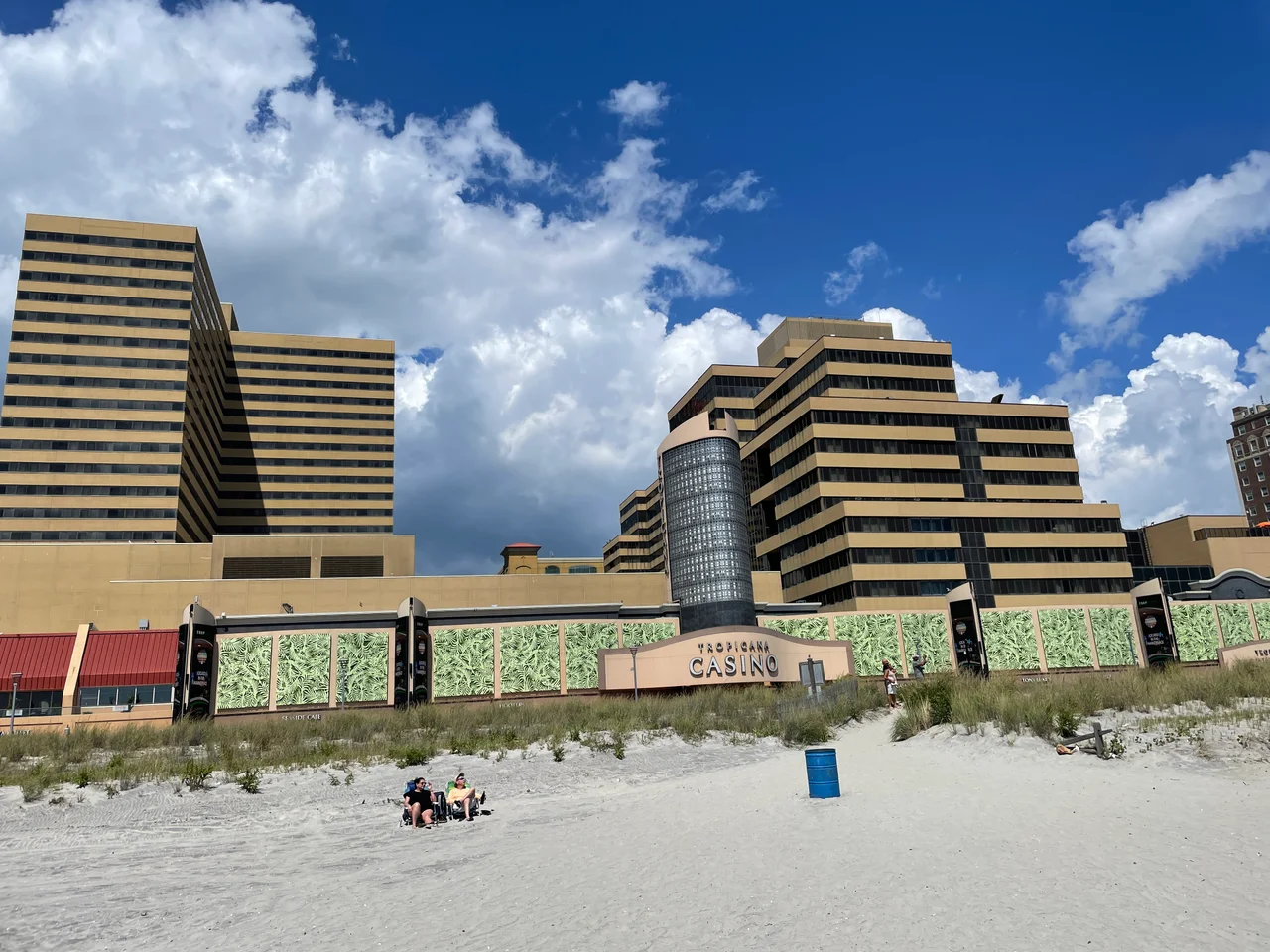

Tropicana Atlantic City
In May 1929, the boardwalk hotel that stood here held what historians have come to call the first true gathering of organized crime in America. Al Capone, Meyer Lansky, Lucky Luciano, Frank Costello, Johnny Torrio, and roughly two dozen other gangsters spent three days at the Ambassador Hotel dividing up territories and ending the bloody bootlegging war that had been killing them off in the streets of Chicago, New York, and Philadelphia. They walked the boardwalk together in matching summer suits. They posed for photographs. They agreed, among other things, to form what would eventually become the National Crime Syndicate. Half a century later the Ambassador was gone, replaced by something flashier - and today the Tropicana stands on the same plot of sand, the largest casino resort in Atlantic City, with six towers, nearly 2,400 rooms, and a 200,000-square-foot Havana-themed shopping district inside.
The Ambassador's Strange Roster
The Ambassador Hotel was designed by the Manhattan architecture firm Warren and Wetmore - the same firm responsible for Grand Central Terminal and the New York Yacht Club - and opened in 1919 at a cost of $4 million. It contained 400 rooms and was expanded with a second tower two years later. The boardwalk hotel attracted both the merely wealthy and the actively dangerous. Arthur Conan Doyle and Harry Houdini stayed there together in the early 1920s, and the hotel was the site of a seance in which Doyle's spiritualist wife Anna claimed to have channeled Houdini's late mother. Houdini later denounced the seance as fraudulent (his mother had not spoken English in life, and the channeled spirit spoke English perfectly) and ended his friendship with Conan Doyle on the spot. In 1931, Philadelphia gangster Mickey Duffy was shot dead in his Ambassador hotel room by assailants who were never caught. HBO's Boardwalk Empire would later turn Duffy into the character Mickey Doyle. The Ambassador closed in the 1970s, joining the long line of Boardwalk hotels that had outlived their era.
Aztar and the New Tropicana
In 1981 the Ramada Inn chain opened a casino on the Ambassador site under the Tropicana name - using the brand of its sister Las Vegas property, the Tropicana Hotel and Casino, which Ramada also owned. Ramada split its gaming properties off into the new Aztar Corporation in 1989, which immediately began investing heavily in the Atlantic City property and eventually sold the Vegas Trop to focus on it. The 604-room West Tower opened in 1996, by which point the property had been formally renamed Tropicana Casino and Resort. A 2003-2004 expansion added the Havana Tower (502 rooms), 22,000 square feet of meeting space, a 2,400-space parking garage, and a 200,000-square-foot shopping mall called The Quarter at Tropicana, themed as a quaint Old Havana streetscape complete with painted-on Cuban facades. The Quarter was explicitly built to compete with the Borgata, the Vegas-style mega-resort that had opened a year earlier in the city's Marina District.
License Denied
In January 2007, Columbia Sussex - a Kentucky-based hotel operator owned by William Yung - bought the Aztar Corporation for $2.75 billion. Within four months Columbia Sussex had cut roughly a quarter of the Tropicana's workforce. Hotel rooms went uncleaned. Casino-floor regulatory compliance collapsed. On December 12, 2007, the New Jersey Casino Control Commission did something it had done only once in twenty-nine years: it denied a license renewal. Commissioners cited the management's abysmal regulatory compliance, lack of business ability, lack of financial responsibility, and lack of good character, honesty, and integrity. The Tropicana was placed under the control of a court-appointed trustee, former New Jersey State Supreme Court Justice Gary Stein, until a new buyer could be found. The lawyers prepared appeals. In 2008 a West Tower elevator carrying 21 people dropped 14 floors at 750 feet per minute, failed to stop at the lobby, and crashed onto the elevator pit's safety buffer. Otis took responsibility, the counterweights had not been properly balanced; the most severe injury was a dislocated knee requiring reconstructive surgery. The Tropicana spent the rest of 2008 in slow-motion collapse.
Icahn Buys, Caesars Holds
In June 2009 a federal bankruptcy court approved the sale of the Tropicana to a group of creditors led by Carl Icahn. Two hundred million dollars of the property's mortgage was exchanged for equity. The New Jersey Casino Control Commission approved Tropicana Entertainment Inc. as the new owner on August 26, 2009, careful to note that the new corporate entity was legally distinct from the old one. By 2010 the Tropicana had fallen into visible disrepair and the new owners began the long process of getting it back into shape. The West Tower was renovated in 2012, the North Tower in 2014-2015, the casino floor and most of the property in 2015, the South Tower in 2018. In 2018 Gaming and Leisure Properties bought the real estate; Eldorado Resorts - later renamed Caesars Entertainment - bought the operating business and now runs the casino under lease. The neighboring Chelsea Hotel was absorbed into the property at the same time, connected by skybridge, adding the Chelsea Tower and the Annex Tower to bring the total to six. By the late 2010s, the Tropicana was the second most profitable casino in Atlantic City, behind only the Borgata.
The Holdout
Walk down South Brighton Avenue on the inland side of the Tropicana and you find a small two-story rowhouse at number 1 - the Milano family home, built in 1897, purchased by Joseph Milano's father in 1935. In 1995 the casino, then called TropWorld, joined with the Casino Reinvestment Development Authority and the City of Atlantic City to try to seize the Milano property through eminent domain for a surface parking lot. The Milanos sued in New Jersey Appeals Court and won. The court issued a restraining order against the casino, the agency, and the city. The casino built its parking garages elsewhere. The Milano family was still living in the building as of 2014 - eighteen years after the casino had tried to take it - in what may be one of the most remarkable single-family holdouts in modern American urban history. The little 1897 rowhouse sits in the literal shadow of the largest casino resort in Atlantic City, surrounded by parking decks on every side. The original Boardwalk extends past the Tropicana to the southwest, where it ends just before the Atlantic City Convention Center. The Trop, all six towers of it, is at the far end of the line. The casino's free Multimedia Light and Sound Show on the boardwalk facade runs after dark from the spring through early fall.
From the Air
Tropicana Atlantic City occupies the block-and-a-half south of Brighton Avenue at 39.3523°N, 74.4456°W on the southern end of the Atlantic City Boardwalk. From altitude the six-tower complex is unmistakable - the largest single resort footprint on the boardwalk, with the colorful tile roof of the Havana Tower being a distinctive aerial marker. Atlantic City Convention Center sits about half a mile west; Boardwalk Hall is roughly the same distance to the north. The Atlantic City Convention Center and the Atlantic City Rail Terminal are nearby landmarks. Atlantic City International Airport (ACY) is about 9 nautical miles west-northwest. Recommended viewing altitude: 1,500-3,000 feet AGL. Pick out the Tropicana by looking for the largest cluster of casino towers at the southwest end of the Boardwalk strip, between the boardwalk and Pacific Avenue. The Milano holdout rowhouse at 1 South Brighton is essentially invisible from the air - lost in the shadow of the parking decks around it.
Nearby Stories
- Cape May 8.1 km away
- A. J. Meerwald 14 km away
- The Pine Barrens: Home of America's Oldest Monster 25 km away
- Hereford Inlet Lighthouse 38 km away
- Constitutional Convention (United States) 50 km away
- PS General Slocum 143 km away
- Wardenclyffe Tower 201 km away
- USS Atik 493 km away