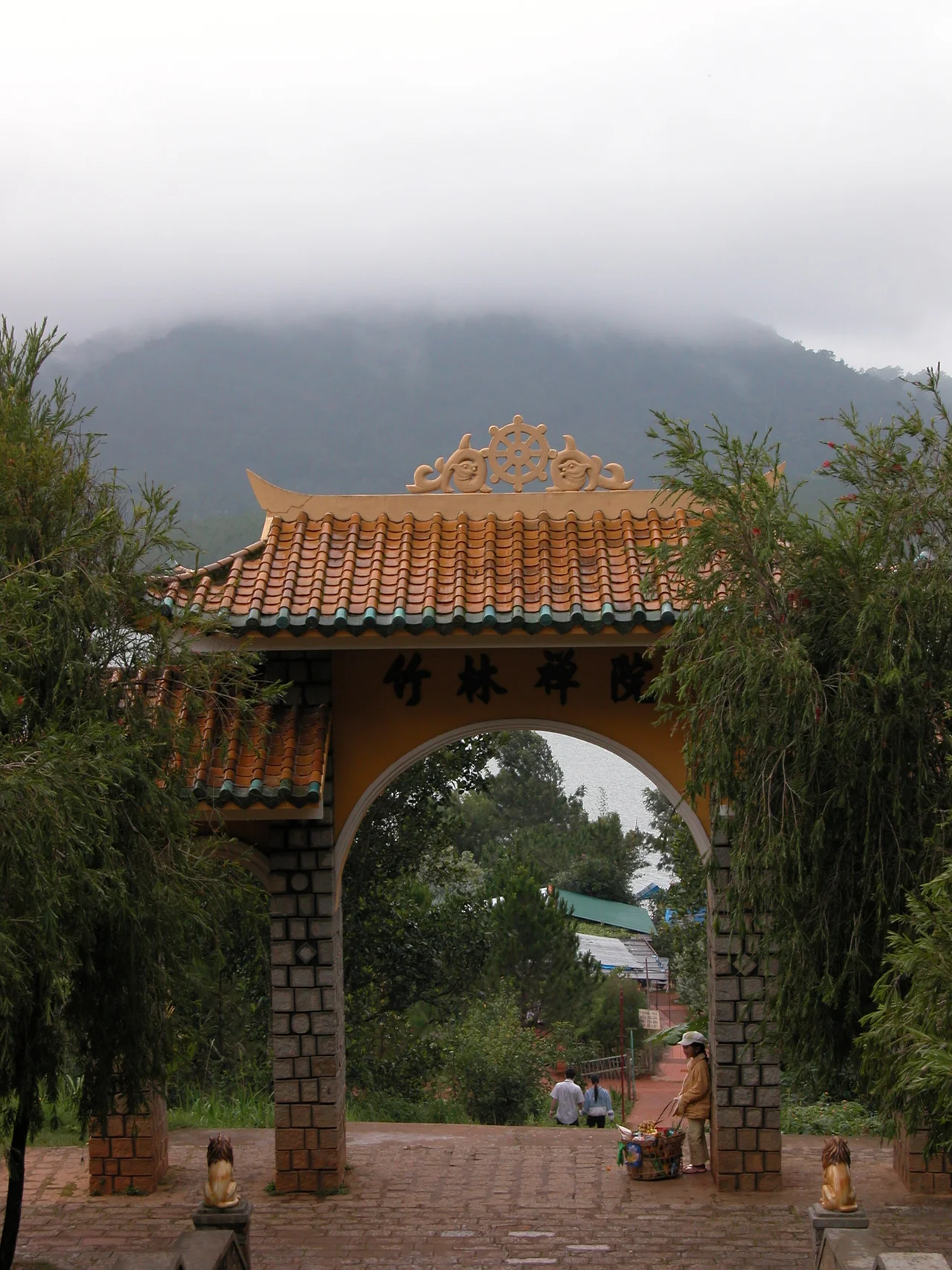

Trúc Lâm Monastery of Đà Lạt
Seven centuries ago, Emperor Trần Nhân Tông did something unusual for a man who had just led his armies to defeat the Mongol invasion: he handed the throne to his son and walked away. He retreated to Yên Tử Mountain, took his vows, and began stitching together three imported strands of Chinese Zen into something distinctly Vietnamese. That tradition, Trúc Lâm, finally found a permanent home on Phượng Hoàng Hill outside Đà Lạt in 1994 — a tiled-roof monastery set above a glittering reservoir, surrounded by pine trees, drawing pilgrims and curious travelers alike.
The Emperor Who Walked Away
Trần Nhân Tông ruled Vietnam during one of its most precarious stretches, repelling two separate Mongol invasions in the late thirteenth century. His military reputation should have guaranteed a long, celebrated reign. Instead, he abdicated in favor of his son Trần Anh Tông and withdrew into religious life. His achievement was not just personal. He fused three Zen lineages — the Tỳ-ni-đa-lưu-chi, Vô Ngôn Thông, and Thảo Đường schools, all originally imported from China — into a single Vietnamese synthesis, Trúc Lâm. The core idea is practical and demanding: apply Buddhist practice wherever you find yourself, whether in a monastery or a marketplace. You do not need to escape the world to practice it. That pragmatic philosophy gave Trúc Lâm staying power through centuries of dynasty change, war, and upheaval. The monastery in Đà Lạt was designed explicitly to revive that spirit.
222 Steps and a Pine-Scented Ascent
There are two ways to reach the main courtyard. One involves 61 steps from the direct gate. The other — more theatrical — passes along the shore of Tuyền Lâm Lake and then climbs 222 steps through a triple-gated entrance that announces arrival with appropriate ceremony. Either route rewards you. The road winding up Phượng Hoàng Hill passes through a scented corridor of pine forest, and the bell tower announces the complex from a distance long before the tiled roofs come into view. The monastery sits at roughly 1,300 meters above sea level on a plateau, so the view from the courtyard opens wide: Benhuit Mountain in the middle distance, and the broad, reflective surface of Tuyền Lâm Lake below. An artificial lake with a 15,000-cubic-meter capacity sits in front of the gate, still and mirroring the sky on calm mornings.
A Living Community
Trúc Lâm is not a museum piece. The 24-hectare grounds are divided between public and domestic areas, and the domestic quarters — separate wings for the approximately 50 monks and 50 nuns in residence — remain closed to visitors. That boundary matters. Behind it, daily schedules follow the Trúc Lâm rhythm: meditation, study, communal meals. In the main ceremonial hall, Gautama Buddha is seated on a lotus, flanked by two bodhisattvas. On the right stands Văn Thù Sư Lợi, embodiment of wisdom; on the left, Phổ Hiền, embodiment of dedicated practice. Twice a month, on the eves of the full moon and new moon, the abbot opens a discussion session on meditation to lay Buddhists. The tradition the emperor started in the mountains has not been bottled for tourists. It continues.
Architecture Between Forest and Water
The public complex was designed by architects Ngô Viết Thụ and Nguyễn Tín and opened on March 13, 1994. Its ceremonial hall anchors the plateau, with the bell tower on the right and guest facilities on the left. The design negotiates between the forested hill and the open views without resolving the tension — which is appropriate. Zen aesthetics have always preferred suggestion over completion. A rose garden grows in front of the guest facilities. The pine trees crowd close on the slopes. In the morning mist that often clings to Đà Lạt's hills, the tiled rooflines disappear and reappear as the fog shifts, making the monastery feel less like a fixed point and more like something that surfaces and retreats according to its own logic.
Đà Lạt's Contemplative Edge
Đà Lạt built its reputation as a resort town — cool highland air, French colonial villas, flower gardens. Trúc Lâm sits outside that story, just far enough from the city center to feel separate. The road from Hòa Bình district toward Prenn Hill passes through the turnoff with no fanfare. Arriving here is a choice, not a casual detour. That self-selection filters the crowd. You're unlikely to find someone checking their phone at the triple gate. The monastery draws people who made the climb deliberately, whether for prayer, for quiet, or for the specific pleasure of sitting at 1,300 meters and watching light move across a lake below. What the emperor built in the mountains centuries ago still holds its shape.
From the Air
Trúc Lâm Monastery sits at 11.9025°N, 108.436°E on Phượng Hoàng Hill at approximately 1,300 meters elevation, overlooking Tuyền Lâm Lake — a large reservoir clearly visible from the air southeast of central Đà Lạt. Recommended viewing altitude: 3,000–5,000 ft AGL for lake and hilltop context. Nearest ICAO: VVDL (Liên Khương Airport, ~25 km south-southeast). The pine-forested hills of the Đà Lạt plateau appear dark green from altitude, with the lake's surface providing a distinctive reflective landmark.
Nearby Stories
- Tà Đùng National Park 3.1 km away
- Phan Rang–Tháp Chàm 4.2 km away
- Cam Ranh 18 km away
- Bao Loc 18 km away
- Operation Byrd 23 km away
- Nha Trang Air Base 25 km away
- Bidoup Núi Bà National Park 34 km away
- Duc Lap Camp 43 km away