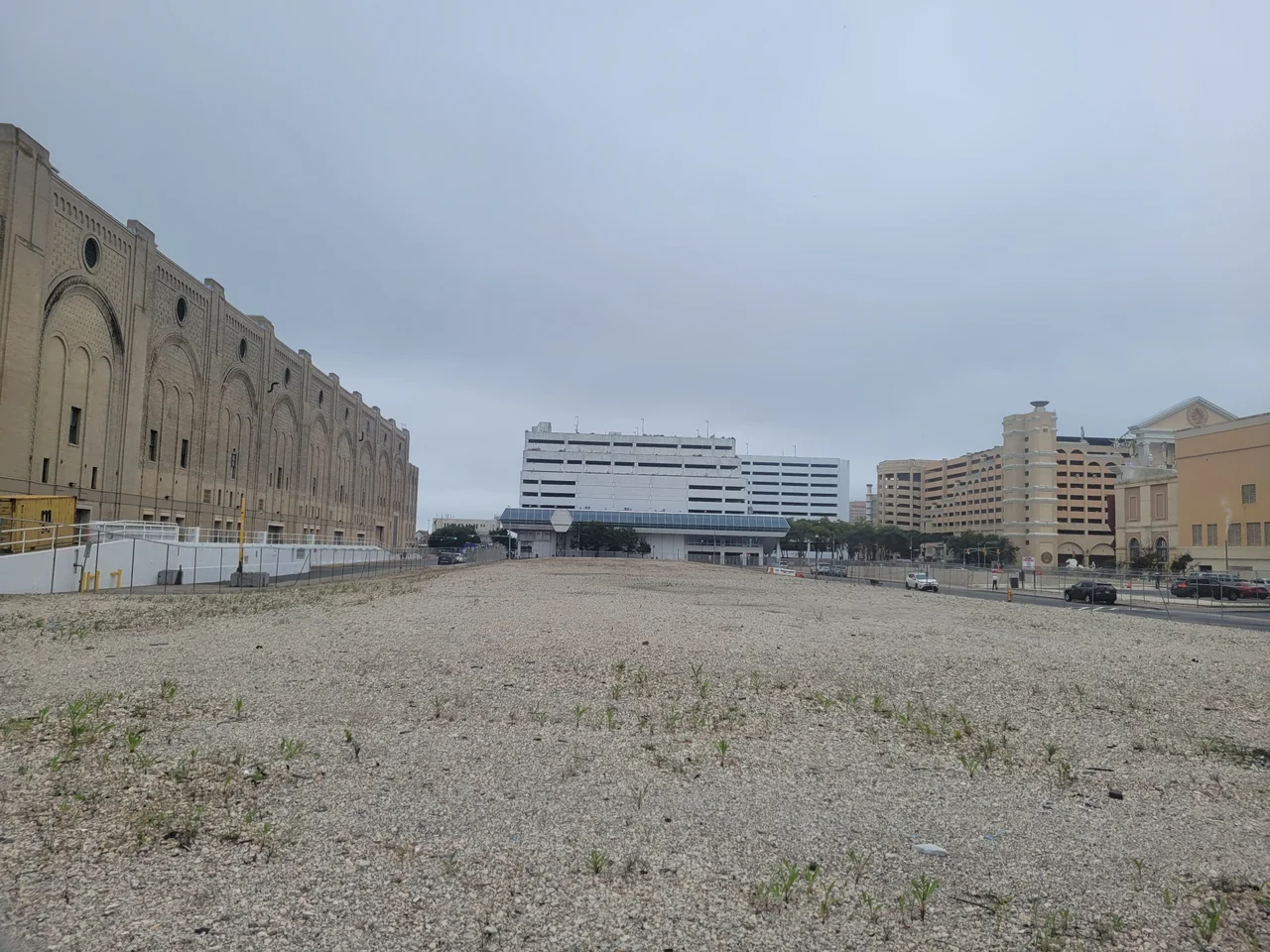

Trump Plaza Hotel and Casino
On the morning of February 17, 2021, the two-tower silhouette of the Trump Plaza Hotel and Casino - a defining piece of the Atlantic City Boardwalk skyline for thirty-seven years - collapsed in roughly fifteen seconds into a cloud of brown dust that drifted west toward the Convention Center. Officials had originally planned to auction the right to push the detonator, with proceeds going to the Atlantic City Boys and Girls Club. Carl Icahn's lawyers, who owned the building, killed the fundraiser. The implosion went forward anyway. Among casino-watchers it had been a long time coming. Trump Plaza had been closed since September 2014, vacant and decaying since then, with chunks of its facade occasionally falling onto Pacific Avenue. Donald Trump himself had sued in 2014 to have his name taken off the building because the property had fallen below the standards required by his licensing agreement. The building wore his name anyway until the moment it came down.
Harrah's Boardwalk, Briefly
The Trump Organization broke ground on the property in June 1982. Harrah's, then the gaming division of Holiday Inn, joined the project a month later as the operating partner. Trump would oversee construction; Harrah's would run the place after opening. The casino was branded Harrah's at Trump Plaza when it opened on May 14, 1984. The arrangement made sense on paper but fell apart fast. Trump had built 85 high-roller suites into the design, while Harrah's brand attracted what the industry called the low-roller market - the slot players, not the baccarat whales. The mismatch produced pre-tax profits of just $144,000 in the first half of 1985 on a $200 million project. Five months after opening the building was renamed Trump Plaza, mostly to avoid confusion with Harrah's Marina across town. The Harrah's partnership unwound shortly after.
The Million-Dollar Hands
The Trump Plaza casino floor was the site of one of the most famous high-roller stories in modern gambling history. In May 1990, the Japanese real-estate magnate Akio Kashiwagi - then estimated to be worth over a billion dollars - sat down at a baccarat table at the Plaza and played for several days against a six-deck shoe. The session was, in essence, a single multi-day match between Kashiwagi and the casino. By the time the play wound down, Kashiwagi had lost $10 million - the largest single-customer loss at any American casino up to that point. Martin Scorsese later fictionalized the session in the 1995 film Casino, transposing it to Las Vegas and softening some of the math. Trump Plaza also hosted WrestleMania IV in 1988 and WrestleMania V in 1989. The World Wrestling Federation billed both events as being at the Plaza, but the actual matches happened next door at Atlantic City Boardwalk Hall - Trump was the sponsor, not the venue. Mike Tyson fought Jose Ribalta on the Plaza's boxing card on August 17, 1986. Over twelve years the property hosted nineteen pro boxing events.
Vera Coking's Holdout
One of the more revealing stories in Trump Plaza's history involved a small three-story rooming house at 127 South Columbia Place owned by Vera Coking, an elderly widow who had bought the property in 1961. In 1993, Atlantic City's Casino Reinvestment Development Authority began condemning hundreds of nearby properties for a planned Trump Plaza expansion - a limousine waiting area and parking lot. Trump had offered Coking $250,000 for her building; Coking refused. The CRDA filed eminent domain proceedings. The Institute for Justice, a libertarian public-interest law firm, represented Coking pro bono. They argued that transferring private property from one private owner to another using government powers - the heart of what would later become the Kelo v. New London debate - violated New Jersey's eminent domain laws. They won. In 1998 the New Jersey courts ruled in Coking's favor. Trump never got his limousine parking lot. Coking kept the house. She continued living there through her nineties, becoming something of a symbol of the limits of eminent domain. In 2014, at age 91, she moved to California to be near family; the house sold at auction for $583,000 to billionaire investor Carl Icahn, who held the debt on Trump Entertainment. Her rowhouse was demolished shortly after.
The Long Decline
The Trump Taj Mahal opened a mile up the boardwalk on April 2, 1990, and immediately began cannibalizing Trump Plaza's customer base. The Plaza barely averted bond default in 1991 by taking out a $25 million mortgage on its parking garage. A prepackaged bankruptcy followed in March 1992. The 1995-1996 East Tower expansion - built from the unfinished Penthouse Boardwalk Hotel that Trump had bought in 1989 for $62 million - briefly stabilized the property. Trump World's Fair, a $48 million renovation of the adjacent Trump Regency hotel connected by an overhead loggia, added more capacity in May 1996. None of it solved the fundamental problem: the Plaza was an aging boardwalk casino in an industry shifting toward newer megaresorts like the 2003 Borgata in the Marina District. By 2011, Trump Entertainment Resorts was openly trying to sell. A February 2013 deal with the Meruelo Group of California for $20 million collapsed when Carl Icahn - by then the senior lender on the Plaza's mortgage - refused to approve the sale price.
The Empty Lot
On July 12, 2014, Trump Entertainment Resorts announced the property would close on September 16 unless a buyer materialized. In early August, Donald Trump filed suit to have his name removed from the facility, citing disrepair in violation of his licensing agreement. Trump Plaza closed permanently on September 16, 2014 - the fourth Atlantic City casino to close that year, after the Atlantic Club, the Showboat, and Revel. About 1,300 employees lost their jobs. The buildings sat empty for over six years while ownership disputes and demolition costs stalled every redevelopment plan. Carl Icahn bought the underlying land deed in late 2018 to terminate the complicated ground lease that had been driving buyers away. By 2020 chunks of the building's facade were falling onto the boardwalk, and Mayor Marty Small Sr. announced that public safety required immediate demolition. The implosion took place on February 17, 2021, making Trump Plaza only the second hotel-casino ever demolished by implosion in Atlantic City after the Sands in 2007. Today the site is a flat lot adjacent to Boardwalk Hall - one more empty parcel between Bally's and Caesars where the eighth wonder of the world used to be, then briefly was not, and then became dust.
From the Air
The former Trump Plaza Hotel and Casino site sits at 39.3532°N, 74.4397°W on the Boardwalk between Caesars Atlantic City (to the south) and Boardwalk Hall (to the north). From altitude the location reads as a vacant lot - a flat parcel between two prominent active structures. The signature Atlantic City Convention Hall (now Boardwalk Hall) is immediately north, identifiable by its distinctive 1929 arched roof. Caesars' octagonal tower is directly south. Atlantic City International Airport (ACY) is about 10 nautical miles west-northwest. Recommended viewing altitude: 1,500-2,500 feet AGL. The site provides good context for the row of Boardwalk vacancies created by the 2014 casino closures - Trump Plaza, the Showboat shell to the northeast, and the cleared Sands site a couple blocks north. These gaps in the skyline tell the story of Atlantic City's boom-and-bust casino history more clearly than the active towers do.
Nearby Stories
- Cape May 8.1 km away
- A. J. Meerwald 14 km away
- The Pine Barrens: Home of America's Oldest Monster 25 km away
- Hereford Inlet Lighthouse 38 km away
- Constitutional Convention (United States) 50 km away
- PS General Slocum 143 km away
- Wardenclyffe Tower 201 km away
- USS Atik 493 km away