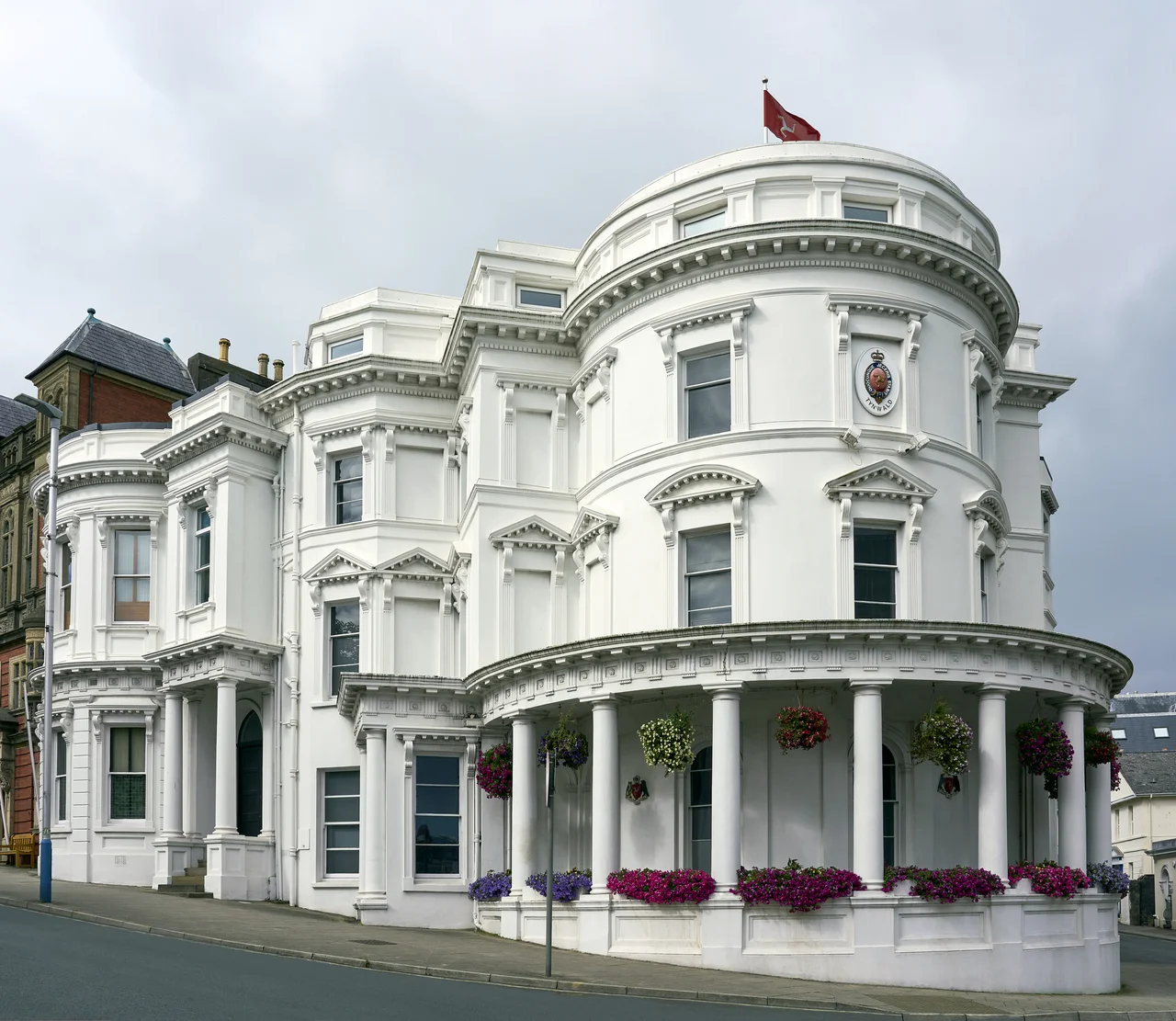

Tynwald
The name comes from Þingvǫllr - Old Norse for the field of the assembly, the place where the thing met. It is the same root that gives Iceland its Þingvellir and Norway its Tingvoll. In the Isle of Man it became Tynwald, and the assembly named after the field has been meeting, in some form or other, for so long that no one can quite agree when it began. What is certain is that on a small hill at St John's, every July, the laws of the island are still read aloud in Manx and English, just as they have been for centuries.
Two Chambers, One Court
Tynwald is bicameral. The directly elected House of Keys originates most legislation; the indirectly chosen Legislative Council acts as a revising chamber. When the two sit together they form Tynwald Court, presided over by a President elected by the members. Most months from October to July they meet in the Legislative Buildings in Douglas to sign bills, receive royal assent from the Lord of Mann, put questions to ministers, authorise taxes, and conduct the public business of the island. Once a year, on Tynwald Day - usually 5 July - they gather outdoors at Tynwald Hill at St John's for the ceremony that gives the institution its public face. The Lieutenant Governor presides unless the monarch as Lord of Mann is present in person. There, every Act of Tynwald is promulgated in both Manx and English. If a law is not promulgated within 18 months of passing, it becomes null and void.
How Old, Exactly?
Tynwald claims to be the oldest continuous parliament in the world. Iceland's Althing is older, but its operation was not continuous. The Manx celebrated their parliament's millennium in 1979, but the year was chosen somewhat arbitrarily - there is no evidence of an assembly held in 979, or that any such gathering would have resembled the modern court. The first record of the place-name appears in the Chronicles of Mann from the 13th and 14th centuries. The first description of the role and composition of the assembly comes from the early 15th century. Comparison helps: the earliest recorded parliament in England dates from 1229, Ireland's from 1216, and Scotland's from 1424. The Manx Statute Book, which the body itself recognised, begins in 1422. The Royal Commission of 1791-92 noted bluntly that prior to revestment, no minutes or journals of the Council or House of Keys proceedings had been kept at all.
Medieval Origins, Modern Form
Tynwald originally consisted only of the 24 Members of the House of Keys - four for each of the island's six sheadings. The earliest surviving record dates from 1417. The Keys were not elected; membership was for life, and when a vacancy arose the remaining members chose the replacement. In practice, membership passed down through the leading families of the island. Through the 16th century the Keys met irregularly, summoned like a jury when the Lord of Mann or the deemsters needed advice on the law. They became a permanent body in 1600. Until 1577 they merely declared and interpreted the ancient common law; only around 1610 did Tynwald take on the power to create new laws. The first Act on record was a 1417 restriction of the church's power to offer sanctuary - a quietly telling beginning.
Crown, Reform, and Suffrage
In 1651, during the English Civil War, Parliamentary forces took the island and Tynwald met only sporadically. After the Restoration the Lords of Mann became absentee landlords, and the Keys' power waned. Then in 1765 the Lord of Mann sold his rights to the British Crown. Tynwald was left with little money and little power, but it kept legislating - repealing restrictive labour laws in 1771, among other things. The Keys petitioned for reform with 800 signatures. A Royal Commission was appointed in 1791, but it was not until the House of Keys Election Act 1866 that any members were elected for the first time. Women have been able to stand for election since the 1919 introduction of universal adult suffrage based on residency. The first woman elected was Marion Shimmin of the Manx Labour Party, at a by-election in 1933. The Millennium Way, the long-distance footpath that crosses the island, was opened in 1979 to mark the parliament's celebrated thousand years.
From the Air
Tynwald Hill at St John's lies at 54.150°N, 4.481°W, in the central western interior of the Isle of Man. The four-tiered ceremonial mound is small but distinctive when seen from the air. Ronaldsway Airport (EGNS) lies approximately 7 nautical miles south-southeast. The Legislative Buildings, where Tynwald conducts most of its business, are in central Douglas. Best viewed at 1,500-3,000 feet AGL; the small village of St John's sits in a flat valley between Snaefell to the east and the western coastal hills.
Nearby Stories
- St Bees Lighthouse 15 km away
- Celtic Array 22 km away
- Kirkmaiden 23 km away
- Isle of Whithorn 23 km away
- Seascale Lifeboat Station 31 km away
- German submarine U-1024 36 km away
- SS Georgetown Victory 40 km away
- Blackpool Illuminations 56 km away