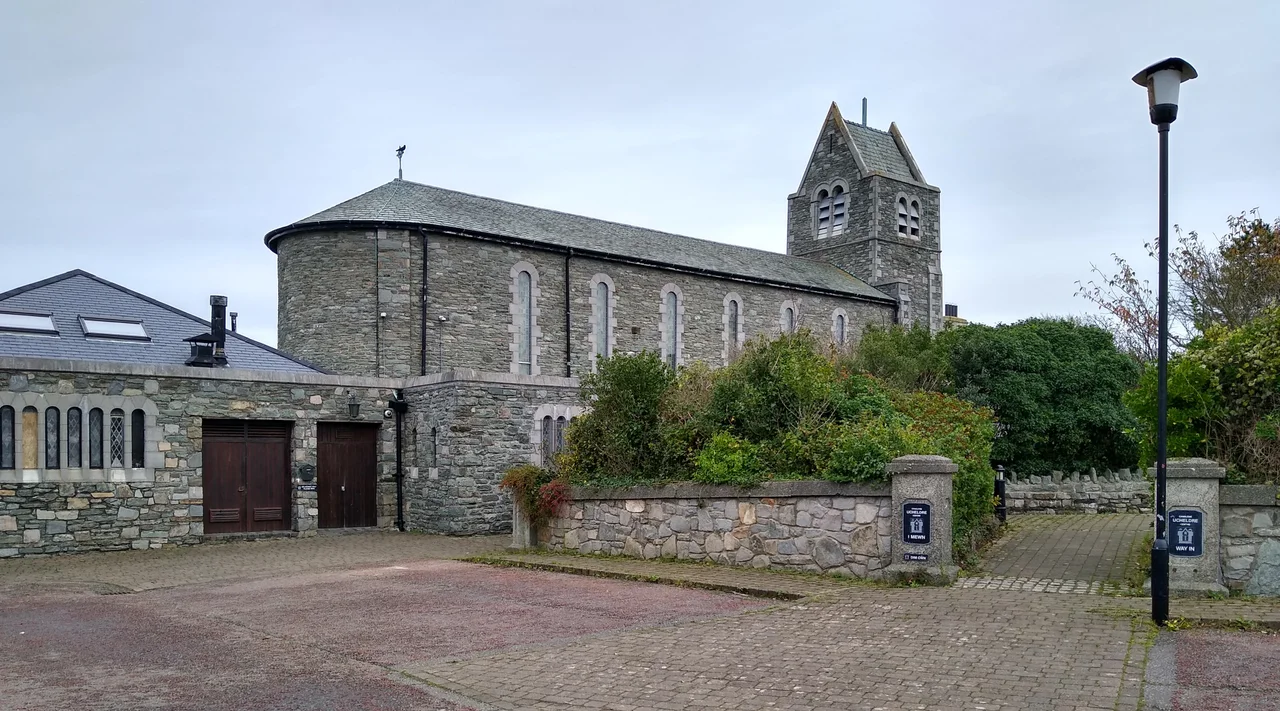

Ucheldre Centre
Bon Sauveur is a French Catholic teaching order founded in Caen in 1732, dedicated mostly to the deaf and to those with mental illness. Some time in the 1930s the order built a substantial convent on a hill overlooking Holyhead, complete with a chapel in modernised Romanesque style designed by a leading Dublin architect, R. M. Butler. The nuns ran a school there for several decades. By the 1980s the order was in decline, the school had closed, and the buildings were sold to a developer who applied for permission to knock them down. A group of Holyhead residents who could not bear to lose the chapel - the tower of green local stone, the high arched roof, the carved Romanesque detailing - went to the planners, raised money, and bought the building themselves. They opened it in 1991 as the Ucheldre Centre. Holyhead had never had a venue for the arts before. It does now.
Saved by the Town
Ucheldre means simply high town in Welsh, the name of the hill the convent sits on. The chapel that became the centre's main hall is one of R. M. Butler's better small church designs - he was responsible for a long list of public buildings in Ireland in the early 20th century, including the original Carnegie libraries in Dublin and Cork. The building uses a great deal of the distinctive green Anglesey stone, which weathers to a soft grey-green; the tall square tower can be seen from across the town. Inside, the original arched chapel roof is now the ceiling of a 200-seat performance space. The acoustic, the volunteers will tell you, is unusually good for music; the height and the curve do most of the work. When the centre took over in 1988, the chapel was structurally sound but stripped of fittings; the conversion left as much of the original architecture intact as possible while adding what a working arts centre needs: a gallery wing, a restaurant, dressing rooms, a small box office.
Kyffin Williams in the Old Chapel
The exhibition programme has, over more than three decades, gone considerably further than a town of Holyhead's size might be expected to support. Sir Kyffin Williams, the most prominent Welsh landscape painter of the 20th century and a man whose thickly-trowelled views of Snowdonia hang in every major British museum, lived nearby on Anglesey and exhibited at Ucheldre several times before his death in 2006. The centre has shown national touring exhibitions, large-scale sculpture in the grounds, and an annual programme of work by contemporary Welsh artists. The Prince of Wales Award was given to the centre in recognition of the original restoration work. On Friday and Saturday film nights, the main hall doubles as a cinema; the programme runs from current Hollywood releases to subtitled European films, an unusually catholic offering for a small Welsh town.
Amphitheatre in the Garden
Outside, the convent's old gardens have been landscaped into an unexpectedly ambitious outdoor space. There is a small grass amphitheatre for summer performances, with the stone of the chapel as a backdrop. Local sculptors have placed work among the paths. In good weather the cafe spills out onto the lawn, and on a warm August evening the town will turn up for an outdoor concert or play with the kind of communal goodwill that small-town arts venues generate when they have been built from below rather than imposed from above. There is no large endowment behind Ucheldre, no major arts council bricks-and-mortar grant. It runs on ticket sales, membership, small grants, and a great deal of volunteer time, and it has been doing so for over thirty-five years. The building it occupies might have come down in 1990; instead it is still here, still in use, still the only place in north-west Anglesey where a Holyhead resident can see a Friday-night film in a converted nineteenth-century convent chapel.
From the Air
Ucheldre Centre sits at 53.309N, 4.638W in Holyhead, west of the town centre and a short walk uphill from St Cybi's Church. From the air, the green-stone Romanesque tower and arched chapel roof are the most distinctive religious-looking building outside the parish church itself. Nearest airfield is RAF Valley (EGOV) 6 nm southeast; Caernarfon (EGCK) 18 nm south-southeast. The harbour, breakwater and Salt Island ferry terminal are 1 km north; Holyhead Mountain rises 2 nm to the northwest. Best photographed in the late afternoon, when the green stone of the tower glows in the low sun against the surrounding houses.
Nearby Stories
- Snowdon Mountain Railway 8 km away
- German submarine U-1051 8.3 km away
- German submarine U-246 11 km away
- Trwyn Du Lighthouse 13 km away
- Irish Sea Bridge 20 km away
- HMS Manners (K568) 34 km away
- HMS Tyler 47 km away
- Birkdale Palace Hotel 79 km away