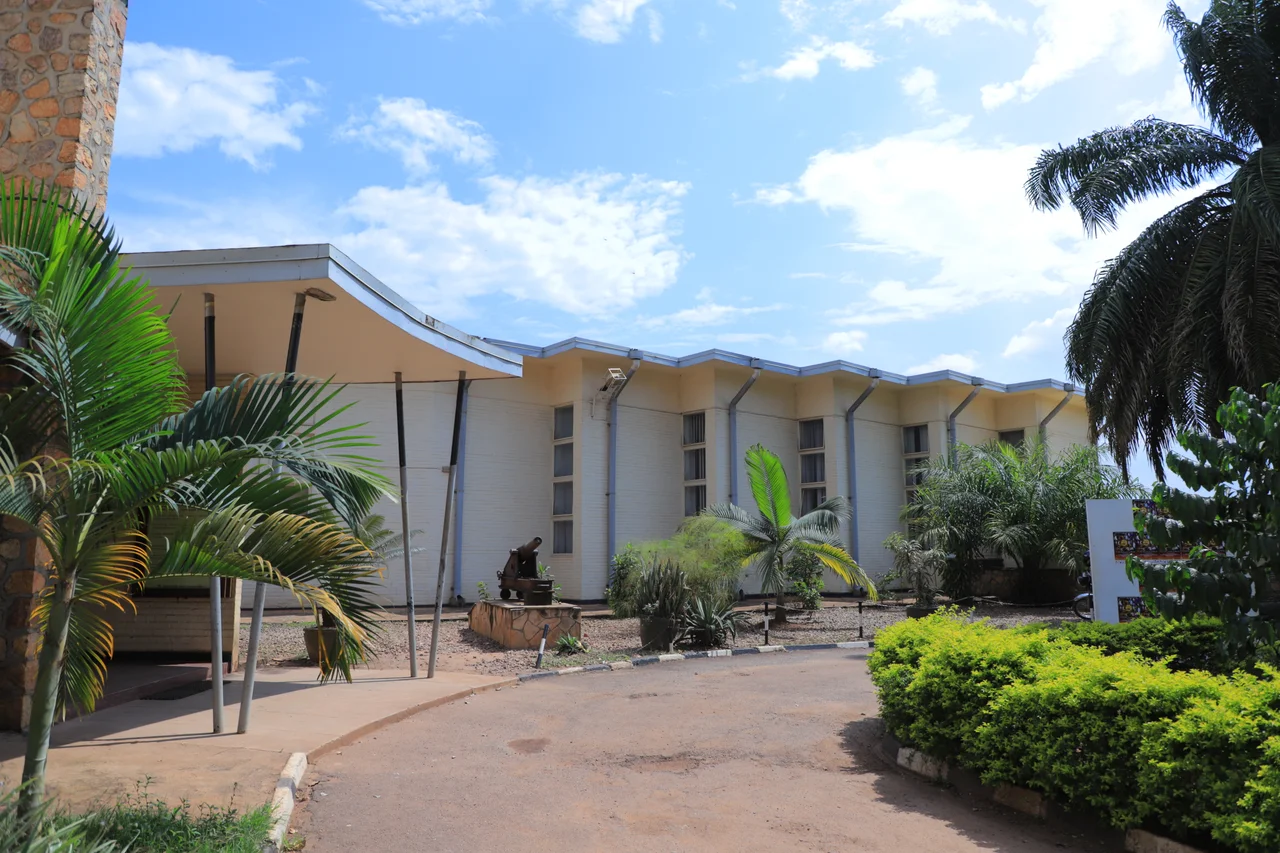

Uganda Museum
Pick up a xylophone mallet and the rule changes here. In most museums the instruments hang silent behind glass, but the Uganda Museum was built on a different idea: that a drum understood only by sight is a drum half-explained. Its music gallery holds one of the richest collections of East African instruments anywhere, and many can still be sounded. A visitor can pluck the strings of an *adungu* harp or strike a row of wooden keys and hear, for a moment, the music a Ugandan court might have heard a century ago. On Kitante Hill in Kampala, this is the country's memory made audible.
The Oldest in the East
The museum is the oldest in East Africa, established by the British protectorate government in 1908. The idea came earlier, in 1902, when deputy governor George Wilson called for "all articles of interest" across the country to be gathered up. The first collection lived in a small Sikh temple at Fort Lugard on Old Kampala Hill, then outgrew it and moved to Makerere University in 1941. Funds were raised for a permanent home, and in 1954 the museum settled on Kitante Hill, where it remains. By 2008 it had stood for a full century. Few institutions in the region can claim so long an unbroken run, through colonial rule, independence, and the turbulent decades that followed.
Instruments You Can Sound
The heart of the museum is its music gallery, grown from a collection the ethnomusicologist Klaus Wachsmann began assembling in 1948. The instruments are grouped by family, the way an orchestra is organized: drums, percussion, wind, and strings. What sets the gallery apart is permission. Many of the instruments are playable, and visitors are invited to make sound rather than merely read labels. A royal drum, a long horn, a notched flute, a lamellophone whose metal tongues hum under the thumb, all carry the textures of regional traditions. To strike one is to close a gap of decades in an instant, and to understand why this gallery, more than any other, is the one people remember.
A Skull from Deep Time
The museum is also a working research institution, and its paleontology unit reaches far past human history. Surveys in the Karamoja region, the foothills of Mount Elgon, and the western rift have produced fossils tied to human evolution. Among them is *Ugandapithecus*, an ancient ape recovered at Napak and dated to roughly 19 to 20 million years old, a remote relative on the long branch that leads toward the great apes. The natural history gallery puts such specimens on view, while the deeper archive stays open to researchers. It is a reminder that this corner of East Africa is not only old in cultural terms but ancient in evolutionary ones, a landscape that has been shaping primates since long before any drum was carved.
A Village Behind the Galleries
Step out the back of the main building and the museum opens into a cultural village, a cluster of huts built to show how Ugandans across many regions once lived. Each dwelling speaks for a people: the Tooro house with its makeshift wooden bed and barkcloth blanket, the Ankole house with the grinding stone once used to prepare millet bread, the Hima house hung with the long horns of cattle that defined a herding life. The objects are ordinary and intimate, milk gourds, clay bowls, beadwork, the texture of daily survival rather than royal display. Walking among them, the abstraction of "heritage" gives way to something concrete: kitchens, beds, and tools, the homes of real families across a country of many nations.
A Modernist Box of Light
The building itself belongs to the story. It was designed by the German modernist architect Ernst May, a figure better known for his social housing in Weimar Frankfurt, who spent years working in East Africa. May shaped the museum around light and air, drawing daylight deep into the galleries and letting breezes move through to protect the collections in a tropical climate. The result is a piece of mid-century modernism standing on a Kampala hilltop, a quietly radical structure that has, more than once, had to be defended against proposals to replace it. It remains both the container and one of the exhibits.
From the Air
The Uganda Museum sits on Kitante Hill in Kampala at 0.336 N, 32.583 E, near the city center. Entebbe International Airport (HUEN), Uganda's main gateway, lies about 35 km southwest on the shore of Lake Victoria; the older Kajjansi airfield (HUKS) is closer, roughly midway between Kampala and Entebbe. Kampala spreads across a cluster of green hills threaded with red-roofed neighborhoods; Lake Victoria's vast pale expanse to the south is the dominant navigation feature. The equator runs just south of the city, so daylight is consistent year-round, though afternoon convective cloud and haze are common in the wet seasons. A late-morning approach from the lake offers the clearest view of the hills.
Nearby Stories
- White Nile 24 km away
- Ssese Islands 57 km away
- Ntusi 89 km away
- Battle of Kabamba 94 km away
- Nyero Rock Paintings 98 km away
- Bunyoro 134 km away
- Migingo Island 140 km away
- Budongo Forest 172 km away