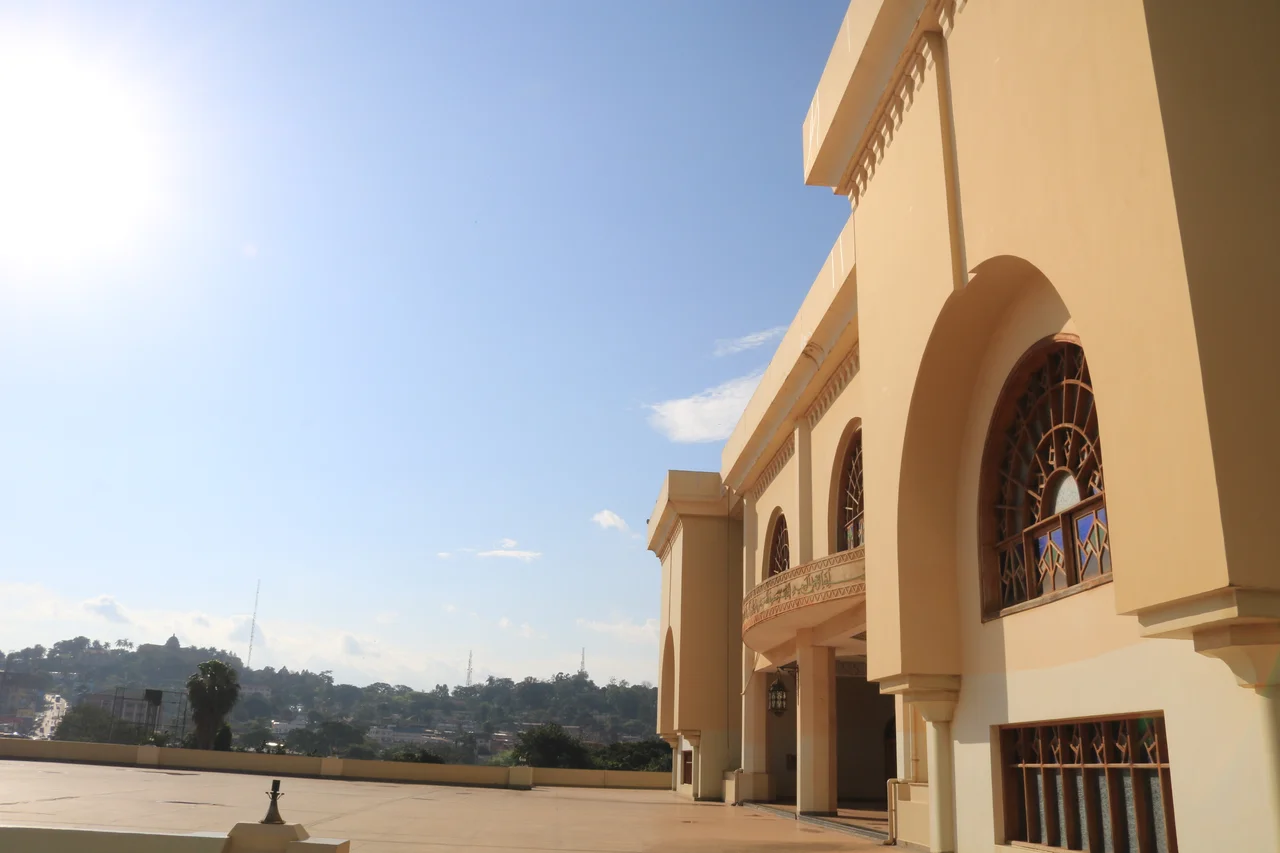

Uganda National Mosque
It took two dictators and three decades to finish this mosque, and the result crowns one of Kampala's oldest hills. Idi Amin laid the first stones in 1972; the work stalled, his regime fell, and for years the unfinished shell sat as a monument to abandoned ambition. Then Muammar Gaddafi adopted the project, and in 2006 the Uganda National Mosque was completed at last. Its 50.5-metre minaret now anchors the city's skyline, the largest mosque in East Africa standing on the hill where Kampala itself began. Climb the roughly 300 steps inside that tower and the whole sprawling capital opens beneath you.
A Gift Finished by Another Hand
Construction began in 1972 under Idi Amin, who envisioned a grand national mosque on Old Kampala Hill. By 1976 the work had halted amid the instability of his rule, and after he was deposed in 1979 the half-built structure seemed destined to stay that way. Rescue came from an unlikely patron. In 2001 Gaddafi offered to complete the mosque as a gift to Uganda's Muslims, and Libyan funding carried it to completion in 2006. The name shifted with history too: opened as the Gaddafi National Mosque, it was renamed the Uganda National Mosque in 2013, after Gaddafi's death, when a new Libyan government proved reluctant to keep restoring a building under his name.
The View from the Minaret
The minaret is the mosque's signature, and its reward is earned on foot. Around three hundred steps spiral up the 50.5-metre tower, and at the top the climber stands above one of Africa's great hilltop cities. Kampala famously grew across a cluster of hills, and from this height the whole layout reveals itself: the green ridges, the red roofs spilling down their slopes, the haze of the lake to the south, and the distant towers of the modern center. Guides at the mosque make the ascent a centerpiece of any visit. There may be no better single vantage point in the city, a place where Kampala's tangled, multi-hilled geography finally makes visual sense.
Room for a Multitude
Inside, the scale matches the ambition. The prayer hall holds up to 15,000 worshippers, with space for another 1,100 in the gallery and 3,500 more in the *sahn*, the open courtyard. The dome rises over a vast carpeted floor, light falling through high windows onto rows that can stretch wall to wall during major prayers. The decoration is itself a small international collaboration, gathering a chandelier from Egypt, Arabic calligraphy by Moroccan craftsmen, and carpets aligned precisely toward Mecca, a fitting reflection of the foreign patronage that built the place. As the largest mosque in East Africa, it serves as a focal point for a Muslim community that makes up a substantial share of Uganda's population. The complex is more than a prayer hall; it houses the headquarters of the Uganda Muslim Supreme Council, making it the administrative as well as spiritual center of Islam in the country. On the great feast days the hall fills, and the building does exactly what its builders intended across all those stalled, restarted years: it gathers a city's faithful under one roof.
The Hill Where Kampala Began
The site carries more than religious weight. Old Kampala Hill is where the city's recorded history starts, the place where Captain Frederick Lugard built a fort in the 1890s, planting the colonial presence that would grow into the capital. The hill that once held a frontier garrison now holds East Africa's largest mosque, its minaret visible across the surrounding ridges. There is a long memory in that overlap of fort and dome, of empire and independence, of a structure begun by one ruler and finished by another. To stand on Old Kampala Hill is to stand at the literal starting point of the city, looking out over everything it has since become.
From the Air
The Uganda National Mosque stands on Old Kampala Hill at 0.300 N, 32.633 E, its 50.5-metre minaret a useful skyline marker over central Kampala. Entebbe International Airport (HUEN) lies roughly 35 km southwest on Lake Victoria; Kajjansi airfield (HUKS) sits closer, between the city and the lake. From the air, Kampala reads as a constellation of hills, each topped by a landmark, with the mosque's pale dome and tower prominent among them and Lake Victoria's broad sheet of water filling the southern horizon. The equatorial position keeps light steady through the year, but expect haze and building cumulus on wet-season afternoons. A morning pass from the lakeside gives the cleanest profile of the hills.
Nearby Stories
- White Nile 24 km away
- Ssese Islands 57 km away
- Ntusi 89 km away
- Battle of Kabamba 94 km away
- Nyero Rock Paintings 98 km away
- Bunyoro 134 km away
- Migingo Island 140 km away
- Budongo Forest 172 km away