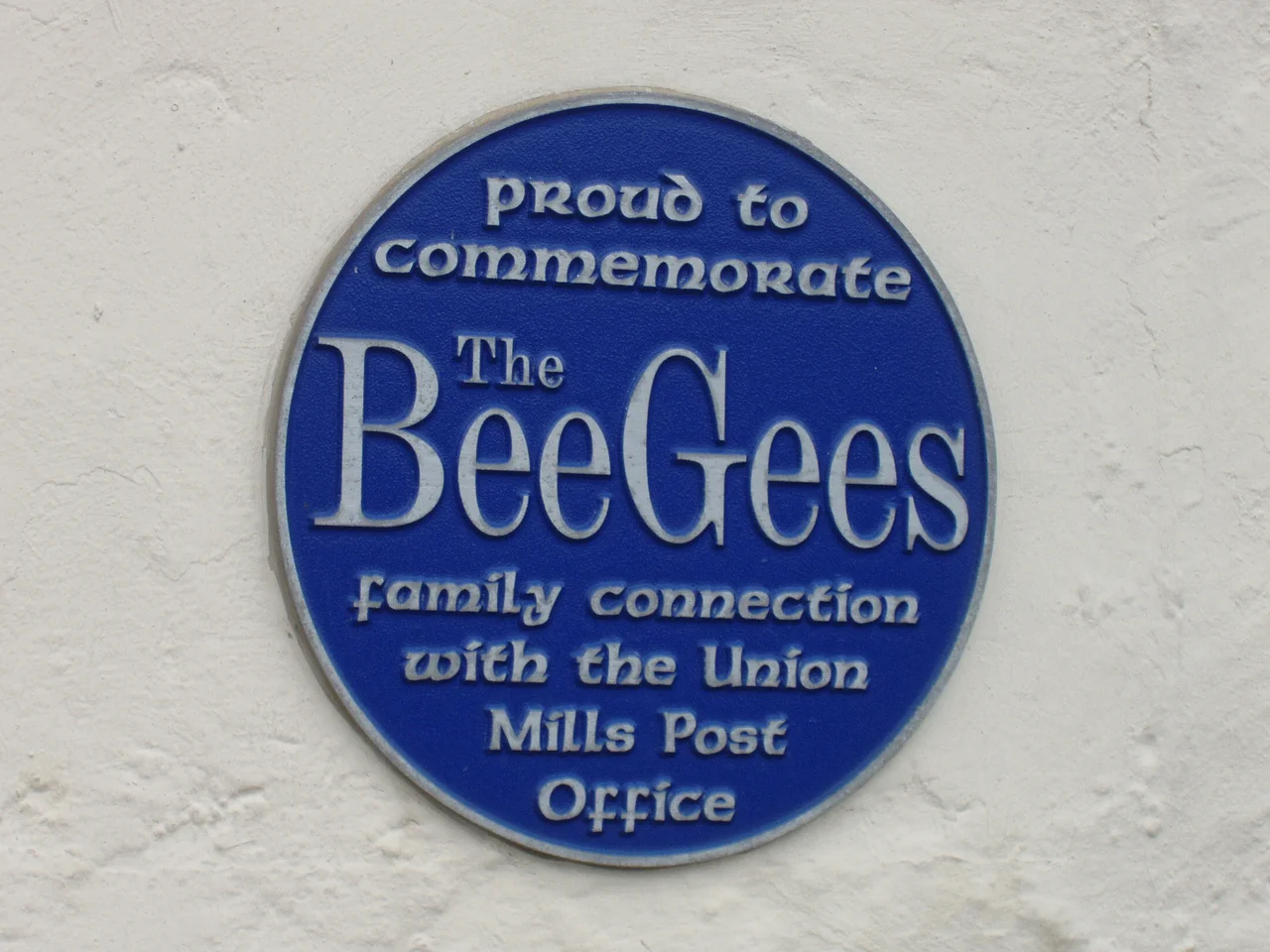

Union Mills
Five Shillings British, the card promised, payable to the bearer on demand. The promissory note was issued on 4 September 1811, signed by William Kelly, and stamped Union Mills. It was private money - the local currency of a single mill complex on the River Dhoo - and it tells you almost everything you need to know about how this village came by its name. In 1807, Kelly had added a cloth mill to the existing corn mill on the site, christened the new partnership Flail and Fleece United, and started paying his workers in scrip that they could spend at the company shop. The Union Mills are gone now. The village they named is still here.
The Mill on the Black Ford
Long before the union, the place was known as Mullin Doway: the Mill on the Black Ford. The name first appears in the records in 1511. For three centuries it was a corn mill on a small Manx river, no more or less notable than dozens of others scattered across the island. William Kelly's 1807 cloth mill changed that. Flail and Fleece United was modern industry on a small scale, processing local fleeces alongside the corn that had always passed through here. Only a few walls of the original mill complex survive today. The miller's house still stands, however, anchoring the village to its industrial founding. The village sits in the parish of Braddan on the A1, the primary road between Douglas and Peel, where the road dips down to cross the River Dhoo.
Roads, Races, and a Memorial
Union Mills lies between the second and third milestones of the Snaefell Mountain Course - the road-racing circuit used since 1911 for the Isle of Man TT and since 1923 for the Manx Grand Prix. For two weeks each year, the village is part of one of motorcycling's most demanding circuits, and the A1 through the centre of town becomes a racetrack. Quieter is the Memorial Hall, dedicated to John Dalrymple Maitland, who fell in France on 21 February 1916 during the First World War. He was the son of Dalrymple Maitland, Speaker of the House of Keys from 1909 to 1919, who died at his home Brook Mooar in this village on 25 March 1919. A father who ran the parliament; a son who died in the trenches; a hall in a small Manx village to hold their names.
A Railway That Came Back, Briefly
The Union Mills station opened on 1 July 1873 as one of the original stops on the Isle of Man Railway's Douglas to Peel line. The line was single-track, but the station here had a passing loop where trains heading in opposite directions could meet. The line closed on 13 November 1965, defeated by the poor condition of its track. To the surprise of many, it reopened on 3 June 1967. The reprieve was short. Financial problems killed it again on 7 September 1968, and this time the closure stuck. The trackbed through the village now forms part of the Douglas-to-Peel heritage trail, popular with walkers and mountain bikers. A short stretch of rail has been re-laid where the station once stood, and a rail-mounted crane sits there as a small memorial to the line.
Village Life in Braddan
What remains is a working Manx village. The Railway Inn is on Main Road. There is a former Methodist Church, and a Wesleyan chapel whose foundation stone was laid on 6 March 1930 - the previous chapel still standing alongside. There is a Spar shop with a small Post Office. Cronk Grianagh Park has been upgraded with new playground equipment, a BMX track, and a skate park built in 2012 and extended in 2016. Union Mills FC plays at Garey Mooar on Ballaotes Road in the Isle of Man Football League. Union Mills Cricket Club fields a side at Ballaoates. Notable residents have included the sea captain William Cain, born here in 1862, and the miner William Kitto, who lived here from his birth in 1855 until his death in 1930. The village goes about its life, somewhere between a mill village, a racing landmark, and a commuter suburb.
From the Air
Union Mills sits at 54.169°N, 4.521°W in the parish of Braddan, about 3 nautical miles west-northwest of Douglas on the A1 to Peel. The village occupies the floor of the River Dhoo valley with low surrounding hills. Ronaldsway Airport (EGNS) is approximately 8 nautical miles to the southeast. Best viewed at 1,500-2,500 feet AGL; the village is small but distinguishable by the bend of the A1 and the former rail trackbed running through it on a roughly east-west alignment.
Nearby Stories
- St Bees Lighthouse 15 km away
- Celtic Array 22 km away
- Kirkmaiden 23 km away
- Isle of Whithorn 23 km away
- Seascale Lifeboat Station 31 km away
- German submarine U-1024 36 km away
- SS Georgetown Victory 40 km away
- Blackpool Illuminations 56 km away