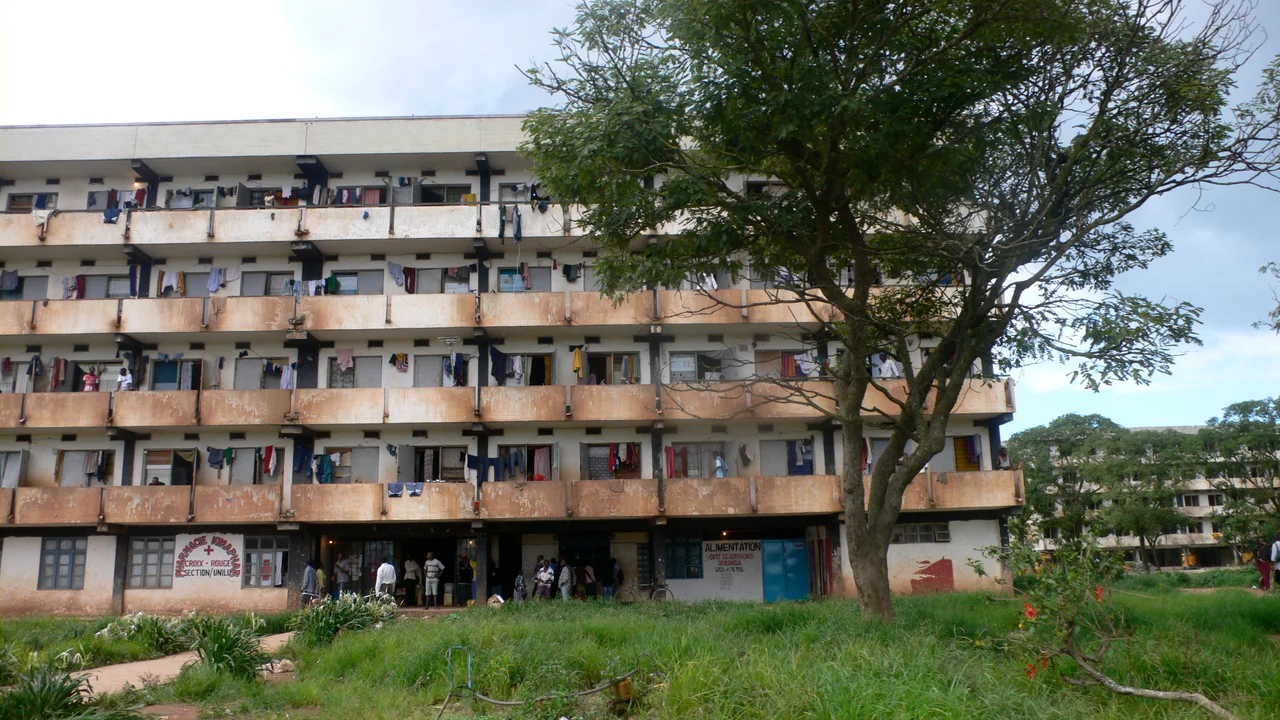

University of Lubumbashi
On the night of 11 May 1990, the electricity went out across the campus of the University of Lubumbashi. The outage was deliberate. In the darkness that followed, a military unit the students had never heard of - Les Hiboux, "The Owls" - moved through the dormitories with machetes and bayonets. The students had been protesting against Mobutu Sese Seko's regime, calling for his resignation. By the time the sun came up on 12 May, at least 290 of them were dead. The massacre became the beginning of the end of Western tolerance for the Mobutu government, and it forever changed what the university could mean in Congolese memory - a place of learning that had also become a place where the state's willingness to kill its young was made terribly clear.
A University of the Belgian Congo
The institution had begun much earlier, in a very different country. In 1955, under Belgian colonial rule, the University of Liège founded a new campus in what was then Elisabethville, in the south of the Belgian Congo. It opened the following year as the Official University of the Congo and Ruanda-Urundi - a mouthful of a name reflecting the colonial geography of the day. The intention was to prepare a generation of Congolese professionals for a future the Belgians were not yet ready to concede. When the Congo became independent in 1960, the university continued under the new flag. In 1971, under Mobutu's drive to Zairianize the country, the campus was folded into the National University of Zaire, one of three regional sections under a single national structure. When that unified system was dismantled in 1981, the Lubumbashi branch reemerged as an autonomous university. The campus sits in the northern part of the city, west of Lubumbashi International Airport, on flat ground that Katangan wind crosses without obstruction.
The Night the Lights Went Out
By May 1990, Mobutu had been in power for twenty-five years. The Cold War logic that had propped up his government through the 1970s was dissolving. Western governments were beginning to tie aid to democratic reform, and African students were pressing their own governments to transition to multiparty politics. At UNILU, students began protesting in early May, demanding Mobutu's resignation. On the night of 11 May, the regime struck back. Little is known for certain about Les Hiboux - the unit operated only at night, which is where the name came from, and moved in expensive vehicles that were rare in Zaire, suggesting an elite force made of regime loyalists. What they did on the Lubumbashi campus was documented by survivors and by the bodies recovered afterward. Students were bayoneted in their dormitories. Those who tried to flee the campus were shot down as they ran. By dawn the halls were soaked in blood and scattered with human remains.
The World Responds
The Congo was a former Belgian colony, and the massacre received heavy coverage in Belgium. The Belgian government, facing public pressure, was forced to publicly criticize Mobutu - a significant shift from the quiet accommodation that had characterized relations for decades. The European Economic Community (now the European Union), the United States, and Canada ended all non-humanitarian aid to Zaire. For Mobutu, it was the beginning of the end of Western support. He would cling to power for another seven years, but the international consensus that had sheltered him was gone. The students who died at UNILU had been demanding that his government step aside. Their deaths made that demand heard more loudly abroad than it ever would have been through their protests alone - a terrible paradox that the survivors have had to carry in the years since. At least 290 young people were killed; exact figures remain contested.
The University Today
UNILU continued. It is one of the largest universities in the Democratic Republic of the Congo, training students from across Katanga and beyond in faculties ranging from law to medicine to engineering. The administration building and the law faculty still stand on the campus where Les Hiboux did their work. Notable alumni include the photographer Sammy Baloji, whose images of Katangan mining landscapes have been exhibited internationally; Christophe Munzihirwa Mwene Ngabo, a Roman Catholic archbishop murdered in 1996 during the First Congo War; and Agnes Nyirandabaruta, who became vice president of the Court of Appeal of Rwanda. The linguist Edgar C. Polomé taught here before his career took him to American universities. Each generation of UNILU students inherits a difficult campus history, but the institution has not been defined only by what happened to it in May 1990 - it continues to turn out the professional class that a country with enormous mineral wealth and enormous challenges still desperately needs.
From the Air
University of Lubumbashi, DRC. Coordinates 11.61°S, 27.48°E. Adjacent to Lubumbashi International Airport (FZQA) on its eastern side - the campus lies west of the airport. Recommended viewing altitude 3,000-8,000 ft. The surrounding Katangan plateau is at about 1,200 m elevation with a characteristic red-soil landscape.
Nearby Stories
- Kinsevere 7.8 km away
- Luishia Mine 30 km away
- Congo Pedicle 60 km away
- Copperbelt 61 km away
- Likasi 87 km away
- 1935 Copperbelt strike 96 km away
- Lake Bangweulu 181 km away
- North-Western Province, Zambia 253 km away