
University of Pikeville
In 1889, a handful of Presbyterian missionaries opened a one-building academy on a steep slope above Pikeville, Kentucky. They called it the Pikeville Collegiate Institute, and for its first two decades it taught primary school students, secondary school students, and a junior college class whose graduates had to transfer somewhere else to finish their degrees. The mountains around the campus held coal seams that were beginning to make a few men very rich. The school's mission was almost the opposite: to bring some kind of education to children whose fathers were dying in those same mines. A hundred and thirty-six years later, that hillside school trains doctors.
The Long Climb to Accreditation
James Franklin Record arrived in 1899 and stayed thirty-three years as president, a tenure that ran from the McKinley administration through the early Great Depression. Under Record, the high school finally won accreditation, a teacher training institute opened, and the junior college took shape. In 1909 the school split: Pikeville College Academy taught primary and secondary, while Pikeville College became an accredited junior college whose graduates moved on to four-year Presbyterian institutions elsewhere. The four-year degree did not arrive until 1955. Two years later, the academy closed. By the late 1950s, the Kentucky General Assembly briefly considered converting the school into a state university - a plan that quietly died the following March, deemed politically impossible. The college stayed private, stayed Presbyterian, and stayed on its hillside.
Building a Medical School
The decision in 1996 to open a school of osteopathic medicine in Pikeville was, by any reasonable measure, audacious. Eastern Kentucky was losing population. Pikeville College had under a thousand undergraduates. Other small Presbyterian colleges in similar situations were closing. But the region had a desperate shortage of doctors, and osteopathic medicine - with its emphasis on primary care and underserved communities - was the right fit. The Kentucky College of Osteopathic Medicine opened in 1997 and is now one of three medical schools in the state. In 2016 the university added the Kentucky College of Optometry, the first optometry school in central Appalachia. The campus today educates over 2,300 students. In 2012, the $34 million Coal Building - named for the industry that built the region and pays a notable share of its tuition - was dedicated for the medical school.
The Hillside Campus
Twenty-five acres of bench-cut hillside hold the university - cramped by mountain standards, generous by the standards of downtown Pikeville. The oldest structure, the Training-Academy Building, dates to the institute's early years and now sits on the National Register of Historic Places, housing the Coleman College of Business. Record Memorial Hall, named for the long-serving president, connects the campus to Hambley Boulevard below and contains Booth Auditorium, the dance studio, the nursing program, and an art gallery. Residence halls cluster around the slope - Derrianna and Condit and Wickham, each with its own history of who slept where. Below the campus, the 7,000-seat Appalachian Wireless Arena hosts the men's and women's basketball teams. The Bears, who compete in the NAIA's Appalachian Athletic Conference, pulled off one of the upsets of the decade in 2011 when, unseeded, they won the NAIA Division I men's basketball championship in overtime.
Notable Bears
John Paul Riddle graduated from Pikeville in 1920, ran off to teach himself to fly, and co-founded what became Embry-Riddle Aeronautical University - one of the world's premier aviation schools. Judi Patton, who became First Lady of Kentucky when her husband Paul served as governor, attended here; Paul Patton himself later served as the university's chancellor. Kelly Coleman, the all-time leading scorer in Kentucky high school history, came through in the late 1950s and was drafted eleventh overall by the New York Knicks. Donnie Jones graduated in 1988 and built a coaching career that took him to Marshall, Central Florida, and eventually to head jobs at Stetson. For a hillside school with under three thousand students, the alumni list runs deep.
The Long Game
Pikeville is the kind of college that closes - small, private, religiously affiliated, in a region the rest of the country writes off. It has not closed. It has, instead, kept adding programs: osteopathic medicine, then optometry, then a partnership with Galen College of Nursing to operate a downtown campus. The university is now one of the largest employers in Pike County and one of the largest sources of professional graduates anywhere in central Appalachia. The Presbyterians who climbed this hillside in 1889 with the modest goal of teaching mountain children to read could not have predicted any of it. But they did pick the right hillside.
From the Air
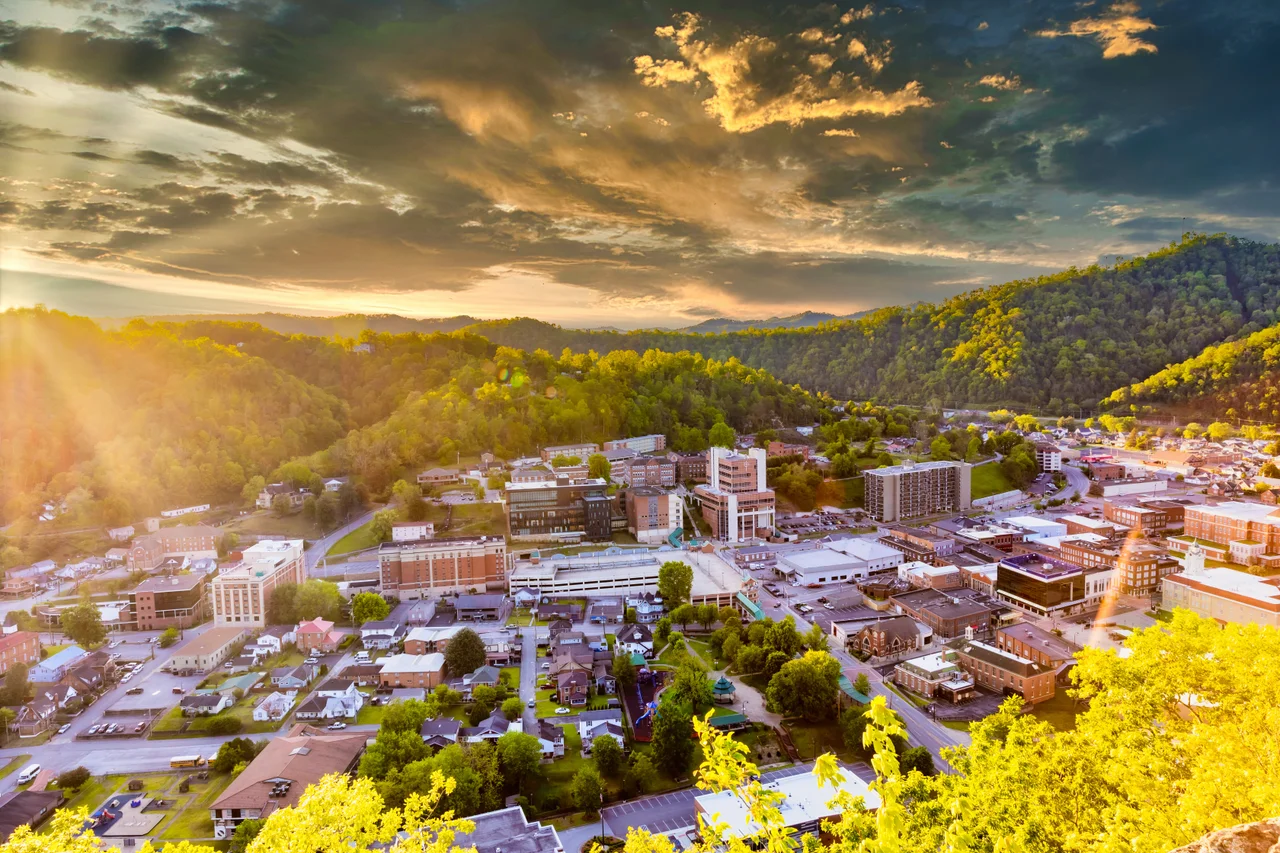
The University of Pikeville campus sits at 37.48 degrees north, 82.52 degrees west on a hillside above downtown Pikeville. Easy to spot at 2,500-3,500 feet AGL by the cluster of buildings stepped into the slope, with the Appalachian Wireless Arena's distinctive roof just downhill. Nearest airport is Pike County Airport (KPBX), about 7 miles southwest of campus. Tri-State Airport (KHTS) is the nearest commercial field, 65 nm to the north.
Nearby Stories
- Aracoma Alma Mine accident 3.2 km away
- Martin County coal slurry spill 18 km away
- Pittston Coal Strike 19 km away
- Welch, West Virginia 31 km away
- Tazewell County, Virginia 35 km away
- The Kentucky Meat Shower: When Flesh Fell From a Clear Sky 78 km away
- Cumberland Gap 97 km away
- Lower Shawneetown 133 km away