
Unstan Chambered Cairn
In 1884, somebody dug up a small Neolithic tomb on a low promontory poking into the Loch of Stenness and found, in a shallow hollow scooped into the clay floor, the broken pieces of a kind of pottery nobody had seen before. Elegant shallow bowls, thin-walled, with a band of grooved pattern running below the rim - made by dragging and stabbing a small tool into the wet clay. The technique gave the pottery its name: stab-and-drag. The bowls themselves got named for the place where they first turned up. Five thousand years after they were made and shattered, Unstan ware became the type example that helped archaeologists begin to read the Neolithic of northern Britain.
An Orkney Hybrid
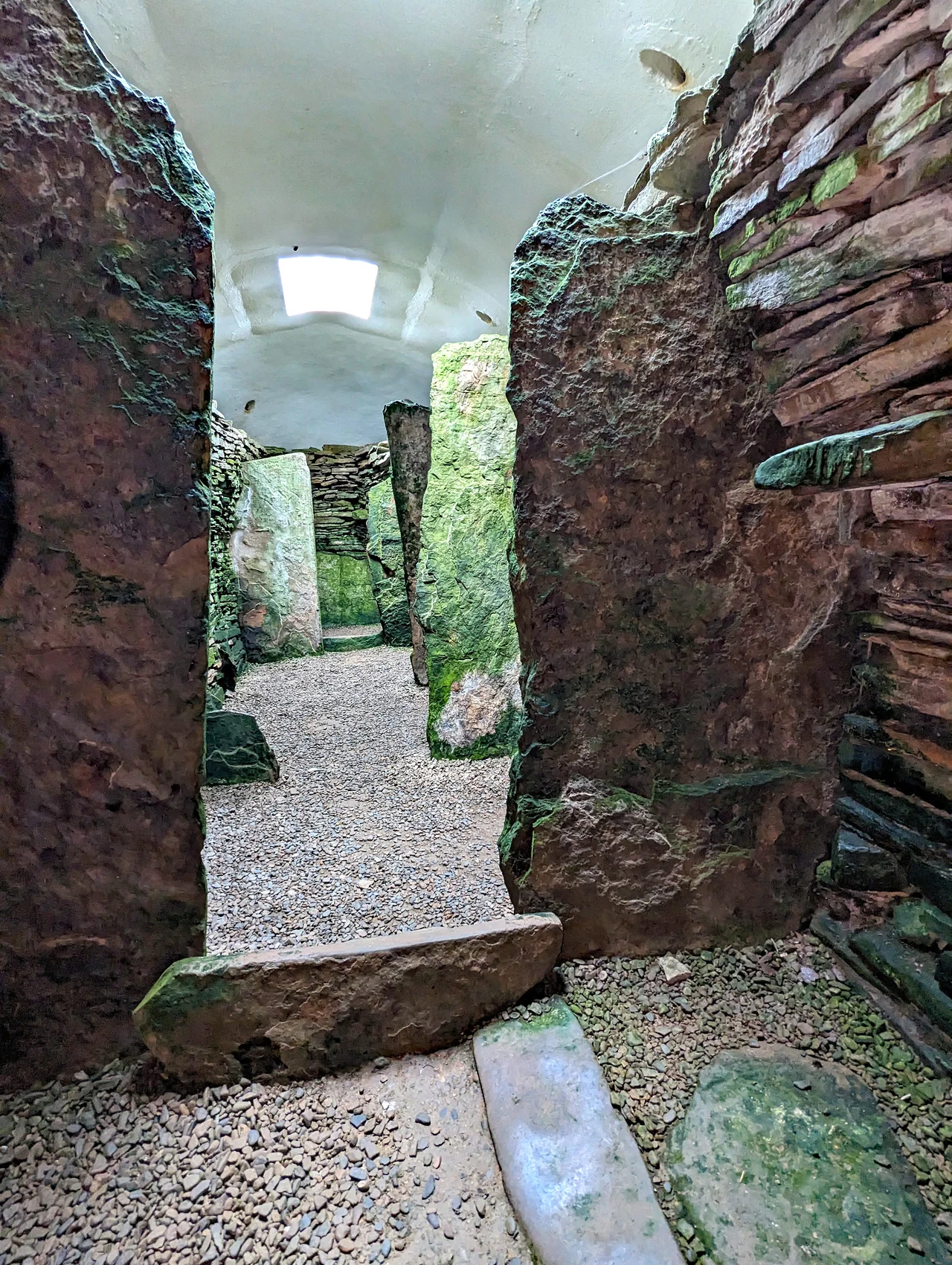
The tomb is a stalled cairn - the kind with a central passageway flanked by paired transverse stones that separate the side spaces into compartments. The early excavators thought the compartments looked like horse stalls, and the name stuck. The form began in Caithness, just south across the Pentland Firth, where the tombs are modest with three or four compartments. In Orkney the builders went bigger; the Knowe of Ramsay on Rousay reached fourteen. Unstan has five compartments flanking its passage, modest by Orcadian standards. But it is also strange. Its barrow is round rather than oblong. It has a side chamber. And the main chamber doesn't open at the end of the passage like other stalled cairns - it opens along one long side. All three traits belong to the other Orkney tomb tradition, the Maeshowe type. Unstan is a hybrid, suggesting either an experiment or a borrowing across two communities of builders who didn't usually mix their grammars.
Stab-and-Drag
Parts of twenty to thirty bowls came out of the tomb, many of them the new style. Some included flecks of crushed volcanic rock in the clay to strengthen them, and after firing the surfaces were burnished smooth with bone tools until they shone and held water. Most of the bowls were broken when found, which is normal for chambered cairns and suggests the vessels were deliberately smashed for inclusion with the dead. They had been used in life first - some sherds carry impressions of barley grains pressed into the wet clay long before firing, ordinary kitchenware before they became grave goods. A number of the reconstructed bowls now sit in the National Museum of Scotland in Edinburgh, their grooves still sharp.
The People Inside
There were two skeletons crouched in the side cell, several more in the main chamber, and scattered bones throughout the passageway. Animal bones lay among them, and charcoal from old fires. The position of the bodies is a clue to chronology - burials in the crouched, fetal position weren't typical Neolithic practice. An arrowhead found in the tomb is the type used by the Beaker people, who arrived from the European mainland late in the Neolithic and into the Bronze Age. Together these hint that Unstan, built somewhere between 3400 and 2800 BC, was still being used as a tomb a thousand years or more after its first burial. The dead kept arriving. The barley kept being scratched into bowls and broken into the dark. Long lives, for a small stone room.
The Concrete Dome
The original corbelled roof is gone, as it is at almost every Orkney tomb. In the 1930s a concrete dome was placed over the surviving walls to keep the weather out and the chamber accessible. The walls inside still rise close to their full height in places, built of thin slabs of local flagstone split from the Devonian Old Red Sandstone that underlies all of Orkney. The site sits in the care of Historic Environment Scotland as a scheduled monument, a few minutes' drive from Stromness, a quiet stop near the more famous Stones of Stenness and the Ring of Brodgar. The name itself is Norse-stamped Orcadian: the *stan* ending comes from *staðr*, an Old Norse word for a farm settlement. Five millennia and two waves of incomers, recorded in two syllables.
From the Air
Unstan Chambered Cairn sits at 58.99°N, 3.25°W on a low promontory extending into the Loch of Stenness on Orkney Mainland, about three miles northeast of Stromness and a mile southeast of the Stones of Stenness. From the air the cairn appears as a small grass-covered mound topped by a flat concrete cap, near the southern shore of the loch. Kirkwall Airport (EGPA) is twelve miles east. Recommended viewing altitude 1,500-3,000 feet. The cairn is best picked out in low morning or evening light when the mound throws a shadow against the surrounding farmland.
Nearby Stories
- Castle of Mey 9.7 km away
- Copinsay 12 km away
- HMS Sword Dance (1918) 27 km away
- Strathnaver Museum 28 km away
- HMS King Edward VII 35 km away
- Fair Isle 74 km away
- Jarlshof 135 km away
- The Laki Eruption: The Volcano That Changed World History 926 km away