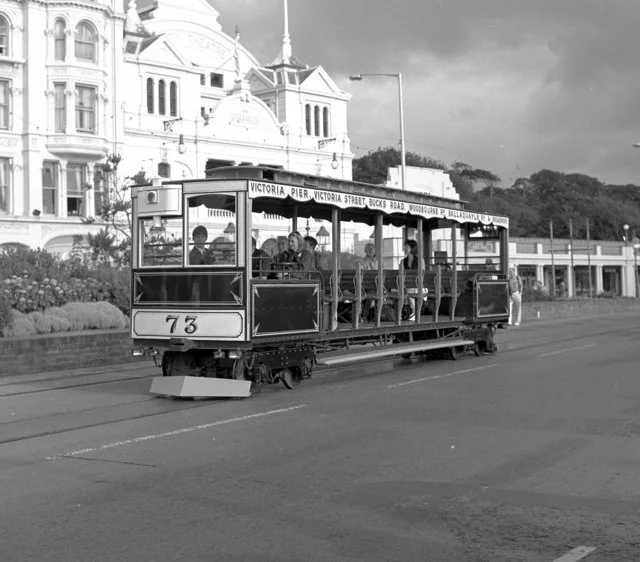

Upper Douglas Cable Tramway
Two tramcars, numbered 72 and 73, spent forty years as somebody's house. After the Upper Douglas Cable Tramway closed on 19 August 1929, the cars were dragged up to Crawyn in Jurby, parked side by side, and joined into a single dwelling. The bogies stayed in place beneath them. A brick chimney was built between the two carriages to make the whole thing habitable. In late July 1968, the Douglas Cable Car Group found them still standing and took them home. The cable car you can see today at the Jurby Transport Museum is what was salvaged from those two patient bungalow-cars, restored over eight painstaking years.
A Tram for the Steep Streets
The Upper Douglas Cable Tramway opened on 15 August 1896, the result of a deal between Douglas Corporation and the Isle of Man Tramways and Electric Power Company. Douglas Corporation - the local authority responsible for the town - wanted public transport for the steep upper neighbourhoods that climbed away from the promenade. The Tramways company wanted an extended franchise on their horse tramway along Douglas Bay. So a swap was made: in exchange for the longer franchise on the flat horse line, the company would build a cable line up the hills. The new tramway was constructed to narrow gauge, suitable to the tight Manx streetscape. Both termini sat on Douglas Promenade - one at the Clock Tower and one at Broadway - and the line ran in a U-shape inland through Victoria Street, Prospect Hill, Buck's Road, Woodbourne Road, York Road, and Ballaquayle Road.
A Bank Collapses, a Section Closes
In February 1900, the operating company's parent collapsed. Dumbell's Bank had been one of the most important financial institutions on the Isle of Man, and its failure ruined depositors and businesses across the island. Douglas Corporation stepped in and took the tramway into public ownership in January 1902, buying it from the liquidator. With the corporation now responsible, a closer look was taken at the southern section south of the depot in York Road. The gradient there was judged too dangerous for safe operation, and that part of the line was closed. The line struggled on through the early 20th century, but the rise of motor buses and the changing economics of cheap fares pressed steadily against it. In 1922 the service was downgraded to seasonal operation only. The end came on 19 August 1929. The rails themselves stayed in the streets, slowly weathering, until they were finally lifted in 1932.
The Curious Numbering
Whoever designed the fleet numbers had ambitions for the horse tramway it served. The cable cars' numbering started at 70 - not at 1 - so that the horse tramway's own fleet could be expanded into the lower numbers if needed. That expansion never came; the highest-numbered horse car was always 50. As a result the cable tram fleet ended up with peculiarly elevated numbers, with the three lowest-numbered cars added later in the system's life as fill-ins for unused slots. The colour scheme of the cars is believed to have been Prussian Blue panelling with cream details, lemon yellow trim and brown lettering, with the major destinations along the upper valence. The restored car 72/73 carries these colours today as the best surviving guide to how the original fleet looked.
Bungalow, Restoration, Museum
When the line closed, cars 72 and 73 were among those bought up for second lives. The pair were converted into the Crawyn bungalow at Jurby - bogies still beneath them, brick chimney between - and lived as a house until 1968. The Douglas Cable Car Group rescued them that summer and undertook a restoration at the old York Road depot, which had served the cable tramway, later the buses, and the horse tram fleet. The work ran from 1968 to 1976. The restored car bears number 72 on one end and 73 on the other - a small acknowledgement that it is a composite, the best of both originals. It runs on battery power now, and was occasionally seen back out on the Douglas Bay horse tramway. It has since moved to the Jurby Transport Museum, where it sits on a short stretch of reproduction track. The Isle of Man Post Office put the tramway on a 13-pence stamp in 1988. Two carriages joined into a house, then a house dismantled back into one carriage - that is the unlikely arc of car 72/73.
From the Air
The former Upper Douglas Cable Tramway ran in a U-shape through central Douglas between 54.157°N, 4.477°W and the surrounding upper streets. Both termini were on the promenade by Douglas Bay. From the air, the original route is now invisible except in the layout of the streets it climbed. Ronaldsway Airport (EGNS) lies about 6 nautical miles south. The preserved car 72/73 is currently at the Jurby Transport Museum in the north of the island, near the former RAF Jurby airfield. Best viewed at 1,500-2,500 feet AGL when overflying central Douglas.
Nearby Stories
- St Bees Lighthouse 15 km away
- Celtic Array 22 km away
- Kirkmaiden 23 km away
- Isle of Whithorn 23 km away
- Seascale Lifeboat Station 31 km away
- German submarine U-1024 36 km away
- SS Georgetown Victory 40 km away
- Blackpool Illuminations 56 km away