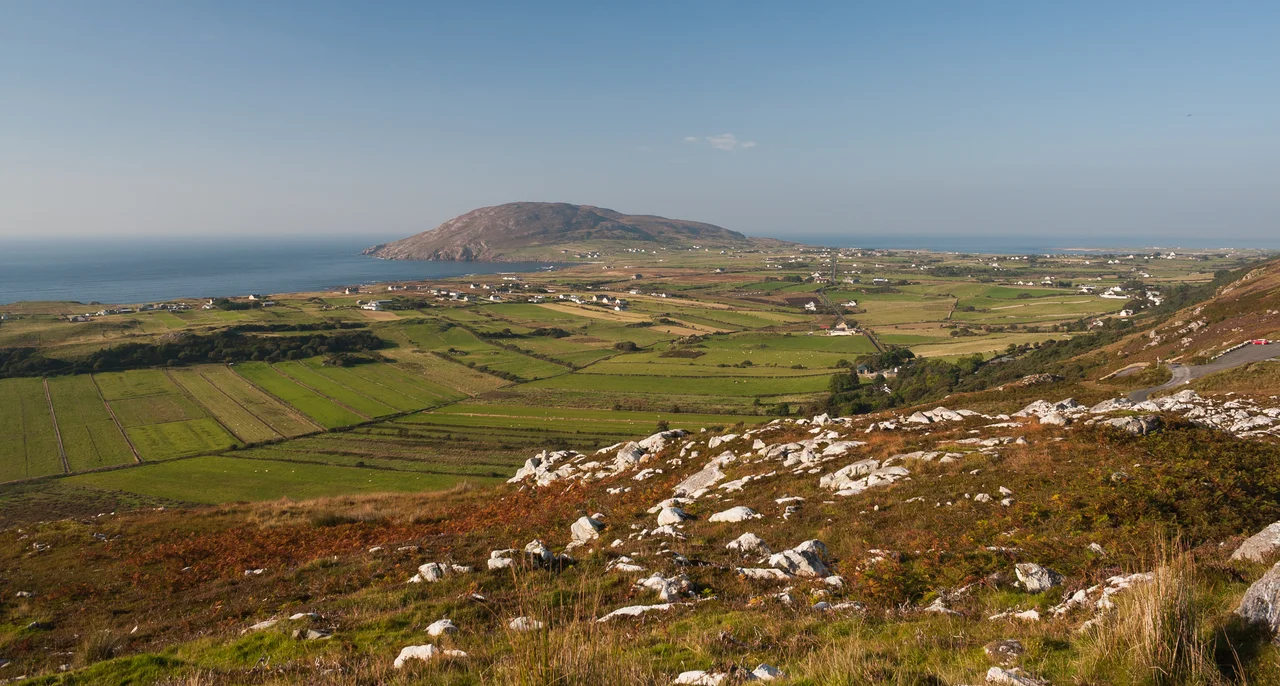

Urris
There are only two ways into Urris. From the south, the road climbs over the Mamore Gap, a narrow pass through the Urris Hills where a holy well sits seven hundred feet above the sea and pilgrims once circled seven heaps of stones throwing pebbles as they prayed. From the east, the road threads through Crossconnell. That is it. No other entrance. For three years in the early 1810s, the locals closed both. They posted scouts. They threw rocks down on the revenue police climbing Mamore. They barricaded Crossconnell. The valley they were defending was producing some of Ireland's most prized illegal whiskey, and they had no intention of giving it up to His Majesty's collectors.
The Poitin Republic
The Urris Hills were ideal for distillation. Surrounded by mountains, sparsely populated, but only sixteen miles from Derry, they offered cover and a market. In 1812 the producers organised. Scouts gave warning. Roads were barricaded. The authorities, frustrated, began levying township fines, collective penalties imposed on whole communities if poitin was suspected nearby. Innocent neighbours paid the bills of guilty ones. In May 1815, General Dalziel led a military force into the valley and the Republic ended. The term Poitin Republic was actually coined a century later, in the 1920s, when Inishowen storytellers gave the episode the name it has carried ever since. By 1818 the locals petitioned parliament for relief from the harsh fines that continued long after the stills were broken. Distillation continued anyway. It still does, quietly, locally.
Colonel McNeill and the Yowmen
In the early eighteenth century the valley lived in fear of a man called Daniel McNeill. He was a Scottish Planter who had fought at the Battle of the Boyne and in the defence of Derry, and he commanded a band of herdsmen the locals called the Yowmen. The records, gathered from local tradition, are unsparing: McNeill targeted young women in Urris. Women he wanted were forcibly taken to his house at Binion, where they were raped. When his victims became pregnant, McNeill granted them small portions of land called McNeills Roods, parcels of which can still be found scattered along the road to Clonmany. At the Pollen fair, the story goes, McNeill tried to abduct one local woman who escaped into the crowd. Returning home that evening, he was ambushed and killed by a group of local men. He died on 11 September 1709, aged fifty-nine, and was buried in Straid graveyard. The grave was still identifiable in the mid-nineteenth century.
Wolfe Tone, Off Dunaff
In November 1798, Theobald Wolfe Tone, leader of the United Irishmen rebellion that had been crushed earlier that year at Vinegar Hill and elsewhere, was captured by the Royal Navy off Dunaff Head at the mouth of Lough Swilly. He had returned from France with a small French expeditionary force, hoping to land troops and reignite the rising. The squadron was intercepted. Tone was taken to Dublin, tried, and sentenced to hang. He cut his own throat in his cell before the sentence could be carried out, dying of the wound a week later. The Inishowen coast where he was captured is now a quiet stretch of cliffs and pasture. The waters that swallowed his last hope of an Irish republic still slap the rocks the same way.
Casement Learns Gaelic
In 1904, the Irish nationalist Sir Roger Casement spent six months in Urris learning Gaelic. He lodged in a house in Tiernasligo. The valley had been the last bastion of Irish-speaking life on the Inishowen peninsula; in 1835 the surveyor John O'Donovan reported that the men, who travelled to fairs, spoke a little English, while the women and children spoke only Irish. An Irish College operated here in the early twentieth century. Native speakers were still common into the 1940s. Casement returned in 1913 to try to organise the Irish Volunteers within the valley. Three years later he was hanged for treason in Pentonville Prison after his attempt to land German weapons in Kerry for the Easter Rising. The house in Tiernasligo where he had lodged a decade earlier outlived him.
Six Men, Six Crashes, One Hill
At about three in the afternoon on 11 April 1941, a Vickers Wellington bomber of RAF 221 Squadron returning from a convoy escort patrol crashed into the Urris Hills at 770 feet. The pilot, Flying Officer Alfred Cattley, had become disoriented in thick fog and mistaken Lough Swilly for Lough Foyle while attempting a visual approach to RAF Limavady. All six crew were killed: Cattley, Pilot Officer James Montague, and Sergeants John Bateman, Francis Whalley, Frederick Neill, and Brinley Francis Badman. Irish Free State soldiers spent days reaching the wreck. In June 1942 a mine exploded at Urris, though no one was hurt. In 1962 three fishermen drowned off Binion Head when their lobster boat struck submerged rocks: Patrick Doherty, aged forty, and John McGilloway and his son John, aged fifty and twenty-four. The pattern of small Atlantic catastrophes that defines this coast did not stop with the wars.
From the Air
Centred near 55.26N, 7.41W, on the western side of Inishowen, sheltered behind the Urris Hills. Nearest airports are Donegal (EIDL) 30 nm south-southwest and City of Derry (EGAE) 22 nm south-east. From altitude, look for the Mamore Gap notching the ridge between the Urris Hills and Raghtin More mountain (502m). Lough Swilly opens north of the valley toward Fanad Head. The hills face northwest into Atlantic weather; expect rapid changes and frequent low cloud.
Nearby Stories
- German submarine U-155 (1941) 7 km away
- Grianan of Aileach 8 km away
- Tory Island 8.9 km away
- Greencastle Lifeboat Station 9.2 km away
- Dungiven 12 km away
- The Rosses 21 km away
- German submarine U-1005 23 km away
- Bruichladdich Distillery 49 km away