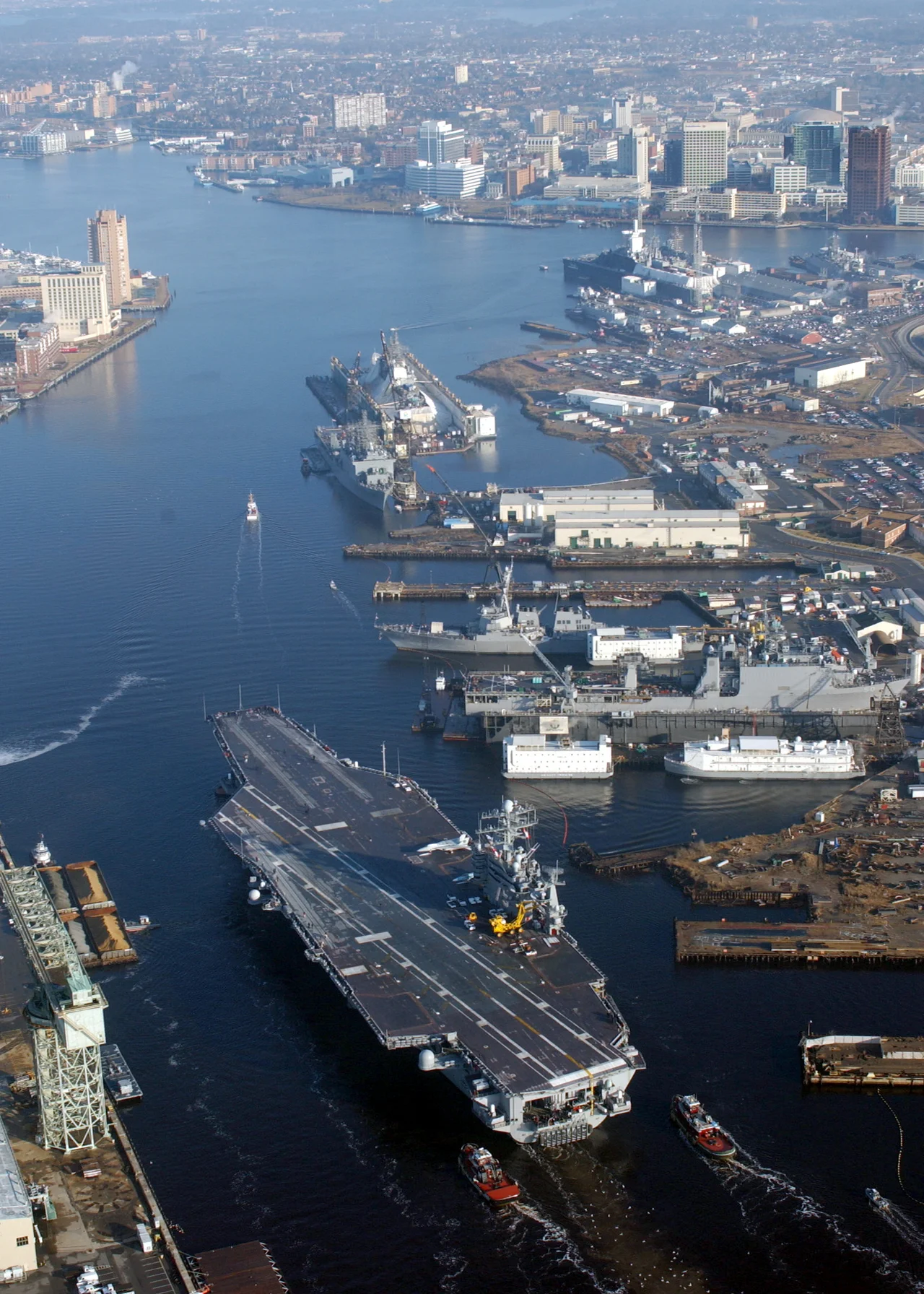

USS Harry S. Truman
There is a fragment of red cloth that flies from a halyard at the back of USS Harry S. Truman whenever she is at general quarters. Crossed cannons, a scarlet background, three words: "Give 'em hell." The phrase is a quote from Truman's 1948 re-election campaign - a heckler in the crowd shouted it at him, and the press caught the moment. The cannons come from the guidons of the 129th Field Artillery Regiment, in which Truman commanded Battery D during World War I. When a battery flag from the muddy fields of France becomes the battle flag of a 97,000-ton nuclear supercarrier, you have either a perfect tribute or a slightly unhinged one. The crew of CVN-75 think it is the former. They fly it often.
Built at Newport News
Her keel was laid at Newport News Shipbuilding on November 29, 1993. She was launched on September 7, 1996, and commissioned on July 25, 1998 at Naval Station Norfolk. President Bill Clinton gave the keynote address. The build cost was more than $4.5 billion in 2007 dollars. She is 1,092 feet long and 257 feet wide; her flight deck spans 4.5 acres. With a full combat load she displaces nearly 97,000 tons. She carries around 90 aircraft and a crew of 6,250 sailors. Two Westinghouse A4W nuclear reactors give her, in theory, three million miles of steaming range before refueling - effectively unlimited at the time scales the Navy plans around. Her propellers, four of them, each weigh 30 tons. Her anchor chains run in 360-pound links.
Twenty-Five Years of Deployments
Truman's operational history reads like a chronicle of the post-9/11 era. She flew the early 2003 strikes into Iraq from the eastern Mediterranean. She provided desalinated water for Hurricane Katrina relief on the Gulf Coast in September 2005. From 2015 into 2016 her air wing dropped 1,118 pieces of ordnance on ISIS targets, surpassing the previous deployment record. In 2018 she conducted dual-coast operations including the Trident Juncture NATO exercise in Norway. Through it all she has won the Battle E for combat effectiveness seven times, the Battenberg Cup once, and food-service awards under the Captain Edward F. Ney program in 1999, 2000, 2001, 2005, 2013, and 2025. The Truman wardroom is famously serious about its galley.
The Decommissioning That Did Not Happen
In February 2019 the Pentagon announced that Truman's mid-life refueling and complex overhaul - tentatively scheduled for 2024 - might be cancelled as a cost-saving measure, retiring the ship more than two decades ahead of schedule. The proposal would have left the carrier fleet at 10 ships, one below the level mandated by law, and it ran headlong into political resistance. President Donald Trump, who had pledged to grow the carrier fleet to 12, overrode the decision on May 1, 2019. The reprieve almost didn't matter - an electrical malfunction shortly afterward delayed Truman's scheduled deployment until late October 2019. She entered the 6th Fleet's area of operations on December 2, 2019. The carrier had been spared once. The next decade had not yet begun.
An Eight-Month Deployment
On September 23, 2024, Truman deployed for what would become one of the most operationally demanding cruises of her career. She entered the Oslofjord on November 1, transited the Suez Canal on December 14, and on December 21 began combat sorties against Houthi positions in Yemen as part of Operation Prosperity Guardian. The next day, an F/A-18F Super Hornet from VFA-11 was downed by friendly fire from one of her own escorts. Both crew members survived. On February 1, 2025, she launched 27 Super Hornets in what the Navy called its largest air strike ever - 124,000 pounds of ordnance dropped on ISIS-Somalia leaders in caves southeast of Bosaso. Eleven days later, in the Mediterranean near Port Said, she collided with the Panamanian merchant ship Besiktas-M shortly before midnight. There were no injuries, but the damage was significant. Her commanding officer, Captain Dave Snowden, was relieved a week later.
Under Attack
In March 2025 the Houthis began targeting the carrier directly with ballistic missiles, cruise missiles, and drones. Truman came under attack at least six times during her deployment. On April 28, while maneuvering hard during a Houthi attack, she lost an F/A-18E Super Hornet overboard from her hangar - the aircraft was being towed at the time and slid off the deck. On May 6, a second Super Hornet was lost when the arresting gear failed during landing. The pilots in both cases survived. She returned to Naval Station Norfolk on June 1, 2025, after an eight-month deployment that earned her crew the Combat Action Ribbon. Truman's battle flag is now one of the few in the modern Navy to have flown over an actively shooting carrier. The cloth is faded. The phrase still reads "Give 'em hell."
From the Air
USS Harry S. Truman's homeport is Naval Station Norfolk at 36.96N, 76.33W, on the south shore of Hampton Roads. When she is in port, look for an enormous aircraft carrier docked alongside the Naval Station's central piers, just inside the harbor entrance. Nearest airports: Naval Station Norfolk Chambers Field (KNGU) just northwest of the piers, Norfolk International (KORF) a few miles east. The base airspace is heavily restricted; civilian overflight requires specific coordination. When Truman puts to sea, check Notice to Mariners and the Navy's underway carrier schedules - she often transits south down the Atlantic before crossing east toward the Suez.
Nearby Stories
- Battle of Gloucester Point (1861) 3 km away
- Coast Guard Station Cobb Island 3 km away
- Flowerdew Hundred Plantation 11 km away
- Great Dismal Swamp 11 km away
- Cape Charles Lighthouse 14 km away
- False Cape State Park 17 km away
- Cactus Hill 29 km away
- Chowan University 35 km away
Sources
- USS Harry S. Truman - Wikipedia
- USS Truman conducted largest airstrike in Navy history - Navy Times
- USS Harry S. Truman collides with merchant vessel - USNI News
- F/A-18 Super Hornet Shot Down By Navy Cruiser - The Drive/The War Zone
- Super Hornet lost overboard USS Harry S. Truman - USNI News
- USS Harry S. Truman returns home - Stars and Stripes