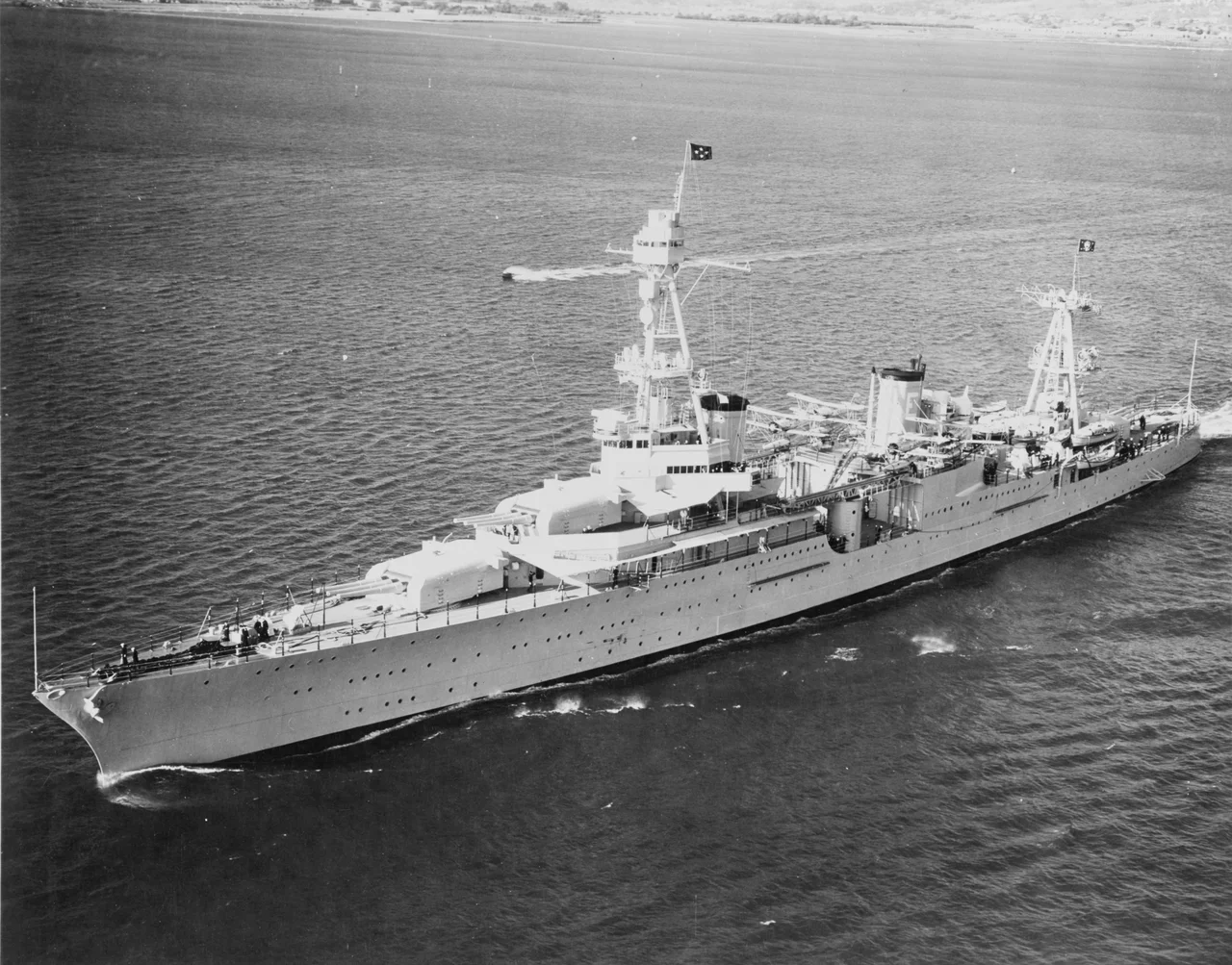
_off_San_Diego_in_October_1935.jpg)
The Galloping Ghost of the Java Coast
For nine months, no one knew what had happened to USS Houston. The heavy cruiser had vanished into the chaos of the Java Sea in early March 1942, and the Japanese weren't talking. Families waited. The Navy listed her crew as missing. Rumors circulated -- she'd been sunk, she'd escaped to Australia, she was hiding in some forgotten harbor. The truth would not emerge until war's end, when emaciated survivors stumbled out of Japanese prison camps and told the story of a ship that had fought until she had nothing left to fight with. The Japanese had nicknamed her the Galloping Ghost of the Java Coast, because no matter how many times they reported her sunk, she kept appearing on the horizon, guns blazing.
A President's Favorite Ship
Houston was born at Newport News Shipbuilding in Virginia, sliding down the ways on September 7, 1929, just weeks before the stock market crash that would define a decade. Commissioned on June 17, 1930, as a Northampton-class cruiser, she carried nine 8-inch guns in three turrets and could make 32 knots. Her namesake city embraced her: when she visited Houston, Texas, in October 1930, over 40,000 people toured the ship, and a downtown parade drew 100,000. She became flagship of the Asiatic Fleet in Manila, then flagship of the entire U.S. Fleet. President Franklin Roosevelt sailed aboard her multiple times, developing such an affection for the ship that he personally intervened to keep her stationed in the Pacific. By the late 1930s, Houston was the most famous warship in the American fleet -- a status that would make her loss all the more devastating.
Running South
When Japan struck on December 8, 1941, Houston was anchored off Iloilo in the Philippines, receiving fuel from barges. At 3:45 in the morning the message arrived: hostilities initiated. By that evening, Rear Admiral Glassford had flown in from Manila by PBY flying boat, and Houston was steaming south toward the Dutch East Indies, escorting a ragtag collection of auxiliaries to Borneo. What followed was a months-long fighting retreat across thousands of miles of contested ocean. Houston joined the hastily assembled ABDA fleet -- American, British, Dutch, and Australian ships thrown together under joint command, their crews unfamiliar with each other's signals and tactics. On February 4, 1942, during an air attack in the Battle of Makassar Strait, a 250-kilogram bomb struck Houston's aft turret. The explosion killed 48 men and permanently disabled the number three turret. Worse, much of Houston's 5-inch anti-aircraft ammunition proved defective -- shells that wouldn't fire when the ship needed them most.
Like a Sheet of Flame
Damaged but not defeated, Houston took on replacement ammunition at Tjilatjap -- 500 rounds of working 5-inch shells left behind by another cruiser -- and headed for Darwin to escort a troop convoy reinforcing Timor. On February 16, forty-four Japanese bombers and flying boats attacked the convoy in two waves. During the second wave, Houston's gunners found their rhythm with the new ammunition. Historian Samuel Eliot Morison described the barrage as making the ship look "like a sheet of flame." Seven of the forty-four attackers went down. The convoy was ordered back to Darwin anyway, as ABDA command suspected Japanese carriers lurking nearby. Houston and the destroyer USS Peary departed Darwin together to rejoin the fleet, but Peary broke off to chase a submarine contact. It was a fateful separation. The next morning, February 19, Japanese aircraft devastated Darwin in the same carrier strike force that had hit Pearl Harbor. Peary was among the ships sunk. Houston, already miles away, escaped by sheer chance.
Last Stand in Sunda Strait
The end came in stages. On February 27, Admiral Karel Doorman led his multinational force -- including Houston and the Australian cruiser HMAS Perth -- against a superior Japanese fleet in the Battle of the Java Sea. It was a catastrophe. Doorman went down with his flagship. The surviving Allied ships scattered. Houston and Perth, low on ammunition and fuel, made for Sunda Strait on the night of February 28, hoping to slip through to the Indian Ocean. Instead, they sailed directly into a Japanese invasion fleet. What followed was a close-range night battle against overwhelming numbers -- heavy cruisers, destroyers, and transports. Houston fought until her ammunition was exhausted, then kept fighting. She absorbed torpedo after torpedo. When she finally rolled over and sank in the early hours of March 1, 1942, her crew had been firing star shells and practice rounds because they had nothing else. Of her complement of roughly 1,070 men, only 368 survived to be captured. They would spend the rest of the war in Japanese prison camps.
A Bell Recovered
Houston's wreck lies in the shallows of Sunda Strait, not far from where Perth went down the same night. For decades the wrecks were known to local divers but officially unconfirmed. In 1973, Houston's bell was unofficially raised from the wreck and passed through several hands over the years before coming to rest on a plinth in a park in Houston, Texas -- a city that never forgot its ship. In 2014, the U.S. Navy formally identified the wreck site. A year later, American and Indonesian Navy divers conducted a nine-day survey, documenting the condition of both Houston and Perth, which had suffered from unauthorized salvaging. The survey data was presented at a conference in Jakarta focused on preserving wartime shipwrecks in the Java Sea. The cruiser that once hosted presidents and drew parade crowds of 100,000 now rests in tropical waters, a war grave and a reminder that the early months of 1942 demanded sacrifice on a scale the American public would not fully understand until the survivors came home.
From the Air
The wreck of USS Houston lies at approximately 5.81S, 106.13E in the Sunda Strait between Java and Sumatra, Indonesia. The site is in relatively shallow water near Banten Bay on the northwest coast of Java. Nearest major airport: Soekarno-Hatta International (WIII), approximately 90 km to the east in Tangerang. The Sunda Strait is visible as the narrow passage between Java and Sumatra, with heavy ship traffic. Anak Krakatau volcano is visible roughly 50 km to the southwest. At low altitude, the coastline of Banten province and the port of Merak are visible landmarks.
Nearby Stories
- The Eye of Krakatoa 2.7 km away
- Four Minutes Over the Java Sea 9.8 km away
- Locked Doors at 1:45 AM 14 km away
- Anak Krakatoa 24 km away
- The Crossing at Silebu 27 km away
- Way Kambas National Park 81 km away
- 1933 Sumatra Earthquake 86 km away
- Battle of the Java Sea 501 km away