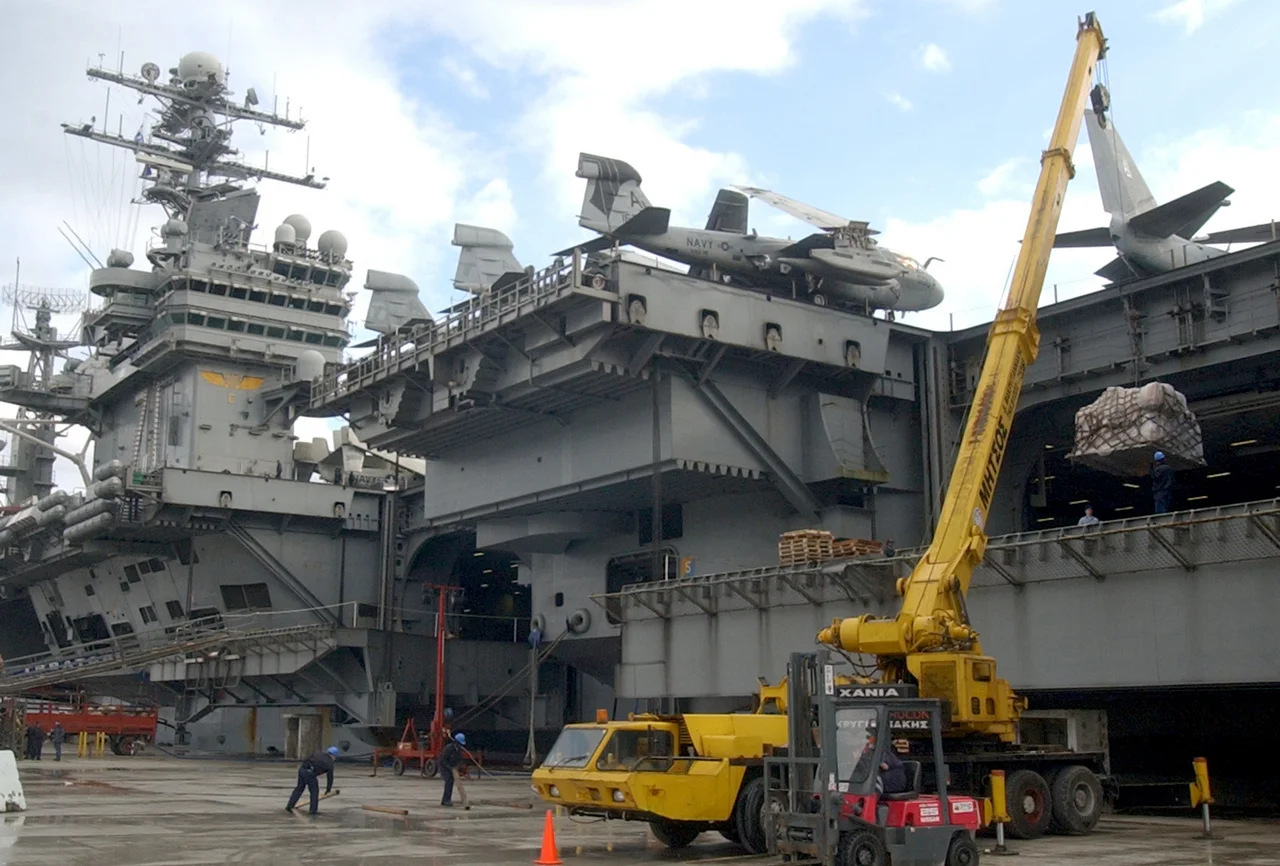

USS Theodore Roosevelt (CVN-71)
Brett Crozier sent the email on March 30, 2020. By then more than 100 of his sailors were infected with a new coronavirus the world had only known about for ten weeks, and his ship was tied up at Guam with nowhere to put them. The captain of USS Theodore Roosevelt wrote that he needed the carrier evacuated to save lives. He sent the email to ten Pacific Fleet admirals and captains, including his immediate superior. He did not send it through the encrypted Navy system. He did not send it only up his chain of command. Three days later he was relieved of command. Four days after that, the acting Secretary of the Navy who fired him flew to Guam, gave a profanity-laced speech mocking Crozier to the assembled crew, was heckled, and resigned within hours of the recording leaking to the press. The ship's name was Theodore Roosevelt. The crisis was, in many ways, the kind of moment the 26th president would have recognized.
The Carter Veto
Her authorization was an act of political reversal. President Gerald Ford cancelled the order for CVN-71 in 1976 and substituted two smaller conventional carriers. President Jimmy Carter then vetoed the Fiscal Year 1979 Defense authorization bill because it included a new Nimitz-class supercarrier. The Iran hostage crisis changed his mind. The increased need for carrier battle groups in the Indian Ocean overrode his concerns about cost, and CVN-71 was authorized under the FY1980 bill. A contract was awarded to Newport News Shipbuilding on September 30, 1980 for "Hull 624D." Secretary of Defense Caspar Weinberger laid the keel on October 31, 1981, initiating the first weld himself. Secretary of the Navy John F. Lehman announced the ship's name three days later. She was christened on October 27, 1984 by Barbara Lehman, the secretary's wife, and commissioned at Newport News on October 25, 1986.
Rough Rider in the Gulf
Her call sign, "Rough Rider," comes from the volunteer cavalry unit Theodore Roosevelt led up Kettle Hill during the Spanish-American War in 1898. The carrier earned the name in her first combat. On December 28, 1990 she deployed with Carrier Air Wing Eight for Operation Desert Shield, arriving in the Persian Gulf on January 16, 1991. When Desert Storm began the next day she launched into the fight. Her air wing flew 3,897 combat sorties before the cease-fire on February 28 - more than any other carrier in the war - and dropped more than 4.8 million pounds of ordnance. When the Iraqi army turned on the Kurds, Theodore Roosevelt and CVW-8 were among the first coalition forces flying Operation Provide Comfort patrols over northern Iraq. She returned to Norfolk on June 28, 1991, after 189 days deployed, 176 of them at sea. She won the Battle E that year, and the Battenberg Cup as the Atlantic Fleet's premier ship.
160 Days at Sea
Eight days after the September 11 attacks, Theodore Roosevelt deployed again - this time with Carrier Air Wing One. She arrived in the North Arabian Sea on October 15, 2001 and began launching strikes into Afghanistan as part of Operation Enduring Freedom. From the day she left Norfolk to her first liberty call in Bahrain on February 27, 2002, she spent 160 consecutive days at sea - the longest continuous underway period for a U.S. Navy ship since World War II. The crew earned the Navy Unit Commendation, the 2001 Battenberg Cup, and the 2001 Battle E. The 2003 cruise saw her launch the opening strikes of Operation Iraqi Freedom on March 22 from the eastern Mediterranean, flying alongside USS Kitty Hawk. Strike Fighter Squadron 201 from NAS JRB Fort Worth deployed as part of CVW-8 - the first Naval Reserve squadron aboard an aircraft carrier since the Korean War.
The Pandemic
On March 24, 2020, three sailors aboard Theodore Roosevelt tested positive for COVID-19. Within a week the number was over 100. On March 30, Captain Crozier sent his email pleading for evacuation. The Navy ordered the carrier emptied with a skeleton crew of 400 to maintain the nuclear reactor, fire-fighting equipment, and galley. On April 2, acting Navy Secretary Thomas Modly relieved Crozier of command. Modly resigned on April 7 after his Guam speech leaked. By Easter Sunday on April 12, 585 crew members had tested positive. A chief petty officer named Charles Robert Thacker Jr. died on April 13, the first U.S. service member to die from COVID-19. By the time initial testing was completed on April 27, 969 sailors had tested positive. The final analysis in December 2020 found 1,271 confirmed cases - and an asymptomatic rate of 76.9 percent, data the CDC used to understand how the virus moved through close quarters. A second chief petty officer suffered an undisclosed medical emergency on the way home and died on July 2, 2020. Captain Crozier was never reinstated.
Return to Service
In July 2021 the ship was moved from her San Diego homeport to Bremerton, Washington, where she was retrofitted to operate the F-35C Lightning II. About 3,000 sailors and their families moved with her. She left Bremerton for sea trials in March 2023 and eventually returned to San Diego. In January 2024 she deployed from Naval Air Station North Island. On March 19, 2024, a Super Hornet from Carrier Air Wing 11 made the 250,000th successful arrested landing on her deck. Later that summer she conducted joint operations with the Indian Navy in the Indian Ocean before returning home on October 14, 2024 - 278 days deployed. She was built at Newport News, and she will likely come back here for her next major overhaul. Aircraft carriers spend their lives in motion. They always come back to the yard that built them.
From the Air
USS Theodore Roosevelt's current homeport is Naval Air Station North Island in San Diego, but she was built and launched at Newport News Shipbuilding at 36.96N, 76.33W, and she returns to Hampton Roads for major maintenance. When in port at Norfolk look for an enormous aircraft carrier docked at the Naval Station piers. Nearest Hampton Roads airports: Naval Station Norfolk Chambers Field (KNGU) just northwest, Norfolk International (KORF) east, Newport News/Williamsburg (KPHF) across the harbor to the north. Carrier piers and shipyard waters are restricted.
Nearby Stories
- Battle of Gloucester Point (1861) 3 km away
- Coast Guard Station Cobb Island 3 km away
- Flowerdew Hundred Plantation 11 km away
- Great Dismal Swamp 11 km away
- Cape Charles Lighthouse 14 km away
- False Cape State Park 17 km away
- Cactus Hill 29 km away
- Chowan University 35 km away