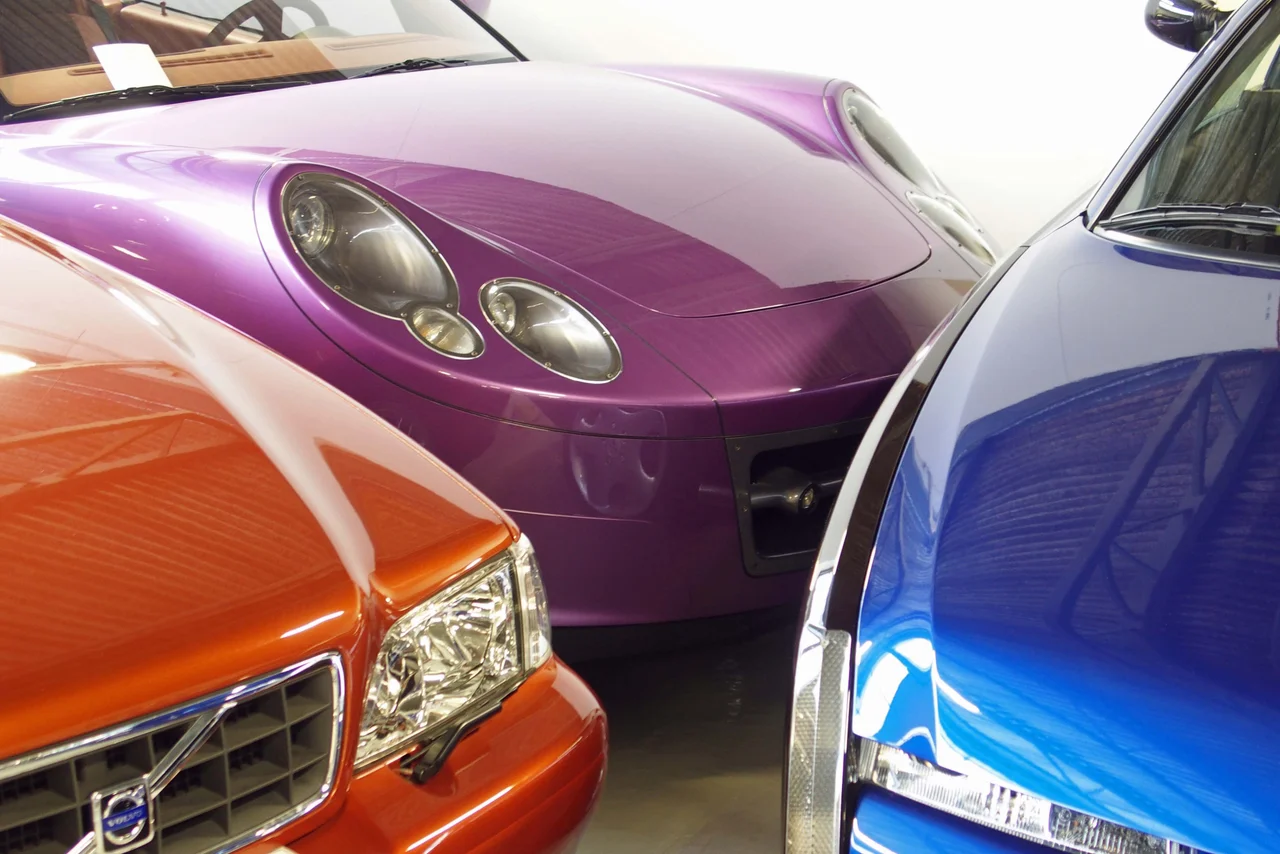

Uusikaupunki Automobile Museum
On 1 May 1913, at an agricultural machinery works in the village of Korvensuu in Mynämäki, Frans Engelbert Lindström's men finished a car. It had a ten-horsepower air-cooled two-cylinder engine, side valves on the exhaust and atmospheric inlet valves that answered to nothing but suction, and almost every component had been made in Finland. It was built to show what the factory could do. Nobody built a second one. That prototype, generally reckoned the first car manufactured in Finland, has sat since 2008 about thirty kilometres northwest of where it was made, in a museum hall a few hundred metres from a plant that has since assembled more than 1.9 million cars.
The Car That Was Never Built Twice
The Korvensuu is easy to underestimate. It looks like what it is, a machine shop's demonstration piece, closer in spirit to a threshing machine than to anything from Stuttgart. But look at the year. In 1912 and 1913, when Lindström's works designed and built it, there was no Finnish automotive industry to draw on, no supplier network, no precedent, and no domestic market worth the name. Making a running car from local parts in an agricultural machinery factory was less an act of manufacturing than an act of argument. Lindström was making a case that Finland could do this. The commercial answer at the time was no, and the Korvensuu stayed a single prototype. A century later it sits inside the country's most emphatic rebuttal.
An Automotive Industry City
The museum exists because a factory manager wanted his town's identity written down. In 1982 Juhani Linnoinen, then chief executive of Oy Saab-Valmet Ab, proposed a car museum for Uusikaupunki on the grounds that it had become, in his words, an automotive industry city. It was not a boast so much as a description; by then the plant had been turning out Saabs for over a decade and the town's payroll ran through it. The factory offered to rent part of its own site for the building. Uusikaupunki's council approved the plan in January 1983, and the doors opened to the public at the beginning of February 1984. Very few car museums are built next door to a working assembly line by the people running it.
The Saab Room
One section belongs entirely to Saab, and this is the part that visitors from Sweden tend to stand in for a long time. Between 1969 and 2003 the plant across the fence built 95s, 96s, 99s, 90s, 900s and 9000s, the 900 and 9-3 convertibles, the 9-3 Viggen, and the long-wheelbase Finlandia and 900 CD variants made for Finnish officialdom. Every one of those bodies passed through a hall you can see from the museum car park. The marque left Uusikaupunki in 2003, and the collection is now the closest thing this town has to a family album of thirty-four years of work. It is not a nostalgia display arranged by outsiders. The people who assembled these cars live here.
Mopeds, Motorcycles, Two Aeroplanes
Beyond the Saabs the collection widens out considerably, in the way that collections built by enthusiasts always do. Three exhibition halls hold roughly a hundred cars, a run of mopeds, a handful of motorcycles, and, for reasons that make sense only once you accept that the line between machines is thinner than museums usually admit, two aeroplanes. The mopeds may be the most quietly historical objects in the building: for a generation of Finns growing up in small coastal towns, a moped was the first thing you owned that could take you somewhere, and their design history is a history of what ordinary people could afford. Unlike most Finnish museums outside the cities, this one is open all year round.
The Workshop at the Back
There is a restoration workshop attached, handling maintenance, restoration and upholstery for vintage cars. That detail says more about the place than the exhibit list does. A museum with a working shop is not primarily in the business of display; it is in the business of keeping machines alive, which requires people who can still cut and stitch a seat cover, true a wheel, and read a 1930s wiring diagram. In a town whose entire modern history is the practical skill of building complicated things well, putting a workshop behind the exhibition halls is the most honest possible statement of what is actually being preserved here. Not the cars. The hands.
From the Air
60.811°N, 21.447°E, on the northeastern edge of Uusikaupunki, immediately adjacent to the Valmet Automotive plant. From the air the museum is a small cluster of halls at the corner of a very large industrial complex, and the way to find it is to locate the plant's long pale roofline and the car storage lots first, then look to the northern edge. The Bothnian Sea coast and the wooden Empire-style town centre lie about 3 km west. Turku (EFTU) is roughly 65 km southeast and Pori (EFPO) about 75 km north. Flat coastal terrain with no obstacles of note. Visibility is usually good year-round apart from winter ice fog drifting inland off the sea, which tends to sit over the industrial area at low level.
Nearby Stories
- Turku Castle 5.8 km away
- Kurjenrahka National Park 13 km away
- Old Rauma: Six Hundred Wooden Houses, Still Occupied 16 km away
- Köyliönjärvi 18 km away
- Archipelago Sea 20 km away
- Sigyn (ship) 34 km away
- Battle of Bomarsund 75 km away
- 1971 Söderhamn Courthouse Murders 219 km away