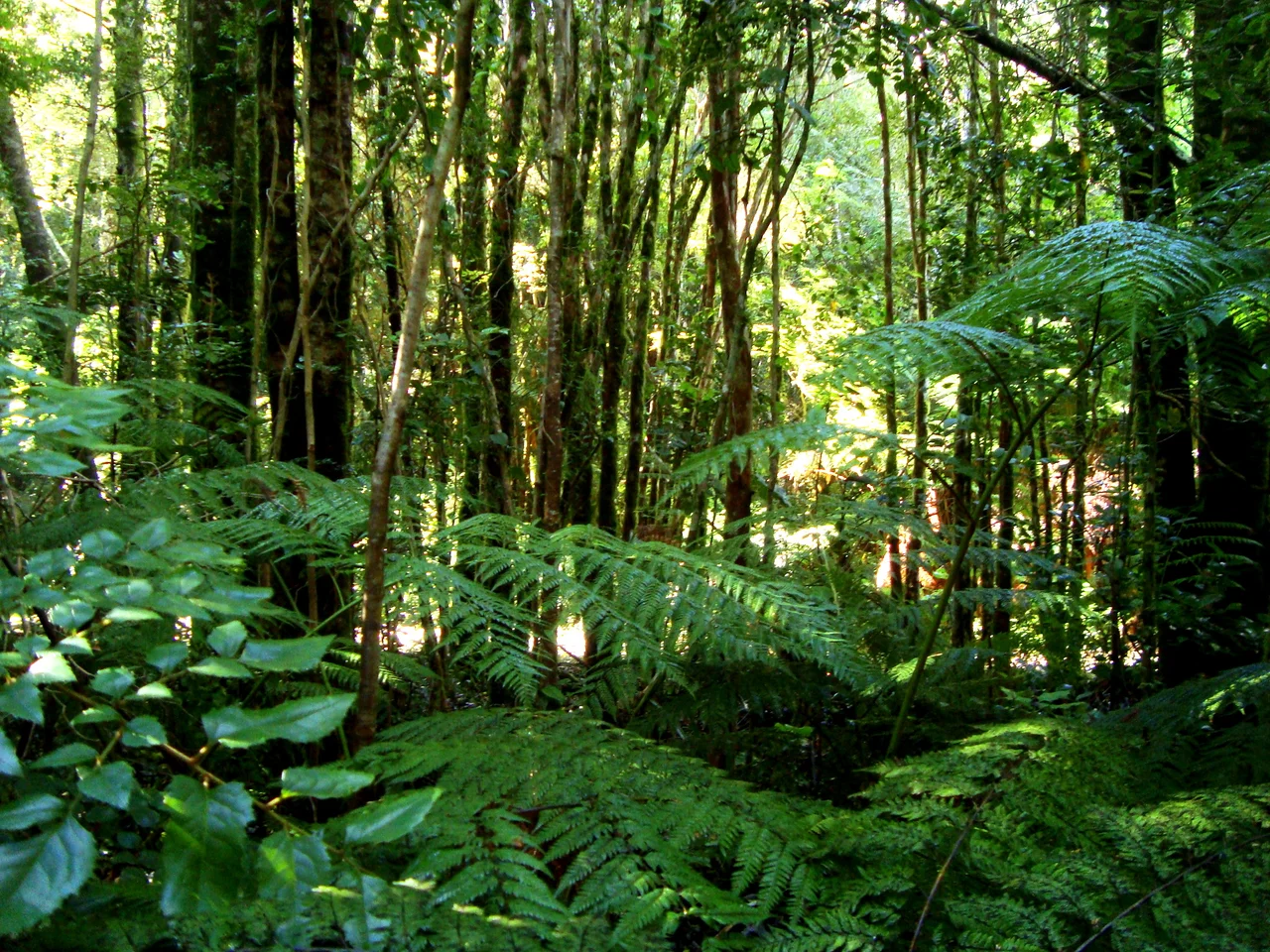

Valdivian Temperate Forests
Some of these trees were already a thousand years old when the Roman Empire fell. In a damp ravine in southern Chile stands an alerce called Gran Abuelo—the great-grandfather—whose growth rings were counted in 1993 to 3,622 years, making it one of the oldest living things ever measured. It belongs to the Valdivian temperate forests, a narrow green strip pinned between the Pacific and the Andes where rain falls in extraordinary quantity and life has gone its own way for millions of years. Walled off from the rest of South America by desert to the north, mountains to the east, and dry steppe beyond, this forest became an island on land—and islands breed wonders.
A Forest in Isolation
Geography made the Valdivian forest a sanctuary. It runs as a coastal band from roughly 37 to 48 degrees south, hemmed between the ocean and the southern Andes. To the north, the Atacama—the driest desert on Earth—forms an impassable wall. To the east rise the Andes and, beyond them, the rain-shadow steppe of Patagonia. Cut off on every side from the tropical forests that blanket the rest of the continent, the Valdivian woods evolved in relative isolation, accumulating a remarkable share of species found nowhere else. South of the 42nd parallel the very land dissolves: the coastal range breaks into a chain of islands, including Chiloé, while the central valley sinks beneath the sea to become the Gulf of Corcovado.
Where the Rain Never Stops
This is rainforest in the truest sense, drenched by winds that have crossed thousands of miles of open ocean. The westerlies sweep in off the Pacific heavy with water vapor, then slam into the windward slopes of the Coast Range and the Andes, wringing themselves out as they climb. Annual rainfall ranges from about a meter at the forest's northern edge to more than six meters in the south—an astonishing deluge that feeds dense understories of bamboo and fern beneath a canopy of evergreen trees. Much of this land was buried under ice during the last glaciation, and the lakes that give Chile's Lake District its name are the flooded ghosts of those vanished glacial valleys.
Living Fossils and Tiny Giants
The creatures here read like a naturalist's fever dream. The monito del monte, a small arboreal marsupial, is the sole survivor of an order otherwise extinct for millions of years—a true living fossil that links the marsupials of South America to those of distant Australia. Sharing the same wet woods is the southern pudú, the smallest deer on Earth, standing barely knee-high, and the kodkod, South America's smallest wild cat. Overhead, the slender-billed parakeet—found nowhere else—wheels through the canopy, while hummingbirds work the red bells of the copihue, Chile's national flower. To walk this forest is to meet evolution's quieter, stranger experiments, run in isolation and left alone.
The Fight to Keep It
Antiquity offers no protection from a chainsaw. The Valdivian forest's greatest treasures—the towering alerce and the southern beeches called Nothofagus—are also its most vulnerable, felled and often shipped abroad as woodchips, the cleared ground replanted with fast-growing pine and eucalyptus for the pulp industry. But the tide has begun to turn. In November 2003, a coalition of conservation groups bought roughly 600 square kilometers of rich rainforest at the auction of a bankrupt logging company. Today about a quarter of the ecoregion sits within protected areas, public and private, and a growing ecotourism economy gives the standing forest a value beyond its lumber. The oldest trees may yet outlast the threat—as they have outlasted empires.
From the Air
The Valdivian temperate forests stretch along the coast of southern Chile and into Argentina, roughly 37°S to 48°S; this entry is anchored near 41.33°S, 73.66°W, in the heart of the Chilean Lake District near Chiloé. From the air, the ecoregion is unmistakable: a deep-green band of dense forest between the blue Pacific and the snow-capped Andes, threaded with glacial lakes, fjords, and the island chains of the south. The nearest major airport is Aeropuerto El Tepual (SCTE) at Puerto Montt; Aeropuerto Pichoy (SCVD) at Valdivia serves the northern part of the region. Expect frequent cloud and rain—this is one of the wettest places on the continent—with clearest flying in the southern summer (December–February). Recommended viewing altitude is 6,000–10,000 feet to take in the forest, lakes, and mountains together.
Nearby Stories
- Frutillar 5.5 km away
- Puerto Varas 15 km away
- Battle of Agüi 25 km away
- Sinking of Janequeo and Leucotón 32 km away
- Pumalín Douglas Tompkins National Park 115 km away
- Parque Tantauco 173 km away
- 1687 Peru Earthquake 2887 km away
- The Nazca Lines: Art Made for the Sky 2966 km away