.jpg)
Vance Monument
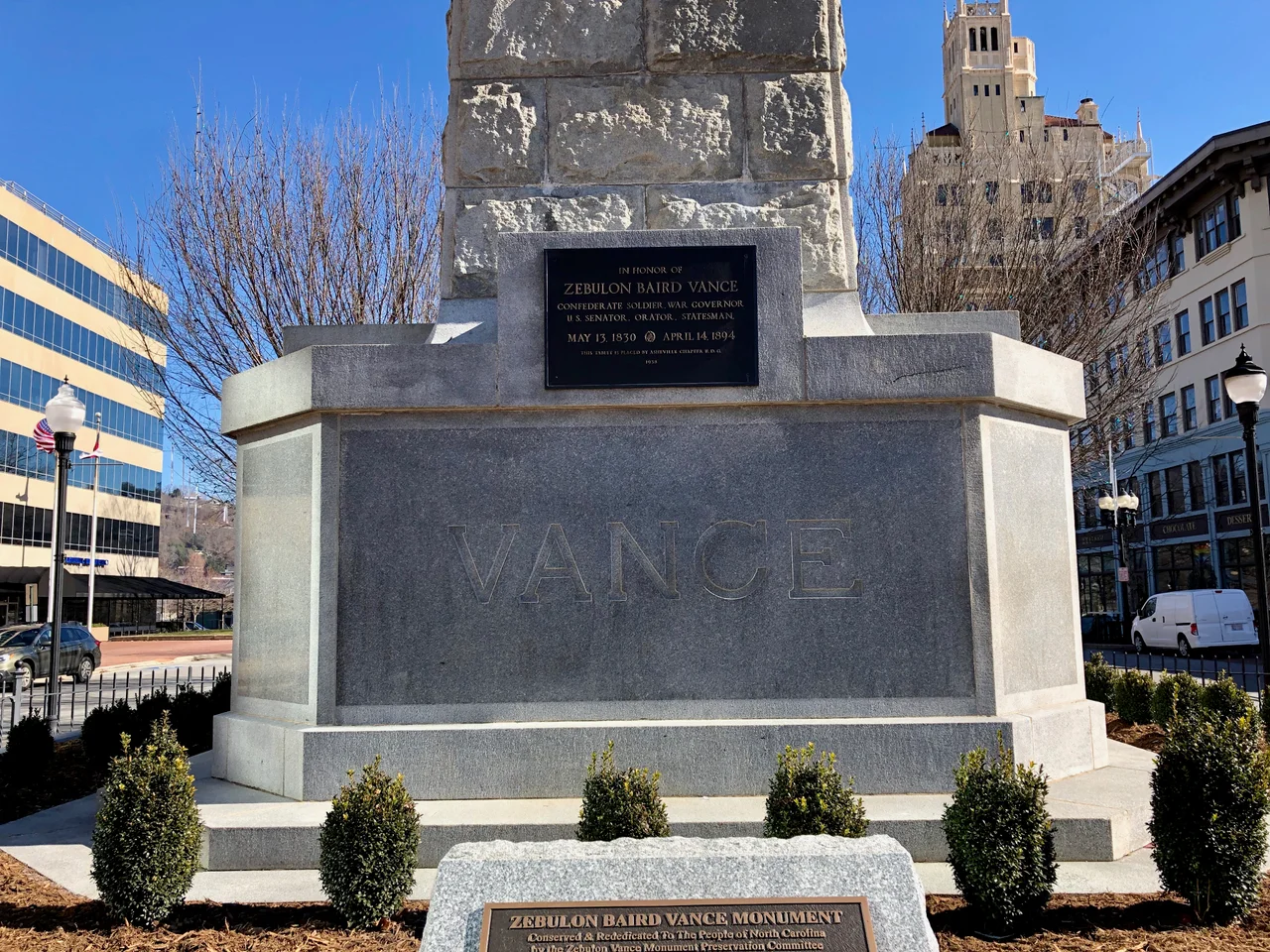
Zebulon Baird Vance was born in a log cabin in Buncombe County, twelve miles south of Asheville, in 1830. He went to Congress before the Civil War, served as North Carolina's governor during it, and ended up in the United States Senate after it. On the floor of the House in March 1860 he said this: "Plainly and unequivocally, common sense says keep the slave where he is now - in servitude." He was a slaveholder. He was also, by some accounts, a popular orator and a defender of Jewish North Carolinians against the antisemitism of his era. The granite obelisk that stood in downtown Asheville from 1898 to 2021 tried to honor all of that at once. Eventually the city decided it couldn't.
Building an Obelisk for $3,326
The Vance Monument Association formed in the 1890s with a clear goal: a memorial in the form of a single granite shaft, fashioned after the Washington Monument, on the public square in downtown Asheville. They raised $3,326 - about $130,000 in today's dollars - mostly from George Willis Pack, a wealthy New Yorker who'd moved to Asheville and donated $2,000 on the condition that Buncombe County dedicate the site in perpetuity. Other money came from Jewish organizations grateful for Vance's defense of religious tolerance, and from businessmen in Pennsylvania, Maryland, and Massachusetts. Richard Sharp Smith - the English architect best known for supervising Vanderbilt's Biltmore House - donated his design services. Contractor James G. Colvin of Asheville built the obelisk for $2,758. Cornerstone laid December 22, 1897. Dedication on May 10, 1898.
The Monument and the City's Black Past
The ground the obelisk stood on had another history, less visible but more painful. The land had once held the county jail. The square nearby had hosted slave auctions, where enslaved people were sold and their bills of sale recorded in the courthouse. No marker acknowledged any of this. *The Colored Enterprise*, an Asheville newspaper of the 1890s, covered the monument's construction with a mix of irony and resignation. African American residents lived and worked in the shadow of a tribute to a man who had publicly insisted on their continued enslavement. The monument's planning committee had ordered 1,000 club buttons in 1897 featuring Vance's portrait alongside the words "white supremacy." The obelisk's official inscription was just the single word VANCE, engraved on each of the pedestal's four polished panels.
The Long Argument
By the early 2000s the question of the monument's place was openly contested. The North Carolina General Assembly created an African American Heritage Commission in 2008. A coalition of Asheville activists - the Center for Diversity Education, Carolina Jews for Justice, the Interdenominational Ministerial Alliance, Masonic Lodge Venus No. 62 - asked the Public Art Board to commission a new work nearby that would acknowledge the site's role in the slave trade. A petition circulated. The city took no action. On June 23, 2015, somebody painted "Black Lives Matter" across the monument's nameplate. The paint was cleaned off. Nobody was arrested. The argument continued.
After George Floyd
In June 2020, after George Floyd's killing in Minneapolis triggered nationwide demonstrations against police violence and Confederate iconography, Asheville and Buncombe County passed a joint resolution. The United Daughters of the Confederacy had 90 days to remove their plaques. A twelve-member task force would decide the monument's fate. On July 8 city workers began shrouding the obelisk in fabric to reduce its visibility. That night someone set off what the bomb squad described as a pipe-bomb-style improvised explosive device at the base; a drone captured the explosion and a person spray-painting the pedestal. A Civil War re-enactment group from Rutherfordton sued to halt demolition, citing the $140,000 they'd raised toward restoration. The case wound through state courts. In March 2024 the North Carolina Supreme Court ruled in Asheville's favor.
What Comes Down, What Stays
Demolition began May 17, 2021. The granite obelisk was completely removed by the next day. Work stopped for wind. By May 30, only the pedestal remained, with plans to remove it in stages. A second court order paused work briefly. The total cost was about $115,000 - roughly what restoration would have cost a decade earlier. The stone blocks are still in storage; contract terms restrict their sale or reuse. The city plans an inclusive square on the site, something that names the history of the place rather than monumentalizing one man's version of it. Pack Square, where the obelisk stood, remains the geographic center of downtown Asheville. What's missing now is conspicuous. So is what was missing before.
From the Air
Coordinates 35.5951° N, 82.5515° W, dead-center downtown Asheville at Pack Square. Nearest airport is Asheville Regional (KAVL) about 10 nm south-southeast; Hickory Regional (KHKY) about 65 nm east, Greenville-Spartanburg (KGSP) about 55 nm south. Recommended viewing altitude 3,500-5,000 ft AGL. Pack Square is the open plaza at the convergence of Patton Avenue and Biltmore Avenue; the obelisk is gone but the square remains a clear visual landmark within the downtown grid.
Nearby Stories
- Hendersonville, North Carolina 2.2 km away
- Forest City, North Carolina 4 km away
- North Carolina Mountains 7.7 km away
- Chattooga River 27 km away
- Grandfather Mountain 30 km away
- Joara 30 km away
- Great Smoky Mountains National Park 41 km away
- Knoxville: The Gateway to the Smokies Where Tennessee Began 87 km away