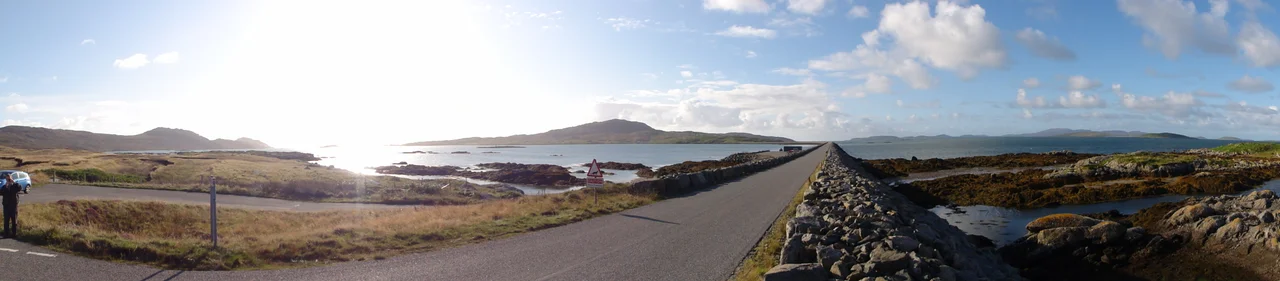

Vatersay Causeway
The bull drowned in 1987. That was the moment the Vatersay islanders stopped asking and started insisting. For decades they had swum their cattle across the Sound of Vatersay to Barra, because there was no other way. When the practice was revived after a livestock barge was decommissioned, it ended in tragedy in the strong tidal currents of the sound. Two years later, contractors began work on a 250-metre causeway that would change Vatersay forever.
The Last Hebridean Island Without a Link
By the late 1980s Vatersay was the only inhabited Hebridean island without either a vehicular ferry or a causeway. Berneray had one. Eriskay had one. Scalpay had one. Vatersay had a passenger ferry from Castlebay on Barra, which made the transport of goods and livestock and emergency cases laborious and expensive. The population had fluctuated wildly over the century, peaking at 288 in 1911 after the Vatersay Raiders had opened the island to crofters, and falling to 65 by 1988. The Vatersay Co-operative, set up in 1983, had used a barge from the Highlands and Islands Development Board to move livestock. When that barge was decommissioned, the old practice of swimming cattle resumed.
The Sound of Vatersay
The strait between Vatersay and Barra is 250 metres wide at the chosen crossing point, with a minimum depth of 11 metres. It joins the Atlantic Ocean on the west to the Sea of the Hebrides on the east, and the tidal currents through it are formidable at every state of the tide. A short-crossing ferry was rejected because of the cost of a deepwater terminal and because the ferry would still need to call at Castlebay for fuel. A bridge would have been ruinously expensive to build and maintain. After much debate the simplest option won. They would build a rock causeway, 250 metres long, straight across the sound, and accept the engineering challenge of placing it in water that fast and that deep.
Funding and Construction
The Western Isles Islands Council Vatersay Causeway Order Confirmation Act 1987 cleared the legal path. The 3.7 million pound cost was met in three parts. The European Regional Development Fund contributed half. The Scottish Development Department contributed a quarter. Comhairle nan Eilean Siar, the Western Isles council, contributed the final quarter. The contract went to R. J. McLeod Contractors Ltd in 1989. The work took eighteen months and included a two-kilometre access road across Barra. A local quarry at Beinn Tangabhal supplied the bulk of the 220,000 tonnes of rock that went into the causeway, tipped into the strait in carefully controlled layers to fight the tide. In July 1991 the causeway opened to traffic.
Connected at Last
Children on Vatersay now ride the school bus to Castlebay Community School. Crofters move cattle in lorries. Ambulances can reach the island within minutes of dispatch from Barra. The Castlebay ferry handles the longer journey to the Scottish mainland. The Eriskay causeway followed in 2001, completing a chain of fixed links that now joins much of the southern Outer Hebrides. Vatersay's population stabilised, then grew slightly. The causeway did not abolish island life. It simply removed the part of island life that involved bulls swimming for the mainland and people not being able to get a vet, a priest, or a doctor when one was needed. It is a small piece of infrastructure that changed everything.
From the Air
The causeway is located at approximately 56.9468 N, 7.5325 W, crossing the Sound of Vatersay between Vatersay to the south and Barra to the north. The 250-metre causeway is easily visible from the air as a straight rock dam across the sound. Recommended altitude 1,000-2,000 ft for detail. Approach from the west over the Atlantic for a dramatic view of the causeway against open ocean. Nearest airports: Barra (EGPR) approximately 5 nm north on Traigh Mhor beach, Benbecula (EGPL) approximately 53 nm north. The tidal currents through the sound remain strong; expect turbulence in low-level passes.
Nearby Stories
- German submarine U-722 7.3 km away
- Cladh Hallan 10 km away
- HMS Sturdy (1919) 13 km away
- SS Polonia 28 km away
- Canna 36 km away
- SS Athelstane (1941) 78 km away
- St Kilda, Scotland 82 km away
- German submarine U-516 102 km away