
Vefsn Municipality
In 1866 an English company arrived in the Vefsn valley to buy trees. Engelskbruket, people called it - the English works - and for a little over thirty years the spruce and pine of inland Helgeland went out through the sawmills and down the fjord to the wider world. When the boom collapsed around 1899, the ledger read strangely. The little port at the mouth of the river had grown rich on it. The valley behind had been logged hard, and farmers who sold up rather than watch their woods disappear had already drifted downriver to the town. Vefsn has spent the century since working out what to do with that inheritance.
A Municipality Cut to Pieces
Few places in Norway have been redrawn as often. Vefsn was established as a municipality on 1 January 1838, and then the subtraction began. In 1862 the vast eastern district, 921 people, left to become Hattfjelldal. In 1876 the port town of Mosjøen, all 379 residents of it, was carved out as a town-municipality of its own - the first town on Helgeland, and the only one for nearly half a century. In 1927 the remainder was split three ways: Drevja to the north, Grane to the south, and 3,119 people left holding the name. Not until 1962 was the district reassembled, when Mosjøen, Drevja and Elsfjord were folded back in. The reunited municipality inherited Mosjøen's coat of arms - a white rooster on black, claws and comb picked out in red, designed by Arthur Gustavsson and adopted by the town in 1960. The rooster stands for watchfulness. Given the history, it seems well chosen.
Knutlia
German forces took Mosjøen on 11 May 1940, a month after the invasion, and made it their headquarters for Helgeland. The town itself came through the war almost untouched - one of the few in Northern Norway never bombed. The countryside around it did not. At Knutlia, in what was then Elsfjord, the occupiers ran Lager Osen, one of the camps holding Yugoslav prisoners, most of them Serbs, shipped north to build roads and railway for an army that regarded them as expendable. At least 425 of the men held at Osen were killed. They had names, homes and families a thousand miles south, and almost no records of them survived the war, because the camp administrations destroyed what they could. In 1975 Vefsn signed a friendship agreement with Gornji Milanovac in Serbia, and it is dated 28 September of that year. The tie is not decorative. It exists because of what happened in the woods above the fjord.
Vaapste
In South Sami the district is Vaapste, and the name is older than the municipal boundaries that keep moving. This is South Sami country, and it has produced voices that carried a long way. Inga Juuso, born in Mosjøen in 1945, spent her life as a yoiker, singer and actress, and did as much as anyone to carry the yoik from something private into something performed. Frode Fjellheim, born at Mussere in 1959, wrote a choral piece in 1996 called Eatnemen Vuelie - Song of the Earth. Disney adapted it, shortened it and stripped out its hymn elements, and it became the opening of Frozen. Several hundred million people have now heard a South Sami yoik from Helgeland without ever knowing what they were listening to.
Smelter Town
The second industrial wave arrived after the war, and this time it stayed. Groundbreaking for the aluminium plant at Mosjøen came in 1956, with 1,100 men on the construction site alone, and production started in 1958. It remains the largest single industrial project the town has seen, and the smelter, now Alcoa's, is still the economic spine of the place. An anode plant followed in 2007, feeding carbon anodes to smelters in Norway and Iceland. Around it, Vefsn is still mostly spruce forest, mountain, lake and farmland: 1,929 square kilometres holding roughly 13,500 people, which works out at about seven per square kilometre. The highest ground is Geittinden at 1,556 metres. Most of the population lives within sight of the water.
Thirty-Five Degrees
On 27 July 2019 the thermometer in Mosjøen read 35.0 degrees Celsius - the warmest temperature ever officially recorded in Nordland or anywhere in Northern Norway. It is a useful corrective to what people expect this far up the map. The valley faces south and inland, sheltered from the coast, and it bakes in a way the outer islands never do. The rest of the year behaves more conventionally. Snow closes in, the fjord stays open, the Nordland Line and the E6 keep running through, and the town of just over 10,000 people at the river mouth goes on being the market, the hospital and the high school for a long stretch of inland Helgeland.
From the Air
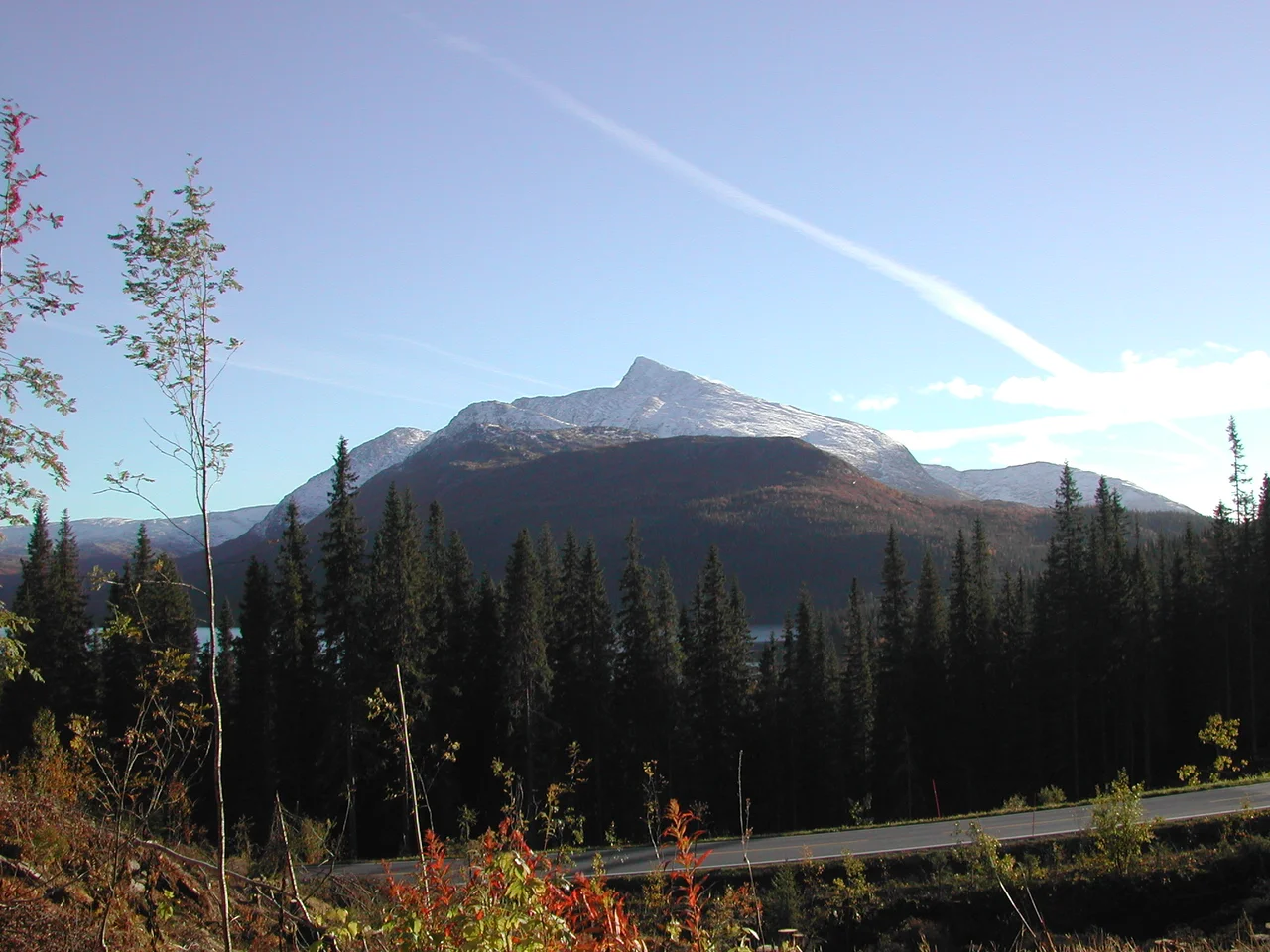
Vefsn Municipality centres on 65.799 N, 13.251 E, with the town of Mosjøen at the head of the Vefsnfjorden roughly 65.84 N, 13.19 E. The obvious visual anchors are the fjord itself, the Vefsna river running in from the south-east, and Øyfjellet rising 814 metres directly behind the town; Geittinden, at 1,556 metres, marks the municipality's high ground. Mosjøen Airport, Kjærstad (ENMS) lies about 5 km south of town with a 1,019 m asphalt runway at 73 m elevation, served by Widerøe Dash 8s. Sandnessjøen Airport, Stokka (ENST) sits on the coast to the north-west with a 1,409 m runway; Mo i Rana Airport, Røssvoll (ENRA) is to the north-east. A viewing altitude of 3,000-5,000 ft down the fjord axis shows the valley, the smelter and the river mouth in one pass. Expect low cloud and rapid visibility changes in winter; summer inland heat can build afternoon convection over the valley.
Nearby Stories
- Bleikvasslia 9.7 km away
- 2024 Finneidfjord Train Derailment 10 km away
- Trofors 11 km away
- Tjotta International War Cemetery 12 km away
- Hattfjelldal Municipality 20 km away
- Wideroe Flight 710 33 km away
- Træna Lighthouse 49 km away
- Dunderland Valley Bus Crash 82 km away