
Vefsna
To save the salmon of the Vefsna, Norway had to kill everything with gills in it. The parasite responsible, Gyrodactylus salaris, is half a millimetre long and cannot be seen without a lens; it clamps to the skin of a young salmon and dissolves it with digestive enzymes until the fish loses the barrier that keeps it alive. There is no way to reach it selectively in a river 163 kilometres long. The standard answer was rotenone, poured into the water, indiscriminate by design - and the Vefsna, the biggest watercourse in Nordland, got the full treatment. In 2018 it was formally declared clean.
From Simskardvatnet to the Fjord
The river starts high, at the lake Simskardvatnet in the mountains of Børgefjell National Park, and runs north for 163 kilometres through Hattfjelldal, Grane and Vefsn before discharging into the Vefsnfjorden at Mosjøen. Its upper reaches are often called the Susna. Its catchment - well over four thousand square kilometres, the largest in the county - reaches close enough to the frontier that some minor tributaries begin on the Swedish side, which is why the river carries three names: Vefsna in Norwegian, Vapstälven in Swedish, and Vaapstenjeanoe in South Sami. That last one is the oldest, and the district it names, Vaapste, is the same word the municipality of Vefsn eventually inherited. Average flow runs to roughly 200 cubic metres a second.
Seventeen Metres at Laksforsen
About twenty kilometres north of Trofors, in Grane, the whole river drops seventeen metres over a rock lip in a single broad fall. Laksforsen sits close enough to the E6 that people pull off, walk down and stand in the spray without planning to; some 80,000 did so in 2004 alone. At high water the fall carries several hundred cubic metres a second, and you feel it in the rock underfoot before you hear anything else. The name means the salmon fall, and it is literal: salmon running upstream have to get past this, and a fish ladder was cut to help them do it. What happened to that ladder is the rest of the story.
The Half-Millimetre Problem
The Vefsna was one of Norway's serious salmon rivers, a fishery that mattered to the people who lived along it. Then, in the 1970s, Gyrodactylus salaris got in. The parasite arrived in Norway from outside and spread river by river with catastrophic effect - by 2001 some 41 Norwegian rivers had been effectively wiped out as salmon fisheries. It breeds fast enough to be almost unopposable: the young are nearly the size of the adults, and the next generation is already forming inside them at birth. In the Vefsna it meant not only the loss of the runs but a standing threat to every watercourse nearby. In 1992 the fish ladder at Laksforsen was closed deliberately, sealing the upper river off, so that infected fish could not carry the parasite further into the system.
Rotenone
The eradication campaign was extensive and it was brutal in the way such campaigns have to be. Rotenone does not distinguish between a parasite's host and anything else that breathes through gills; treating a catchment of this size meant dosing the main river and its tributaries and accepting what that costs. It worked. The Vefsna was declared free of Gyrodactylus salaris in 2018, and the ladder at Laksforsen had already reopened the year before, in 2017, after twenty-five years shut. Newer methods now exist - aluminium salts dosed at low concentration can kill the parasite while leaving the fish alive - but the Vefsna belongs to the older, blunter chapter.
The Dam That Was Never Built
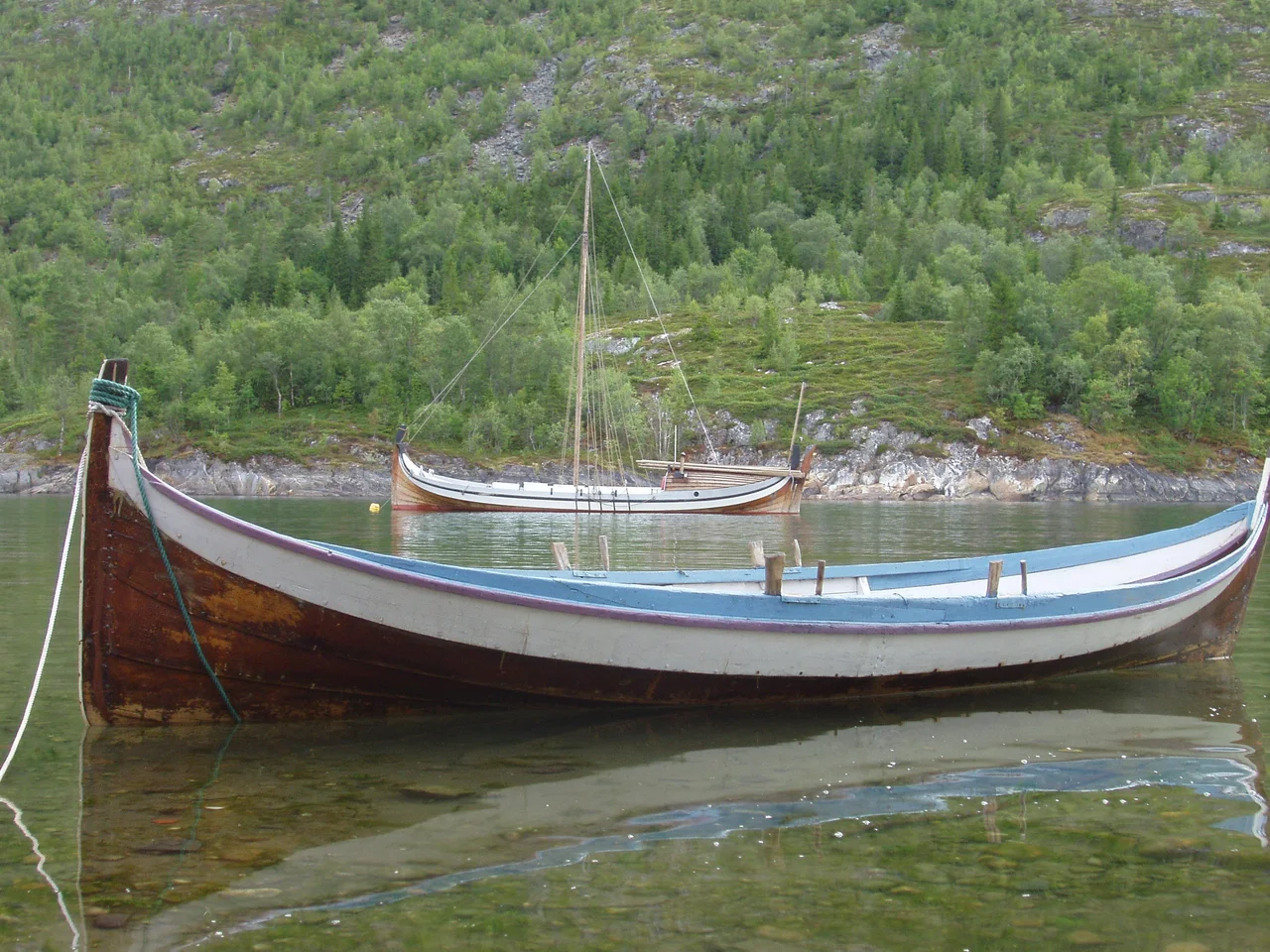
A river of this size, dropping from Børgefjell to sea level, was an obvious hydropower prospect, and for decades it was studied as one. In 2009 the Norwegian parliament placed the Vefsna under permanent protection in the national watercourse conservation plan, and the development case closed for good. That decision, taken while the river was still infected and its salmon still gone, was a bet on a future the river had not yet earned. The bet came in. Below the falls the water still runs out past Mosjøen into the fjord, where the old Nordland boats used to work - and salmon can climb past Laksforsen again for the first time in a quarter of a century.
From the Air
The Vefsna's mouth is at 65.845 N, 13.183 E, at Mosjøen at the head of the Vefsnfjorden; the river traces south-east and then south, roughly parallel to the E6 and the Nordland Line, to its headwaters at Simskardvatnet in Børgefjell National Park near the Swedish border. Following it southbound at 2,500-4,000 ft gives an unbroken 163 km line feature - one of the clearest natural navigation references in inland Helgeland - with Laksforsen, in Grane about 20 km north of Trofors, the single most identifiable point along it. Mosjøen Airport, Kjærstad (ENMS) sits at the northern end with a 1,019 m runway at 73 m elevation; Sandnessjøen Airport, Stokka (ENST) and Mo i Rana Airport, Røssvoll (ENRA) are the regional alternates. The valley funnels weather: expect low cloud on the flanking ridges, valley fog on clear autumn mornings, and rapidly rising terrain on both sides of the upper river.
Nearby Stories
- Bleikvasslia 9.7 km away
- 2024 Finneidfjord Train Derailment 10 km away
- Trofors 11 km away
- Tjotta International War Cemetery 12 km away
- Hattfjelldal Municipality 20 km away
- Wideroe Flight 710 33 km away
- Træna Lighthouse 49 km away
- Dunderland Valley Bus Crash 82 km away