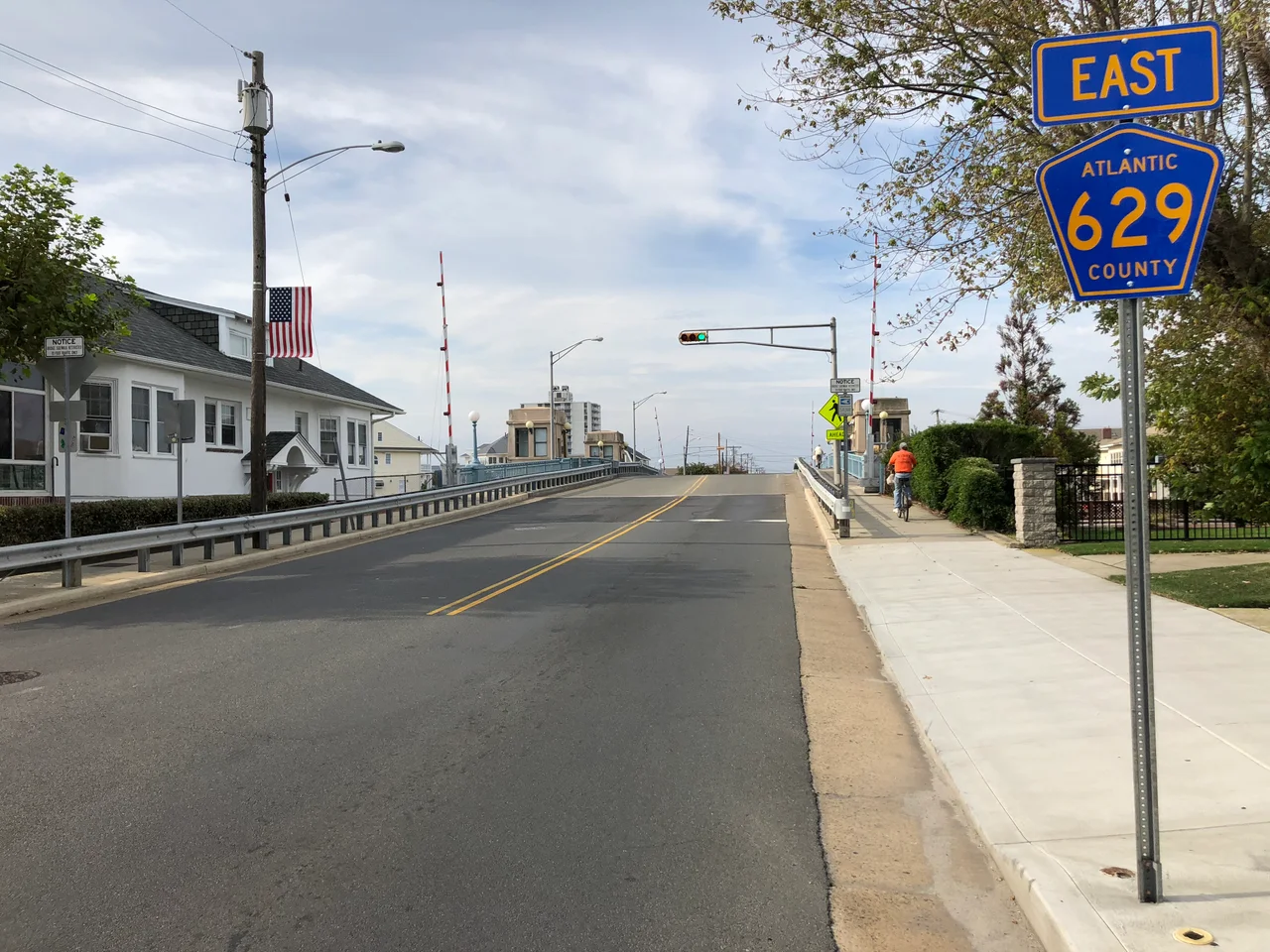
_at_Winchester_Avenue_in_Ventnor_City,_Atlantic_County,_New_Jersey.jpg)
Ventnor City, New Jersey
In January 1889, Mrs. S. Bartram Richards - wife of the secretary-treasurer of the Camden and Atlantic Land Company - was looking at a stretch of empty barrier-island sand south of Atlantic City and trying to think of a name for the new resort her husband's company wanted to build there. She had just returned from a trip to the Isle of Wight off the southern coast of England, where she had been charmed by a Victorian seaside town called Ventnor. The name made her think of summers and oceans. The Camden and Atlantic Land Company took her suggestion. Fourteen years later, on March 17, 1903, the New Jersey Legislature formally incorporated Ventnor City, New Jersey - the only city in the United States to bear the name, lifted from a town of 5,000 people most Americans have never heard of.
Between Two Other Cities
Ventnor occupies the middle of Absecon Island, sandwiched between Atlantic City to the northeast and Margate to the southwest. The geometry shapes everything about the town. The boardwalk - 1.7 miles of weathered planks running along the Atlantic - is physically continuous with the Atlantic City Boardwalk; you can walk from one casino district through Ventnor to the Margate elephant without noticing where one city ends and the next begins, except for the subtle change in beach width and the disappearance of the casino skyline behind you. The 2020 census counted 9,210 year-round residents. Ventnor is a real year-round community in a way many other shore towns are not - the population swells in summer, but never to the seasonal extremes of Longport or the more vacation-oriented stretches of the coast. Italian, Irish, German, and Russian ancestry topped the 2000 census rolls. Eighteen percent of the population was Hispanic or Latino by 2010. The boardwalk ends at the Margate line. The Dorset Avenue bascule drawbridge carries County Route 629 across the back-bay Intracoastal Waterway.
Notable Roster
For a city of nine thousand, Ventnor has produced an unusual cross-section of accomplishment, eccentricity, and at least one footnote of American cultural notoriety. Walter Evans Edge served two non-consecutive terms as Governor of New Jersey - 1917-1919 and again from 1944-1947 - one of only six men to hold that office twice. Benjamin Foulois, born in Connecticut but a longtime Ventnor resident, was one of the first three United States Army officers to learn to fly an airplane in 1909 and went on to command Army Air Service operations in World War I; the Foulois House at Fort Sam Houston in Texas is named for him. Siegmund Lubin founded one of the earliest American motion picture companies in 1902. Valerie Solanas wrote the SCUM Manifesto in 1967 and the next year shot Andy Warhol in his Factory studio, nearly killing him. Anne Heche grew up in Ventnor before becoming one of the most prominent actresses of the late 1990s. Cathy Rush coached Immaculata University to three consecutive AIAW women's basketball championships from 1972 to 1974, when women's college basketball was barely an organized sport.
A Sleepwalking Death
Among the strange entries in Ventnor's roster is the Reverend Charles Henry Parkhurst, the New York Presbyterian clergyman and reformer who in 1892 delivered the sermons that began the takedown of Tammany Hall corruption in Manhattan. Parkhurst spent his summers in Ventnor with his family and was known for sleeping on the second-floor porch of his shore house in warm weather. On the night of September 8, 1933, at age 91, Parkhurst sleepwalked off the porch, falling about ten feet to the ground below. He died of his injuries the next morning. The New York Times ran a respectful obituary noting the sleepwalking. The Ventnor house has not been preserved. Parkhurst's career - he had spent decades being lowered into Manhattan's most disreputable opium dens disguised as a drunkard so he could collect first-hand evidence of police protection of vice - ended in a peaceful Jersey Shore bedroom, undone by his own sleeping mind.
The Gambling Vote
Mike Segal, born 1922, was a Ventnor businessman who in the early 1970s led the petition drive that put casino gambling on the New Jersey ballot. The 1974 statewide referendum failed. Segal and his coalition regrouped, redrafted the proposal to legalize gambling only in Atlantic City rather than statewide, and tried again in November 1976. That referendum passed, and Segal was generally credited as one of its key local organizers. He died in 1982 - four years after Resorts International opened the first Atlantic City casino, but before any of the boardwalk's later boom-and-bust cycles. Frank S. Farley, a longtime Ventnor resident who served as a New Jersey State Senator for thirty years, was the Republican political boss of Atlantic County for decades; his control over the city government extended deep into the 1970s. The intersection of Ventnor politics and Atlantic City gambling history is closer than the maps suggest.
The Walsh Act and the Beach
Like Margate and Longport, Ventnor operates under the Walsh Act commission form of government - three commissioners elected at-large to four-year terms, each running a department, who choose one of their own as mayor. The system suits small shore towns where the line between government and citizen stays thin. Ventnor's beaches were the first on Absecon Island to participate in the Army Corps of Engineers' beach restoration program, and dunes have been protecting the shoreline for over twenty years. When neighboring Margate finally agreed to dunes in 2013, Ventnor's experience was offered as evidence that they worked. The most surreal moment in recent Ventnor City Hall history came on September 8, 2012, when local hockey product Justin Williams - then with the Los Angeles Kings, later with the Carolina Hurricanes - brought the Stanley Cup to City Hall during his day with the trophy. Children lined up around the block to touch it. The hockey trophy sat on a folding table in a city hall normally devoted to property taxes and dog licenses, and the boardwalk just outside was quiet enough to hear the cup being set down.
From the Air
Ventnor City occupies the central portion of Absecon Island at 39.3422°N, 74.4819°W, between Atlantic City to the northeast and Margate to the southwest. From altitude the city forms an unbroken grid between the Atlantic and the back-bay marsh, with the 1.7-mile-long boardwalk running along the ocean side - physically continuous with the Atlantic City Boardwalk. The Dorset Avenue bascule drawbridge crosses the Intracoastal Waterway from the southwest end of the city. The Atlantic City skyline rises clearly to the northeast; Lucy the Elephant is visible in Margate to the southwest. Atlantic City International Airport (ACY) is about 11 nautical miles west-northwest. Recommended viewing altitude: 1,500-3,000 feet AGL. The Margate dune line is a useful aerial marker - it begins partway through Ventnor's beachfront, with the older Ventnor dunes visible as a distinct lower line of vegetation closer to the city.
Nearby Stories
- Cape May 8.1 km away
- A. J. Meerwald 14 km away
- The Pine Barrens: Home of America's Oldest Monster 25 km away
- Hereford Inlet Lighthouse 38 km away
- Constitutional Convention (United States) 50 km away
- PS General Slocum 143 km away
- Wardenclyffe Tower 201 km away
- USS Atik 493 km away