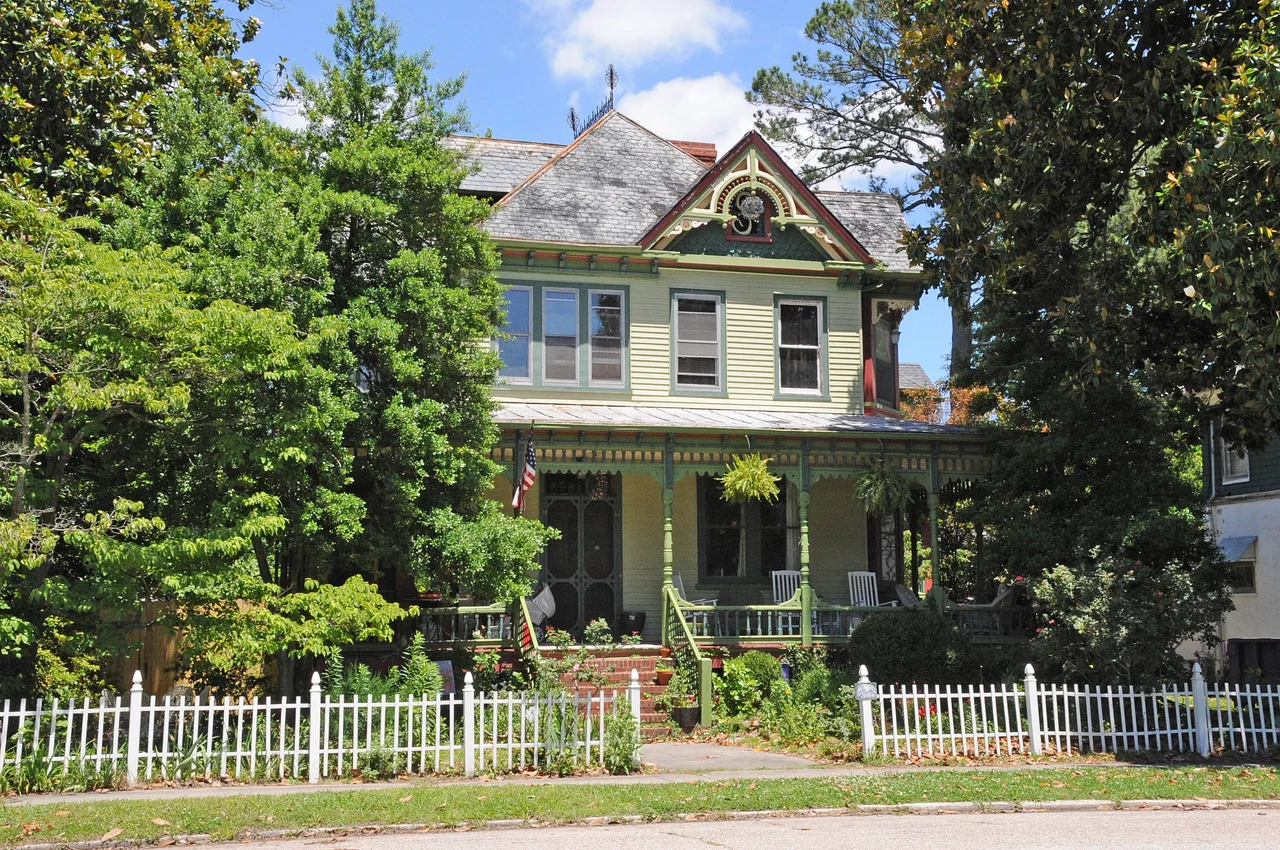

Victoria Boulevard Historic District
James S. Darling arrived in Hampton in 1866 carrying a schooner full of lumber, and a city ruined by the Civil War bought every board. Within two decades the New Yorker was running 350 acres of oyster beds, a grist mill, a streetcar line, and a Buckroe Beach hotel. When he finally retired in 1898, he did it on a tree-shaded street he had platted himself - a 1888 streetcar suburb called Little England, anchored by what is now Victoria Boulevard. The 87 contributing buildings clustered along these blocks tell the story of upper-middle-class Hampton learning, decade by decade, what 'home' was supposed to look like.
A Lumberman's Lucky Schooner
Darling did not plan to stay. Hampton in 1866 was a smoking ruin - the Confederates had burned it themselves in 1861 to keep it from Union hands - and a New York merchant with a hold full of pine had every reason to sell and sail home. Instead, he stayed and rebuilt. The lumber yard came first, then a grist mill, then by 1879 a menhaden oil factory that a storm promptly destroyed. Bankrupt and pivoting, he tried oysters. By 1884 he was one of the largest oyster merchants in the United States. In 1887 he founded the first electric streetcar railway on the Virginia Peninsula, threading Hampton to Newport News on rails that swung west right past a piece of waterfront he had just bought, called Little England.
The Right People on the Right Tracks
The streetcar made the neighborhood inevitable. Where the line turned west toward the shipyards, Darling laid out lots a businessman could reach in either direction. His son Frank moved in first, building 4403 Victoria Boulevard around 1895 - a man who at various times ran the streetcar company, served as vice-president of the Hampton Bank, founded the Hampton Fire Department and Dixie Hospital, and sat as a trustee of the Hampton Institute. By 1900 his neighbors made up a kind of professional-class roll call: a lawyer at 4501, a druggist at 4607, the city's only photographer at 4411, a furniture store owner at 4509, a plumbing supply man at 4400. Frank's mother lived at 4405. Across the cluster, ship pilots, trawler owners, and the occasional 'capitalist' filled in the gaps.
Queen Anne Gives Way to Something Plainer
The houses on Victoria Boulevard, Columbia Avenue, Park Place, and Linden Avenue document a quiet aesthetic argument. Early lots got elaborate Queen Anne facades - weatherboard layered with shingles, decorative chimneys, half-timbering, casement windows arranged for effect rather than for any one historical period. Then magazines started warning that the odd-shaped rooms were impossible to clean and harbored bacteria. By the 1910s the new taste ran toward Colonial Revival, simpler and supposedly safer, evoking 'Virginia's glorious colonial past.' One Cedar Point Georgian Revival house, built in 1927 by Frank Darling for his son J.S. Darling II, reached a level of refinement rare in the state. The American Foursquare - dignified, rectilinear, plain - filled in the remaining lots and turned out to harmonize with both styles.
Built by Hampton Institute Hands
Three Foursquares on Victoria Boulevard - 4404, 4406, and 4612 - were almost certainly built by students of the Hampton Institute Trade School. The institute was founded by Major Samuel C. Armstrong to provide trade education to Black and Native American students after the Civil War, and its annual report for 1914-15 records two student-built houses on Victoria Boulevard. The 4612 residence belonged to Robert Sugden, a manual arts instructor at the institute. Stylistic analysis and the Darling family's deep ties to Hampton Institute point to 4404 and 4406 as student-built as well, both on Darling property around 1915. The Cedar Hall mansion that Mary Darling funded for her son Frank in 1900 stood on Cedar Point until 1975. Today three split-level ranches occupy that ground, excluded from the historic district that the National Register added in 1984.
From the Air
Victoria Boulevard Historic District (Historic Little England) sits at approximately 37.0192 N, 76.3481 W in downtown Hampton, on the Virginia Peninsula side of Hampton Roads. From 3,000 feet on a clear day, look for the tree-lined grid south of downtown Hampton, between the Hampton River and Mill Creek. Langley Air Force Base (KLFI) lies 4 nm north; Newport News/Williamsburg International (KPHF) is 12 nm northwest. Norfolk International (KORF) is 14 nm south across Hampton Roads. Class C airspace surrounds KORF; expect tower coordination on Hampton Roads transits.
Nearby Stories
- Battle of Gloucester Point (1861) 3 km away
- Coast Guard Station Cobb Island 3 km away
- Flowerdew Hundred Plantation 11 km away
- Great Dismal Swamp 11 km away
- Cape Charles Lighthouse 14 km away
- False Cape State Park 17 km away
- Cactus Hill 29 km away
- Chowan University 35 km away