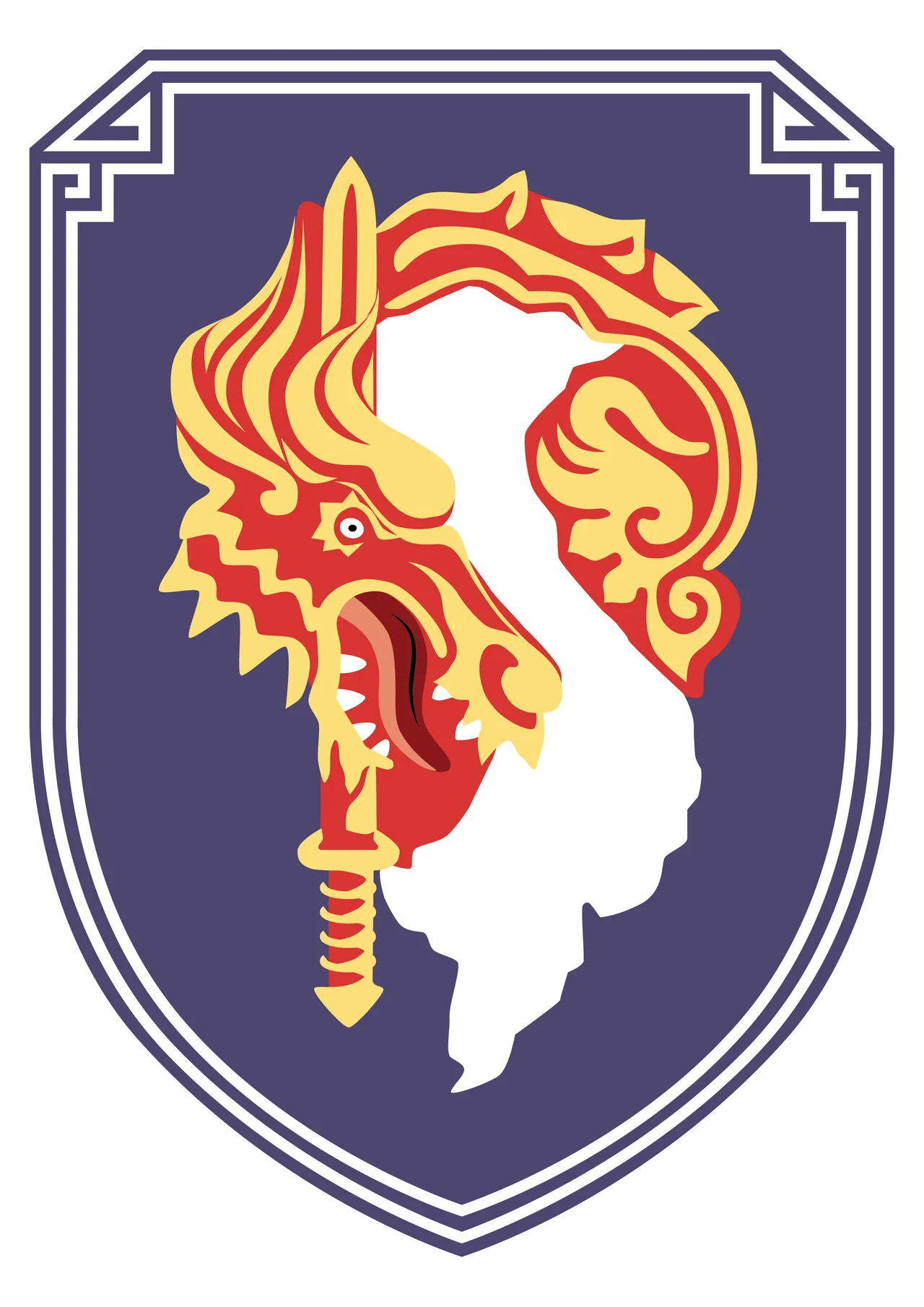

Vietnamese National Military Academy
On 20 April 1952, Emperor Bảo Đại stood before a parade ground in Dalat and handed a Saint-Cyr-styled saber to each new officer of the first graduating class — a class named *Hoàng Diệu* after a revered Vietnamese general. Then the senior cadets raised bows and fired four ceremonial arrows, one toward each compass point. It was a deliberate act: ancient imperial symbolism pressed into service to declare that Vietnam's armed forces now belonged to the Vietnamese.
Born in Two Languages
The academy's origins lay deep inside the colonial project it would eventually outlast. The French established a school for the Eurasian children of soldiers in Dalat in 1936 — *Ecole des Enfants de Troupe Eurasiens de Dalat* — modeled on a similar institution in Autun, France. The Japanese occupation dissolved it in 1944. It resurfaced in 1950 as a school for soldiers' children more broadly.
Meanwhile, the Vietnamese National Military Academy itself was founded in December 1948 in Huế. Under French oversight, it was a nine-month course designed to produce infantry platoon leaders — quick, functional, and limited by design. In 1950 it moved to Dalat, drawn by the city's cooler climate and clearer skies. The French retained control until the 1954 Geneva Accords ended their formal role in Indochina. In the handover of that first 1952 graduation ceremony, the colonizers and the newly independent were still sharing the same parade ground, the same swords, the same forms — but the arrows fired that day pointed outward in every direction, announcing something new.
The American Chapter
American advisors arrived in 1955, and the curriculum expanded with them — first to one year, then two. In 1959, President Ngo Dinh Diem announced an ambitious transformation: the academy would become a full four-year, degree-granting university-level institution, comparable to West Point. Construction began. Plans multiplied.
The ambition collided with the war. The urgent demand for junior officers — platoon leaders needed now, in a conflict that was escalating faster than any institution could expand — overwhelmed the long-term project. The academy graduated three three-year classes, but never a four-year class. By 1963 it had reverted to the two-year model, producing what the planners called 'enlightened platoon leaders.' In March 1963, Taiwanese Premier Chen Cheng visited with President Diem to review the cadets — a reminder of how thoroughly the academy had become embedded in the wider network of Cold War partnerships and alliances.
For a decade, the institution churned out officers as quickly as it could, knowing the country needed them faster than they could be properly trained.
The Commandants Who Shaped a Nation
The list of the academy's commandants reads, in retrospect, like a compressed history of the Republic of Vietnam itself. Lieutenant Colonel Nguyễn Văn Thiệu served as commandant twice — from 1955 to 1957, and again from 1958 to 1959. He would go on to become president of South Vietnam, ruling the country for nearly a decade until the fall of Saigon in 1975.
Brigadier General Lê Văn Kim, who commanded in 1959–1960, later became one of the key figures in the 1963 coup against Diem. Others on the list — Lâm Quang Thi, Lâm Quang Thơ — commanded forces in the final years of the war. The academy trained not just the army of South Vietnam but the political class that led it, for better and for worse. Every general who passed through Dalat as a cadet or as commandant carried with him the institution's particular blend of French military tradition, American tactical doctrine, and Vietnamese national aspiration.
Ghosts in the Highlands
The fall came in April 1975. As North Vietnamese forces swept south, Dalat fell without the dramatic last stands that marked other cities. By late 1975 the academy's grounds were taken over by the new government's military institution, which relocated there from Hanoi. The old cadets and officers dispersed — some into re-education camps, some into exile, some into the diaspora communities that formed in California, France, and Australia.
Today the campus still stands in Dalat's cool pine-scented air, the plateau city that the French chose precisely because it felt, climatically, like Europe. The buildings that once housed a generation of South Vietnamese officers now serve a different military in a unified country. The saber ceremony, the ceremonial arrows, the ghost of the Saint-Cyr tradition — all of it belongs to a republic that no longer exists. What remains is the place itself: the highland air, the parade ground, the weight of what was trained and lost here.
From the Air
The Vietnamese National Military Academy is located at approximately 11.97°N, 108.47°E in Dalat, on the Langbiang Plateau at roughly 1,500 meters (4,900 feet) elevation — the city's cool climate was the very reason it was chosen over Huế. Approaching from the coast, the plateau rises sharply from the lowlands. The nearest commercial airport is Lien Khuong Airport (VVDL), about 30 km south-southwest of Dalat. The city itself is unmistakable from altitude: a dense urban area surrounded by pine forests and terraced flower farms on the plateau, ringed by higher peaks including Bidoup (2,287m) to the north. Flying northeast from here leads to Cam Ranh Bay (VVCR) and its long coastal runway, roughly 90 km distant.
Nearby Stories
- Vietnam Airlines Flight 474 2.2 km away
- Bidoup Núi Bà National Park 15 km away
- Tà Đùng National Park 17 km away
- Núi Chúa National Park 20 km away
- Duc Lap Camp 31 km away
- Bao Loc 32 km away
- Operation Byrd 36 km away
- Vũng Rô Bay 79 km away