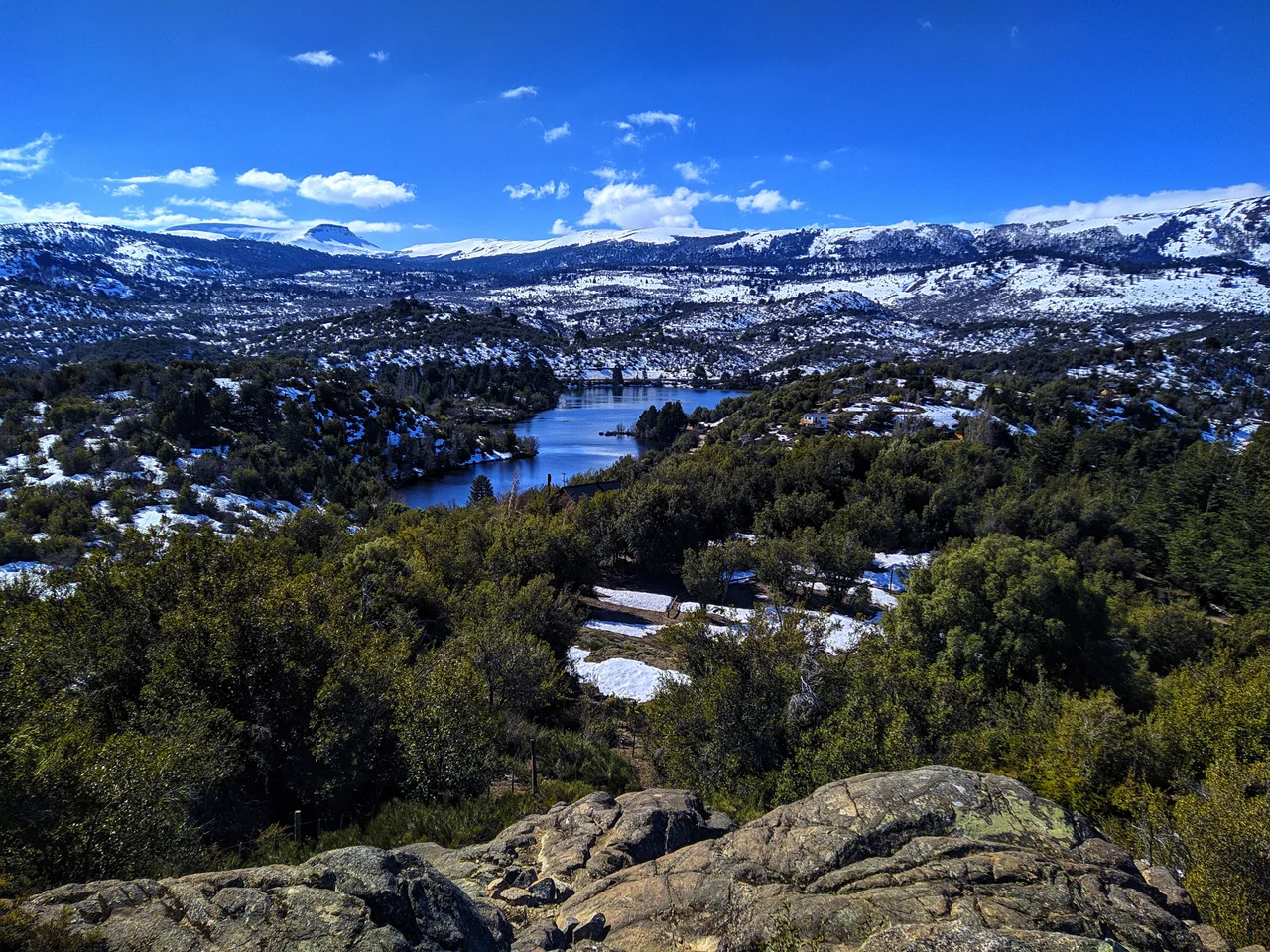

Villa El Chocón
Villa El Chocon was not so much settled as installed. In 1968 there was almost nothing here but red rock, scattered goats, and a handful of herders on the semi-arid plain along the Limay River. Then the state arrived to build a dam it called the work of the century, and an entire town materialized around the project: identical white houses with red-tiled roofs, streets laid out in tidy rows, schools and a church and a sports center, all engineered into existence to serve a machine. The dam was finished. The town, against the odds, found a second life.
The Work of the Century
In 1967 the Argentine government created a company, HIDRONOR, to harness the Limay and Neuquen rivers, and the Ezequiel Ramos Mexia dam became its centerpiece. Built from loose rock and earth rather than concrete, it rose to 87 meters and impounded a vast artificial lake on the Patagonian steppe. It remains one of the largest dams in Argentina, able to release some 8,000 cubic meters of water per second, and it anchored the nation's electrical grid. The first turbine spun in December 1972; the sixth and last was installed in 1977. For a few intense years the project pulled in workers from across Argentina and beyond, and the population of this engineered village swelled past 5,000 people.
A Town Built by Rank
The village still wears the logic of the project that made it. Its neighborhoods climb a set of low hills, and they were filled, originally, in order of rank: the highest-ranking personnel housed in one zone, the rest arranged in descending order along the slopes. The houses are nearly identical, rectangular with white walls and red roofs, set close together along narrow paved streets, backyards neatly squared off. The Church of the Holy Spirit is the town's one flourish of imagination. Inside, it is shaped like Noah's Ark and hung with the flags of every country the dam workers came from; outside, its dark green roof slants like a half-poured bowl, a deliberate echo of the dam itself.
After the Dam
When the construction ended, so did the reason most people had come. With no other industry to hold them, families drifted away, and the boomtown of 5,000 contracted sharply. By recent count the village holds 1,174 residents. The dam that built the place now barely employs it: of all the people who keep its turbines running, only about eight actually live in town, the rest commuting in from other cities. Many who remain work for the town hall, the gendarmerie, the museum, or the police; some run shops in the small center, and others travel each week to the city of Neuquen for work. The town had to find another reason to exist.
The Valley of the Dinosaurs
It found that reason in the ground beneath it. The same red sandstone that makes the cliffs glow at sunset is dense with fossils, and in 1993 the discovery of Giganotosaurus, one of the largest carnivorous dinosaurs ever found, put Villa El Chocon on the scientific map. The town now calls itself the Valley of the Dinosaurs. Visitors come for the Ernesto Bachmann museum, for the lookouts over the turquoise reservoir, and for something stranger and older: along the lake's red shore lie fossilized dinosaur footprints, three-toed tracks pressed into mud between 96 and 100 million years ago. A company town conjured for a 20th-century engineering feat now draws the world for the footprints of giants that walked here long before any river was dammed.
Life Beside the Reservoir
The dam left behind more than electricity; it left a sea. The enormous reservoir that drowned the old valley floor now defines daily life in Villa El Chocon, lapping at a beach of white sand against a backdrop of rust-red cliffs. The contrast is the whole appeal: cold blue-green water meeting desert stone under an immense Patagonian sky. Residents and visitors swim, camp, and fish along the shore, walk the trail of the Canadon Escondido, the Hidden Canyon, and climb to overlooks that take in the lake, the dam, and the badlands in a single sweep. A town built to be temporary, expected to empty out once its machine was complete, instead settled into an unlikely role as a small Patagonian resort with dinosaurs in its backyard.
From the Air
Villa El Chocon lies at approximately 39.26 S, 68.78 W in Neuquen Province, Argentina, on the Limay River where it widens into the Ezequiel Ramos Mexia reservoir. From the air the scene is vivid: a great earthen dam, the broad blue-green lake, dramatic red and ochre sandstone cliffs, and a small grid of white red-roofed houses stepped up low hills. A viewing altitude of 3,000 to 6,000 feet captures the dam, lake, and badlands together; the fossil-track sites line the reddish lakeshore. Nearest major airport is Presidente Peron International at Neuquen (ICAO: SAZN), roughly 70 km northeast; Zapala Airport (ICAO: SAHZ) lies to the west. Skies are typically clear and dry with strong westerly winds and long visibility across the open Patagonian steppe.
Nearby Stories
- Neuquén 14 km away
- Museo Carmen Funes 41 km away
- FaSinPat 44 km away
- Zapala 71 km away
- Vaca Muerta 109 km away
- Sol Líneas Aéreas Flight 5428 174 km away
- Lanin National Park 176 km away
- Patagonian Desert 203 km away