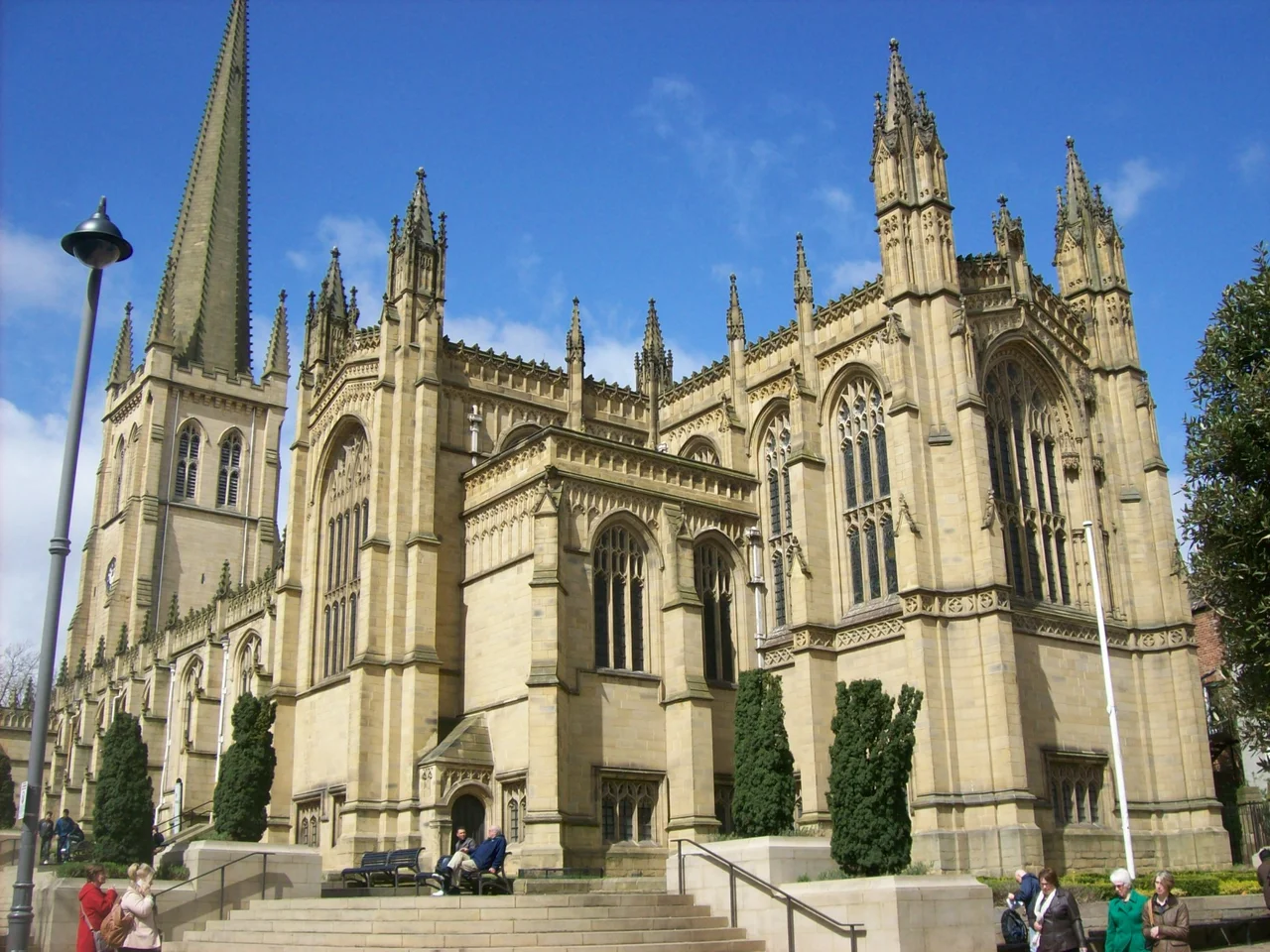

Wakefield Cathedral
The spire reaches 247 feet, the highest point in the City of Wakefield and the tallest church spire in Yorkshire. Below it, a Saxon church stood when the Domesday surveyors came through in 1086. Below that, the foundations go back further. In 1900, when extensions were being made to the east end, the diggers turned up evidence of the earlier church that the Normans had built over. The Cathedral of All Saints has been rebuilt at least four times in nine centuries, and each rebuilding has used the stones of the one before.
From Saxon to Norman
A church in Wakefield is recorded in the Domesday Book of 1086. In 1090 William II gave the church and its land to Lewes Priory in Sussex, which was unusual but not unique. Shortly afterwards a Norman church rose on the hill at Kirkgate. The Norman building was rebuilt in 1329 and then again, more extensively, in 1469, leaving only the tower and spire from earlier phases. Up to the Reformation the church was known by its Anglo-Saxon name of All Hallows. After Henry VIII broke with Rome, it became All Saints. The spire took its share of weather. In 1823 a violent gale damaged it badly enough to require renewal, and a Victorian restoration by George Gilbert Scott and his son John Oldrid Scott between 1858 and 1874 gave the building most of its current late-medieval appearance. The wall of the north aisle, dating from about 1150, is the oldest fabric still standing. The nave piers go back to the 12th and 13th centuries. The chancel arches are 14th century. The chancel itself, late 15th century, now serves as the choir.
Cathedral Status
In 1888 the Diocese of Wakefield was created, and the parish church was raised to cathedral status. Because it still served as a parish church, the head of the chapter of canons was called the provost rather than the dean. That arrangement lasted until 2000, the same year a boundary change brought the medieval chantry chapel on Wakefield Bridge into the cathedral's care. The Chantry Chapel of St Mary the Virgin, built originally in wood in 1356 and then in stone, is the oldest of four surviving English bridge chapels and one of the most ornate. In 2005 Queen Elizabeth II visited the cathedral to distribute Maundy money, the silver coins given out by the monarch every Maundy Thursday. In 2012, with £1.58 million from the Heritage Lottery Fund, the cathedral cleared the oak pews from the nave and reordered it as open space for worship and public events. A decision in the 2012 budget to charge VAT on restoration of historic buildings briefly threatened the project. The work went ahead. The Diocese of Wakefield was itself dissolved on Easter Sunday 2014, merged into the new Diocese of Leeds, and Wakefield is now a co-equal cathedral with Bradford and Ripon under one bishop.
Bells, Rood, and Mouseman
The tower carries a ring of fourteen bells. The tenor weighs 35-1-0 hundredweight and sounds in C. There is a flat 6th in B-flat and an extra treble in A, allowing for a light ten in F. No more than twelve are usually rung at one time. Ringers work through everything from rounds and call changes up to Surprise Maximus, one of the most complex change-ringing patterns in the English tradition. The bells are rung on Sundays and for special national occasions, including the Diamond Jubilee of Elizabeth II. Inside, the 17th-century rood screen carries a rood by Ninian Comper completed in 1950. The font is mid-17th century. The pulpit dates from 1708. The reredos is by John Oldrid Scott, the high altar by Frank Pearson. In St Mark's Chapel, look for the small carved mouse on the furniture. That is the signature of Robert Thompson, the Mouseman of Kilburn, whose workshop in the North York Moors made church and college furniture across Yorkshire for half a century. Find his mouse, and you have found his work.
Peregrines and Choristers
Peregrine falcons have nested on the tower since 2015, raising 24 chicks in seven breeding seasons. The peregrine, once nearly wiped out by DDT, is now the world's fastest animal in level flight as well as in its hunting stoop, capable of speeds over 240 miles per hour. The Wakefield birds are watched by livestream cameras that draw audiences across the UK and internationally. They are perhaps the most famous current residents of the building. The cathedral choir, directed by James Bowstead, includes boys, girls, and adults, and has appeared on BBC One's Songs of Praise and BBC Radio 3's Choral Evensong. In 1992 Wakefield Cathedral became only the second cathedral in Britain to accept female choristers. Jonathan Bielby MBE, who served as organist for decades, was the longest-serving organist in any English cathedral. The Cathedral Church of All Saints has been on Kirkgate hill for nearly a thousand years. The peregrines are recent. The bells, the choir, and the slow patient renewal of stone go back a great deal further.
From the Air
Wakefield Cathedral sits at 53.68N, 1.50W in the center of Wakefield on Kirkgate, on a low hill above the River Calder. The 247-foot spire is the tallest structure in the city and visible for miles. Leeds Bradford Airport (EGNM) is 12 nautical miles north-northwest. From altitude, look for the spire above the cluster of Wakefield's civic buildings, with the M1 motorway running east of the city and the M62 to the north.
Nearby Stories
- Stockport Air Disaster 4.5 km away
- Hillsborough Disaster 6.1 km away
- Murder of Sophie Lancaster 6.3 km away
- Battle of Stamford Bridge 9.8 km away
- Wressle Castle 12 km away
- Gordale Scar 12 km away
- Gainsborough Old Hall 19 km away