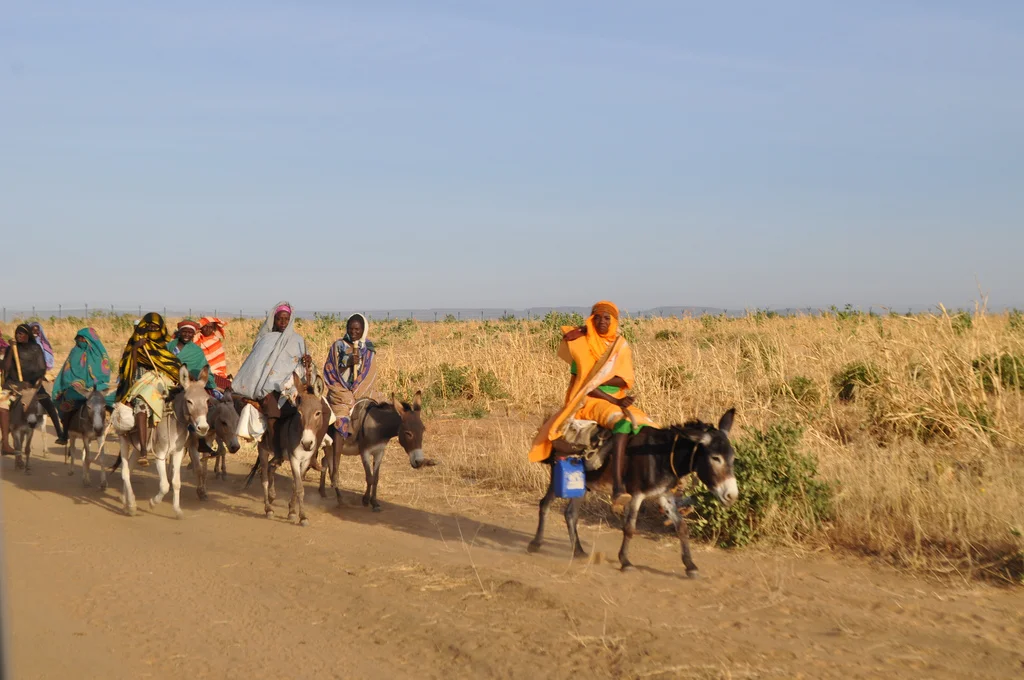

West Darfur
The people of West Darfur have been called Dar Masalit for as long as anyone remembers - the land of the Masalit. Today the Masalit people are at the center of a genocide. From April to November 2023, Rapid Support Forces fighters moved through Geneina, the state capital, killing thousands. CNN reported 10,000 dead in the city alone. Later estimates suggested the total was higher. Their neighbors had turned on them: RSF fighters and allied Arab militias, the paramilitary descendants of the Janjaweed who had committed the 2003 Darfur genocide, returned to what they had done before. This time there was no external force stopping them.
The Land of the Masalit
West Darfur covers 79,460 square kilometers - about the size of the Czech Republic - in the far west of Sudan, pressed up against the Chadian border. Most of the state is savanna, with sandy desert in the north and mountains rising to Sawani peak at 1,154 meters. Wadis like the Kaja cut through the terrain, and dense forests grow on the higher slopes. Home to roughly 1.9 million people in 2023, the state's population is built from the Erenga, Gimir, Masalit, Misseriya Jebel, Sinngar, and Zaghawa peoples - a tapestry of communities speaking different languages and practicing different livelihoods, some agricultural and settled, some pastoral and mobile. The Masalit are the largest of these groups, and their cultural and political identity has long defined what West Darfur is. Al-Junaynah - Geneina - is the capital, a city that grew up at the crossroads of trade between Sudan and Chad.
The Black Book
West Darfur is also where the 2003 Darfur war began to organize itself intellectually. In 2000, a clandestine group of mostly Darfuri authors published The Black Book, a dissident manuscript documenting in statistical detail the domination of Sudan's economy, government, and military by a narrow elite from three northern riverine tribes - the Shaigiya, the Ja'alin, and the Danagla. The book circulated despite government attempts at censorship, and many of its writers went on to help found the Justice and Equality Movement, one of the two major rebel groups whose 2003 uprising triggered the catastrophic government response in Darfur. Hostilities had already been simmering in West Darfur through the late 1990s - minor clashes in 1998 displaced 5,000 Masalit; deadlier fighting in 1999 killed hundreds on both sides. The 1999 reconciliation conference agreed on compensation. But Masalit intellectuals and notables were arrested, imprisoned, and tortured, while government-backed Arab militias attacked Masalit villages. The war that would explode in 2003 had been prepared by years of uneven violence in Dar Masalit.
The First Darfur Genocide
The 2003-onward war in Darfur killed between 200,000 and 300,000 people by most estimates and displaced more than two million. West Darfur bore the heaviest weight. Geneina, sitting on the Chadian border, absorbed refugees fleeing the Janjaweed campaigns to its east while also experiencing its own attacks. Refugee camps in Chad swelled with hundreds of thousands of Darfuris. In 2009 the International Criminal Court issued arrest warrants for Omar al-Bashir for war crimes and crimes against humanity in Darfur; a 2010 warrant added genocide. Bashir continued to travel to African Union members who refused to arrest him. In 2020, the transitional government in Khartoum signed the Juba Peace Agreement with several Darfur rebel groups, and there was hope - cautious, skeptical, but real - that Darfur's long war was ending. That hope lasted less than three years.
The Massacres of 2023
When fighting between the Sudanese Armed Forces and the Rapid Support Forces broke out on 15 April 2023, the RSF - which had grown from the Janjaweed militia of the earlier Darfur war - turned its forces on West Darfur and on the Masalit civilians who lived there. The 2023 Masalit massacres unfolded in Geneina between April and November. Witnesses described RSF fighters moving through neighborhoods asking residents their ethnicity, killing Masalit men on the spot, and burning houses with families inside. The West Darfur governor, Khamis Abakar, publicly accused the RSF of genocide and was killed hours later, on 14 June 2023 - abducted and shot after an interview in which he named what was happening. Tens of thousands fled into Chad, where the refugee camps at Adre and elsewhere filled with survivors carrying accounts of what had been done. The UN, international humanitarian officials, and the US government all publicly warned of genocide. By late 2023, CNN reported that at least 10,000 people had been killed in Geneina. The real number was almost certainly higher.
What Survivors Want Known
The survivors of the West Darfur massacres have tried to make the world hear. Many testimonies have been collected by Human Rights Watch, by Amnesty International, by the UN Commission of Inquiry. They describe systematic ethnic targeting - not a war between armies but a campaign against a civilian population. They name specific commanders. They document specific incidents. The people of Geneina and the surrounding villages are not statistics: they are teachers, farmers, shopkeepers, students, elders, children. They had names, and their families still remember them. What the Masalit community of West Darfur wants is what any people who have survived genocide want: accountability, the return of their homes, the possibility of going home. At the time of writing, none of these has been achieved. The war continues. The RSF has not been defeated. And in October 2025, reports emerged that the RSF's capture of El Fasher in neighboring North Darfur had produced tens of thousands more deaths - perhaps 60,000 - and the pattern established in Geneina was being repeated. The Sudanese Armed Forces are not innocents in this war either. But the targeting of the Masalit by the RSF specifically for who they are is the act that has produced the genocide warnings.
From the Air
West Darfur sits in the far west of Sudan, bordering Chad. The state capital Geneina (El Geneina) is at approximately 13.45°N, 22.45°E; the state reference coordinate here is 12.90°N, 23.18°E. From cruising altitude the terrain shifts from the Sahelian scrub of central Darfur into the more sharply defined relief of Jebel Marra (in Central Darfur) to the east and the Chadian plains to the west. Nearest airports are Geneina Airport (HSGN) within the state and Zalingei (HSZA) to the southeast. The Chadian border runs along the state's western edge; the refugee camps at Adré and elsewhere in eastern Chad have been major destinations for civilians fleeing the 2023-present conflict. Darfur airspace has been subject to significant restrictions during the civil war.
Nearby Stories
- Kreinik massacre 26 km away
- Marrah Mountains 78 km away
- Ain Farah 146 km away
- Central African Republic–Chad border 193 km away
- 1987 Dhein massacre 310 km away
- Zakouma National Park 370 km away
- Manovo-Gounda St. Floris National Park 504 km away
- Great Man-Made River 1368 km away