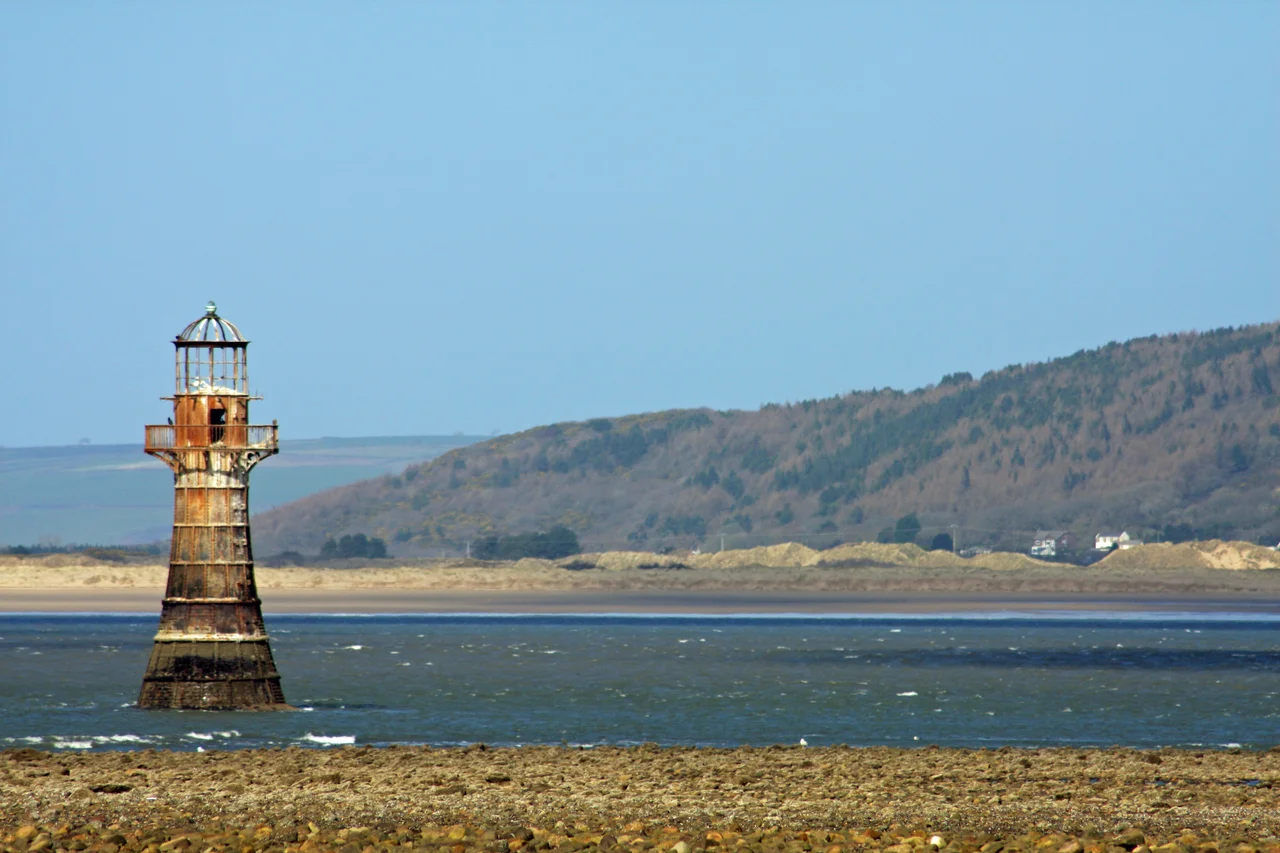

Whiteford Lighthouse
At low tide on Whiteford Sands you can walk to it. The lighthouse stands offshore in the open inlet, a tapered black tower made from 105 cast-iron plates bolted together, riveted to 88 wooden piles driven into glacial moraine 160 years ago. There is no road, no causeway, no keeper's cottage on the rock. At high tide the sea comes up around the base and the tower stands alone in moving water - which is exactly what its builders intended. Whiteford is the only wave-swept cast-iron lighthouse left in Britain, and one of the very few that ever existed anywhere in the world.
John Bowen's Design
John Bowen of Llanelli designed the lighthouse for the Llanelli Harbour and Burry Navigation Commissioners in 1865, to mark the dangerous shoals of Whiteford Point at the western end of the Gower Peninsula. He was working in a tradition that was already old: the first cast-iron British lighthouse went up at Swansea Harbour in 1803, plates cast at the Neath Abbey Ironworks. Bowen's job was harder. Other cast-iron lighthouses stood on piers or harbour walls, well clear of the water. Whiteford had to stand directly in the sea, taking the wave loading without disintegrating. His solution was 44 feet of bolted iron, tapered from a 24-foot base to an 11-foot-6-inch diameter at lantern level, with a pitched stone apron at the bottom that broke the worst of the swell.
Iron Plates and Wrought Straps
The construction was meticulous. Eighty-eight wooden piles were driven into the glacial moraine at low tide, linked horizontally with 500 cast-iron walling pieces and bolts, then partially filled with concrete to form the foundation. The tower itself rose in eight tapered courses of 105 plates, each plate about 32mm thick, each held by cast-iron bolts weighing two pounds apiece. The first three horizontal joints were sheathed in iron bands. It was finished in 1865 and immediately began to crack. By the 1870s vertical fractures had appeared in the plates of the lowest three rings - the result, engineers later concluded, of the inner masonry settling and pushing outward against the iron skin. A local blacksmith called Powell forged wrought-iron straps and bolted them across the cracks. By 1884, 150 of his straps were in place. The lighthouse keeper that year reported that the tower was swaying 'several inches' in heavy weather, and in 1885 the Commissioners poured an 18-inch concrete skirt around the base, bound by a two-inch iron band, anchoring the whole structure to the sea floor.
Argand Lamps
Three Argand lamps and reflectors were fitted - one pointed toward the south channel of Lynch Pool, one toward Burry Port, one toward Llanelli - and in 1876 the Harbour Master added a fourth lamp shining west along the north channel. The Argand lamp, invented in 1780 by Aimé Argand, was a major improvement over earlier oil lamps: a cylindrical wick fed with air on both sides, producing a steadier, brighter flame. The 1887 Admiralty chart shows the lighthouse's arc of visibility sweeping from slightly west of south, through north, to slightly south of east. The lighthouse keepers worked a two-week rotation, alternating with Llanelli Harbour Lighthouse on shore. The 1888 inventory said the station could house two keepers; the census returns from 1871 through 1901 always recorded one. The work was solitary and required walking out across the sands during the gap between tides.
Decommission and Revival
In 1920 Trinity House took over responsibility for the light and decided to establish a new beacon at Burry Holms across the inlet. The Whiteford lamps were extinguished. They stayed dark for sixty years. Then, in the 1980s, the local yachting community made the case that the lighthouse was still navigationally useful - particularly on dark nights, when sailors crossing between the Gower and Burry Port had a tendency to find themselves on top of Whiteford Point before realising it. The Harbour Commissioners contributed £1,000 and the Burry Port Yacht Club covered the balance of £300. A new fully automatic light went in, switching itself on at dusk; two nautical almanacs in 1987 listed it as flashing every five seconds. The solar power unit eventually failed and the light was removed. The tower itself stayed.
Scheduled Monument
Carmarthenshire County Council now owns it. Cadw - the Welsh historic environment service - lists Whiteford as Grade II* for what is, in the dry language of heritage law, 'a rare survival of a wave-swept cast-iron lighthouse in British coastal waters'. It is also a Scheduled Ancient Monument, which gives it the same legal protection as a Bronze Age burial mound. Walkers from Cwm Ivy across Whiteford Burrows reach the lighthouse on foot at low tide, in summer often as part of a circular walk through the dunes and the salt marsh of the North Gower National Nature Reserve. The cracks that Powell's straps held together are still there. So are the straps. The tower sways, just a little, when the wind comes hard from the southwest.
From the Air
Located at 51.6525 N, 4.2510 W off the northern tip of the Gower Peninsula, in the open Burry Inlet. Recommended viewing altitude 1,500-2,500 feet for close inspection, higher for the broader Gower coastline. The lighthouse is most striking at half-tide when the sand bars are partly exposed - it appears as a slim dark tower with no land directly under it. Nearest airports: EGFH Swansea (8 nm east), EGFP Pembrey (5 nm north). The vast sand expanses of Whiteford Sands and the salt marshes of Llanrhidian Sands are visible to the south and east.
Nearby Stories
- Trinity University College 4.5 km away
- Wolf's Castle 5.7 km away
- Castlemartin Training Area 5.9 km away
- Neath Abbey 8.2 km away
- Exmoor National Park 20 km away
- Ilfracombe Lifeboat Station 23 km away
- HMHS Glenart Castle 25 km away
- Brecon Beacons National Park 32 km away