
Wolfburn Distillery
In 1826 the Wolfburn Distillery, on the western edge of Thurso, produced 28,056 Total Gallons of Proof Spirit - roughly 125,000 litres - making it the biggest distillery in Caithness. The figure survives because the Excise demanded a return and the return is in the tax archives. Almost everything else about the original Wolfburn is missing. There are no photographs - the technology hadn't quite arrived. There are no architectural drawings. There aren't even reliable accounts of when it closed: sometime in the 1860s, after running for roughly forty years and being handed down through three or four generations of the Smith family, William Smith having founded it in 1821. By 1872 it appears on the first Ordnance Survey map of the area marked, simply, as a ruin.
The Stream That Names It
The Wolf Burn is a small stream that rises in the moorland south of Thurso and runs down through farmland to the sea. It is not a river of any importance to anyone except the distillery that has twice taken its name. Why the burn itself is called the Wolf Burn is unclear - probably from a local Gaelic or Old Norse origin that has weathered away in the local speech - but the name has been on the maps for centuries. William Smith chose his site in 1821 because the burn ran clean and steady through this particular field. Water is the first thing a whisky distillery needs, and the quality and consistency of that water shapes the spirit for as long as the place keeps making it. The new Wolfburn, which opened nearly two centuries later, draws from the same burn, about 350 metres from where the original stood. The water has not changed appreciably. The whisky tries not to either.
The Long Silence
What happened to the original Wolfburn is not entirely clear. The 1860s were a difficult period for many smaller distilleries: the Spirit Act of 1860 changed the tax structure in ways that favoured larger operations, and a few decades of consolidation followed. The Smith family seems simply to have stopped producing whisky, and the buildings were left to fall in. No one has found a photograph. The 1872 Ordnance Survey shows the site marked as a ruin and gives no other detail. By the early 20th century the structures had been quarried for stone or had collapsed entirely. For nearly a century and a half, Thurso had no distillery of its own. Whisky was made elsewhere in the north - in Speyside to the south, on Orkney to the north - and the Caithness coast became one of the few stretches of mainland Scotland without a working still.
The Revival
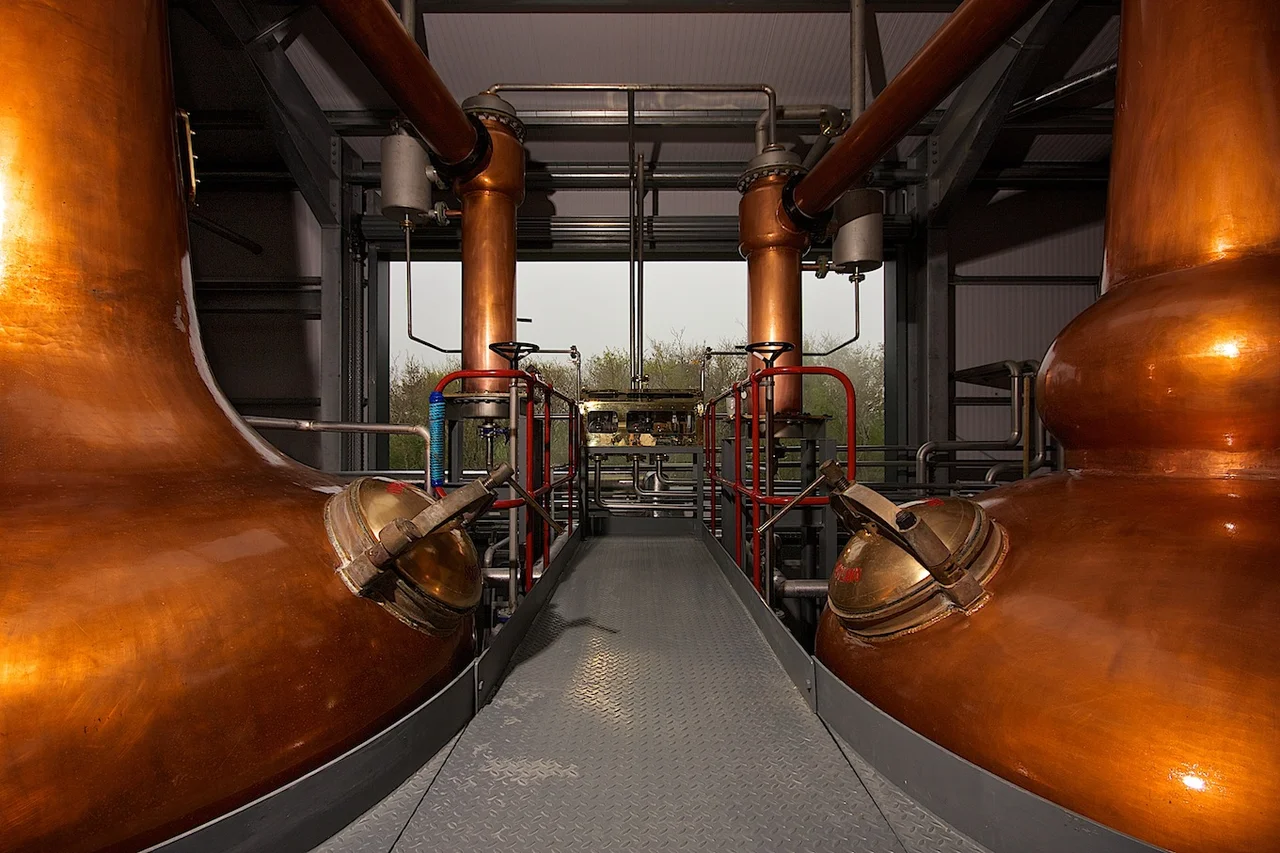
In 2012 a private consortium gained planning approval from Caithness authorities to build a new distillery in Henderson Park, on the western edge of Thurso. They kept the old name. The site lies about 350 metres from where William Smith had worked, and the new distillery draws its water from the same Wolf Burn. The Scottish fabricators Forsyths, who have built most of the modern Scottish whisky stills, installed the plant and equipment. Production commenced in early 2013. Wolfburn is the most northerly whisky distillery on the Scottish mainland - a distinction it can claim because Orkney's distilleries (Highland Park and Scapa) sit on islands. The site consists of four buildings: the distillery itself, with its single wash still and single spirit still, and three warehouses for casks to mature. In February 2016 the distillery opened its own bottling line. The inaugural single malt was launched globally in March 2016 and has since won several gold medals in international competitions.
Coming of Age
Scotch whisky cannot be called Scotch whisky until it has aged in oak for at least three years and a day. For a new distillery, that wait is the hardest part of the business plan. Wolfburn's early releases were young - good young whisky, but young - and the distillery built a reputation patiently rather than chasing the easy market for grain spirit blended young and old. In 2023, ten years after restart, Wolfburn released its first age-statement bottling: a 10 Year Old single malt. In 2025 the range expanded with two 8 Year Olds and a new flagship 12 Year Old. The whisky carries the maritime character of its location - the distillery sits perhaps a kilometre from the open Atlantic, on a coast where the wind delivers salt to everything it touches - and the casks breathe that air through wooden staves for the years they sleep. It will be another decade before Wolfburn matches the production volume of its 1826 predecessor. But unlike William Smith, the current owners have time, modern equipment, and the certainty that someone is still buying Caithness whisky.
From the Air
Wolfburn Distillery sits at 58.595°N, 3.551°W in Henderson Park on the western edge of Thurso. Best viewed at 800 to 1,500 feet AGL: the distillery building is modest in scale - a square distillery hall and three warehouse buildings on the inland edge of the town. The Wolf Burn itself runs past the site to the sea. Wick John o' Groats Airport (EGPC) lies 16 nm east-southeast; Inverness (EGPE) about 95 nm south. The Dounreay sphere is the dominant aerial landmark to the west - 8 nm away on the same coast. Pentland Firth weather is exposed: expect strong westerly winds, rapid changes, and frequent rain coming off the Atlantic.
Nearby Stories
- John o' Groats 6 km away
- Scapa Flow 6.7 km away
- Bettyhill 10 km away
- Loch Naver 13 km away
- Dunbeath Air Crash 17 km away
- Stromness Museum 24 km away
- HMS Exmouth (H02) 40 km away
- The Laki Eruption: The Volcano That Changed World History 938 km away