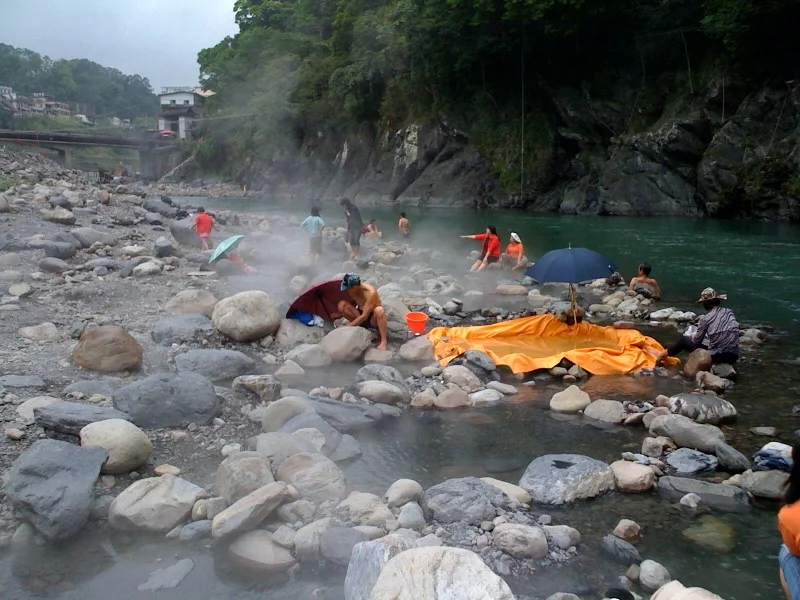

Wulai Hot Spring
The water emerges clear and almost entirely without odor — unusual for a hot spring — and it comes out of the earth at temperatures that can reach 80 degrees Celsius. At that heat, you do not soak. You watch the steam, you let the ambient warmth work on you, and you understand why an Atayal hunter who encountered this mist rising from a stream felt it necessary to name the phenomenon and warn others. The Wulai Hot Spring has been here, at the confluence of the Tonghou and Nanshi rivers in the Xueshan Range, longer than any building beside it.
Water From the Xueshan Range
The geology beneath Wulai is what makes the hot springs possible. The Xueshan Range — the second-highest mountain range in Taiwan, running northeast to southwest across the northern part of the island — contains the thermal activity that heats water deep underground and forces it upward through fissures in the rock. Where two rivers meet, as the Tonghou and Nanshi do at Wulai, the valley bottom sits low enough that this superheated groundwater emerges at the surface. The springs spread out along the Nanshi River banks, clear and colorless, distinguishable from the cold river water only by temperature and the delicate wisps of steam that lift from the surface on cooler days. There is no sulfur smell here, no milky opacity — just hot, clean water arriving from depth.
Two Ways to Soak
Wulai has accommodated the hot springs in two distinct ways. Hotels and resorts in the valley have built private and semi-private bathing facilities, channeling spring water into tiled pools at temperatures made comfortable for extended soaking — typically cooled from the source's extreme heat to somewhere between 38 and 42 degrees Celsius. Alongside them, outdoor public soaking pools have been built along the Nanshi River banks themselves, where visitors can soak in view of the gorge and the forested ridgelines above. The outdoor pools are the more direct encounter with the place: you are sitting in an Atayal river valley, in water that has traveled from deep within the mountain range, with the sound of the river running alongside you. The hotel pools offer comfort; the riverbank pools offer context.
What the Name Carries
The name Wulai derives from the Atayal language. The Atayal phrase *kilux ulay* refers to something hot, a quality the springs have always possessed. Across indigenous languages of Taiwan, place names are often direct environmental observations — the landscape described in the words used to navigate it. *Ulay* encodes the defining characteristic of this valley: the anomalous heat in the water. That the Atayal named it this tells you the springs were known and significant long before they became a tourist destination. The hot springs are a feature of Atayal geography first, and a resort amenity second. That order of precedence matters when you are visiting someone else's homeland.
Recovery After the Storm
Typhoon Soudelor in August 2015 hit Wulai hard. The floods that tore through the Nanshi valley destroyed hotels, buried infrastructure, and damaged several of the hot spring facilities. Some pools were filled with debris. The river, swollen beyond its banks, reshaped sections of the channel it had carved. Recovery was slow and difficult for the community. In the years since, facilities have been rebuilt and the hot springs have returned to operation — but the memory of the typhoon, and the knowledge of what a flooding mountain river can do, has settled into the local understanding of this place. The steam still rises from the water. The Xueshan Range continues to heat the groundwater, as it has for far longer than any storm or any structure beside the river.
From the Air
Wulai Hot Spring is located at approximately 24.87°N, 121.55°E, in the Nanshi River valley of New Taipei's Wulai District — about 40 kilometers east-southeast of Taiwan Taoyuan International Airport (RCTP) and roughly 25 kilometers south of Taipei Songshan Airport (RCSS). The river confluence where the springs emerge is not visible from high altitude, but the deep forested gorge of the Nanshi River valley is a prominent feature in the mountain terrain south of Taipei's urban area. Recommended observation: 5,000–7,000 feet MSL on a clear day, following the river valley south from the Taipei basin.
Nearby Stories
- Tamsui 4.6 km away
- Hakka Round House 12 km away
- Smangus 14 km away
- Dapu Incident 19 km away
- 2022 Chinese Military Exercises Around Taiwan 47 km away
- Sinking of MV Sewol 1079 km away
- Yellow Sea 1130 km away
- Twin Forts of Romblon 1338 km away