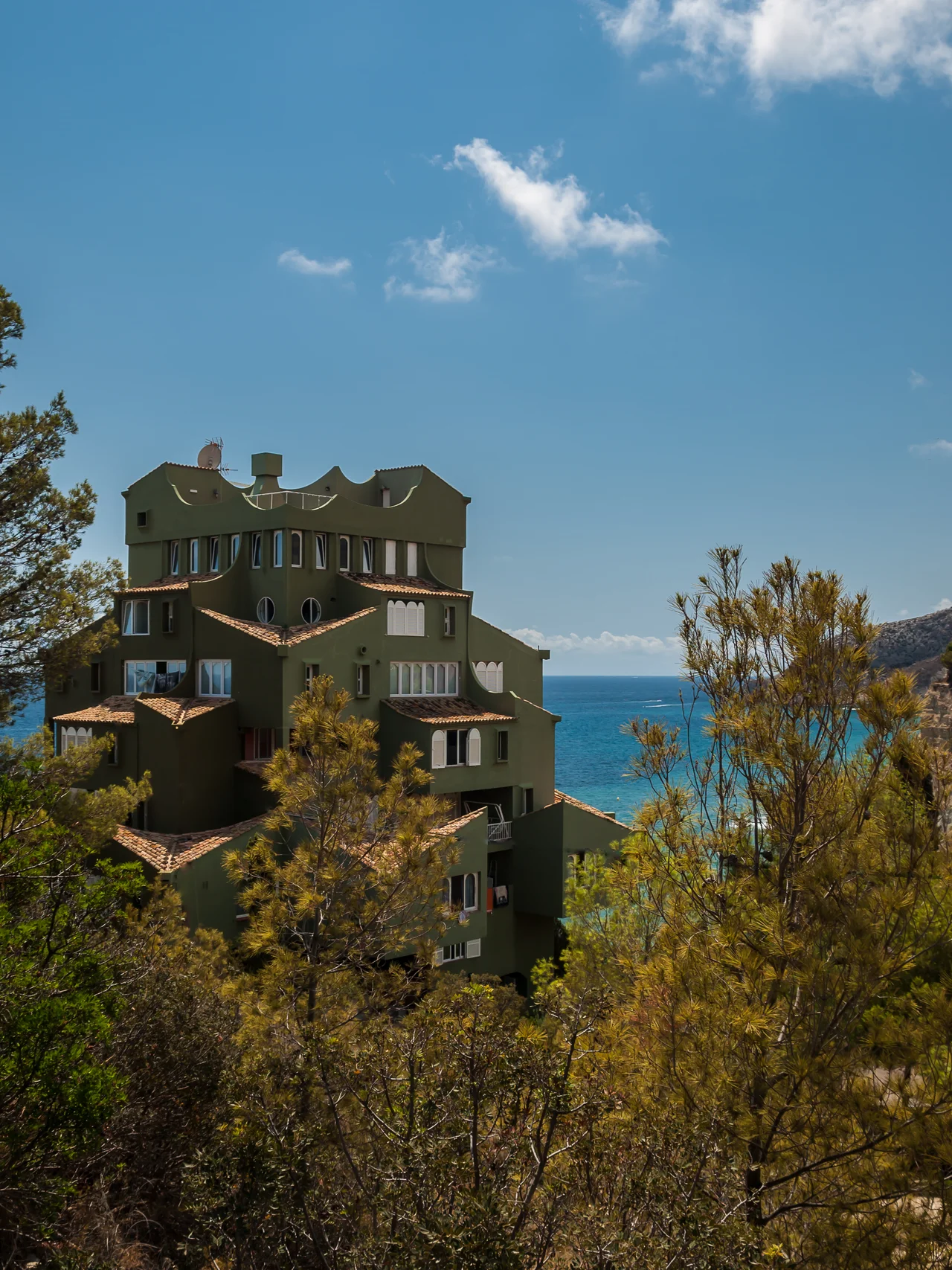

Xanadu (Calp)
The name arrives loaded with promise. Xanadu, the anglicised form of Shangdu, the summer capital where the Mongol emperor Kublai Khan kept his pleasure-palace, a word that centuries of poets turned into shorthand for somewhere opulent and impossibly far away. It belongs, improbably, to a dark green tower perched on a Calpe cliff above the Mediterranean. Ricardo Bofill's studio chose it deliberately, to lend an ordinary apartment block an air of mystery and wealth. The building has spent the decades since trying to live up to it.
A Garden City in Space
Bofill completed Xanadu in 1968, at the height of a decade drunk on architectural utopias. He described his aim as building a garden city in space, and the tower's insistent verticality was meant to echo the great rock of the Penyal d'Ifac that looms further along the coast. The deeper inspiration came from Archigram, the British avant-garde whose plug-in city imagined buildings as modular megastructures, frames onto which dwellings could be slotted, added, and swapped like components. Xanadu is a small, buildable fragment of that dream, a piece of 1960s futurism that actually got poured in concrete and lived in. The result is compact but uncompromising, a tower that pointedly refuses to resemble the ordinary holiday flats rising all around it.
Built Around a Staircase
Everything in Xanadu hangs from its spine. The structure, some 2,300 square metres in all, is organised around a central staircase, with seventeen apartments attached module by module up its height. Because those modules sit on a square base, the stacking leaves gaps in the form; some become terraces, open to the sea air, while others are simply voids, sealed pockets that no door inside the building ever reaches. The exterior wears a dark green skin streaked with oxidised tones, a colour chosen to make the tower look weathered and organic, as though it had grown from the same rock as the Penyal it faces.
A Name Borrowed from an Emperor
Why name a Spanish holiday flat after a Mongol capital? The choice was pure atmosphere. Kublai Khan's Xanadu had long since passed out of history and into legend, a byword for exotic splendour, and by borrowing it Bofill's studio dressed a modest cliffside block in borrowed grandeur. It is a very 1960s gesture, the confidence that a building could conjure a whole imaginative world through form and a well-chosen word. Whether the seventeen apartments deliver on the fantasy is a question their occupants get to answer each morning, looking out at the sea.
The Bofill Cluster
Xanadu does not stand alone. It rises in the Manzanera urbanisation on the edge of Calpe, alongside two more of Bofill's works: the celebrated Muralla Roja, with its maze of red and pink walls, and the Social Club of the Manzanera. Taken together they form a compact record of a young studio testing its ideas on a single hillside. Xanadu itself has become a minor destination, categorised among the tourist attractions of Spain's east coast, available to rent by the night, its strange green exterior open to anyone willing to walk up and look.
Living in a Utopia
Half a century on, Xanadu poses the question every architectural utopia eventually faces: what is it like to actually live inside one? The sealed voids that photograph so intriguingly are, from the inside, simply space that cannot be used. The modular ambition that thrilled the avant-garde became, for residents, a floor plan to be furnished and a green wall to be maintained against the salt wind. Yet the tower endures, still occupied, still faintly futuristic, a fragment of the 1960s that never quite let go of its dream of cities built like machines and named like poems. The building is small enough to take in at a glance, seventeen homes stacked on a single stair, yet ambitious enough to have earned its place in the histories of modern architecture. And whatever else it is, Xanadu remains a place with a view: every apartment looks out on the same restless Mediterranean that first drew Bofill to this cliff.
From the Air
Xanadu clings to the coastal cliff on the Manzanera hillside at the southwest edge of Calpe, 38.64 degrees north, 0.04 degrees east, a short distance from its red-walled sibling La Muralla Roja and within sight of the Penyal d'Ifac to the northeast. Its small, dark green form is easiest to pick out on a low, slow coastal pass at 1,500 to 2,500 feet. Alicante-Elche (LEAL) lies about 60 km southwest; Ibiza (LEIB) sits east across the water. The dark exterior reads best against the pale cliff in raking morning or evening light.
Nearby Stories
- Canelobre Cave 9.7 km away
- Monastery of the Corpus Christi (Llutxent) 12 km away
- Ciudad de la Luz 16 km away
- Cova Foradà 23 km away
- Es Vedrà 43 km away
- Cala d'Hort 57 km away
- Tabarca 59 km away
- Battle of Cape Cherchell 205 km away