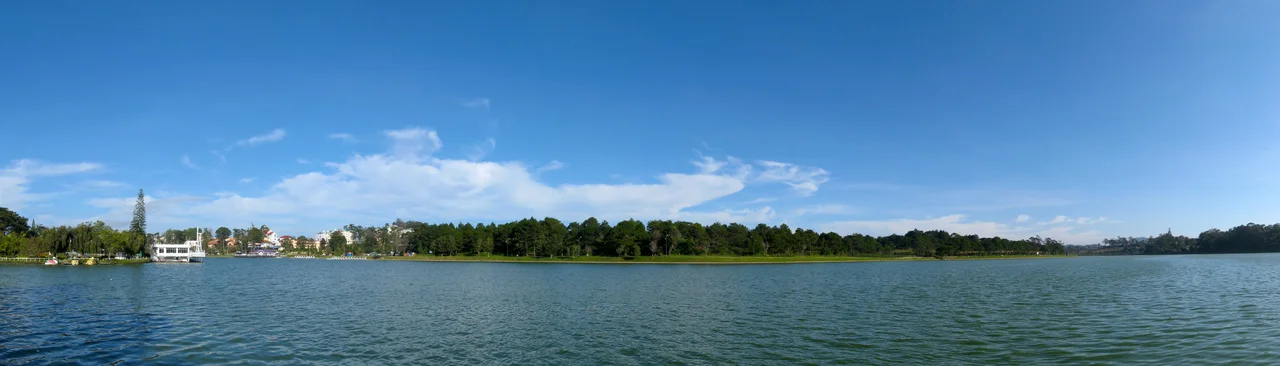

Xuân Hương Lake
Even its name is a dispute that tells you something. The lake in the center of Đà Lạt is called Xuân Hương, and nobody can quite agree whether that name honors the fragrance of flowers along its banks or the memory of Hồ Xuân Hương, a Vietnamese poet of the eighteenth century whose verses were frank enough to unsettle the men who read them. Either answer suits the lake. It is fragrant and a little subversive, a manufactured piece of nature that the city has adopted so completely that Đà Lạt feels unthinkable without it.
A Stream Made into a Mirror
Before 1919, Xuân Hương was not a lake at all. It was part of the Cam Ly stream, running through what would become the center of a French colonial hill station. In that year, an engineer named Labbé built a dam at the suggestion of envoy Cunhac, with approval from Paul Doumer, then Governor-General of French Indochina. The backed-up water formed the first lake. Four years later, a second dam created another lake below the first. Then, in March 1932, a major storm knocked both original dams out. The French rebuilt more seriously: between 1934 and 1935, engineer Trần Đăng Khoa designed and constructed a stronger stone dam, and the lake as it exists today took its shape. The French called it Grand Lac. Only in 1953, when the town's chairman Nguyễn Vỹ renamed it, did Xuân Hương supplant the colonial designation.
The City That Grew Around It
From the moment the stone dam held, the lake became the organizing principle of Đà Lạt's layout. Streets curved around it. Hotels faced it. The French built their villas on the hills above its shores. Đà Lạt's reputation as Vietnam's romantic highland escape — cool air, pine trees, the antithesis of the humid coast — owes much to a body of water that exists entirely because of human engineering. There is something both honest and poetic about that. The lake does not pretend to be primeval. It sits in the middle of the city without apology, receiving the reflections of hills and clouds and the occasional pedalboat with equal calm. A stroll around its perimeter is still how Đà Lạt introduces itself to visitors.
What the Poets Heard
The lake acquired its literary reputation early. The most famous response to Xuân Hương came from the poet Hàn Mặc Tử, who wrote "Đà Lạt trăng mờ" — Đà Lạt in Dim Moonlight — drawing on the lake's particular quality of stillness. His lines are an instruction: *"Keep silent, don't talk too much, / To listen to the water ringing at the bottom of the lake / To listen to the willow howling in the wind / And to listen to the meaning of love."* Whether the lake was named for Hồ Xuân Hương or for flowers, the effect Hàn Mặc Tử describes is the same — a place that rewards quiet. Many poems and literature pieces have taken the lake as subject. The romantic reputation stuck.
Đà Lạt's Emotional Center
Today Xuân Hương anchors the daily life of Đà Lạt more than any other single feature. The path around the water passes flower gardens, vendors selling grilled corn and hot soy milk, and early-morning joggers in the cool mist. In the evening, couples walk the lakeside. The surrounding hills — dotted with pine trees, French-colonial guesthouses, and the occasional greenhouse — frame a panorama that is genuinely unlike anywhere else in Vietnam. The lake shifts with the light: silver at dawn, deep blue at midday, orange and pink at dusk, and darkly reflective at night when the city lights come on around it. Its manufactured origins long since dissolved into the city's identity.
From the Air
Xuân Hương Lake lies at 11.9418°N, 108.4468°E in the center of Đà Lạt at approximately 1,500 meters elevation. The lake is the most prominent water feature visible from altitude in the central Đà Lạt basin — an elongated, crescent-shaped body of water surrounded by urban development. Recommended viewing altitude: 3,000–5,000 ft AGL. Nearest ICAO: VVDL (Liên Khương Airport, ~25 km south-southeast of the lake). The Đà Lạt plateau appears as a green highland basin ringed by darker forested ridges.
Nearby Stories
- Tà Đùng National Park 3.1 km away
- Phan Rang–Tháp Chàm 4.2 km away
- Cam Ranh 18 km away
- Bao Loc 18 km away
- Operation Byrd 23 km away
- Nha Trang Air Base 25 km away
- Bidoup Núi Bà National Park 34 km away
- Duc Lap Camp 43 km away