.JPG)
1692 Salta Earthquake
It came on a September morning, around eleven o'clock, on the 13th day of 1692. The ground beneath the Lerma Valley heaved and split, and for three days, until the 15th, the aftershocks would not stop. The quake measured a reconstructed magnitude of approximately 7.3 (older sources cited 7.0) at a depth of about thirty kilometers; on the scale that counts not energy but ruin, it reached intensity IX - violent enough to throw down walls and crack open the earth. Thirteen people died. In a frontier of only a few thousand souls, thirteen was not a statistic. It was neighbors, families, a portion of everyone known to everyone.
The Town That Vanished
The earthquake's worst blow fell on Esteco - properly Nuestra Señora de Talavera de Madrid, a small Spanish town in what is now Metán department. It was leveled completely. For generations afterward, Esteco lived on in the folklore of northwestern Argentina as a parable: a wealthy, prideful town swallowed by God's judgment, its bells said to ring faintly from beneath the ground. The legend obscured a plainer truth, which archaeologists from Argentina's national research council, CONICET, would later recover. Digging a small trench at the site near the Río Piedras, they uncovered a fragment of wall and one of the four towers of the fort that had guarded the town. The myth had buried real people; the spade brought back the outline of where they had lived.
A Voice in the Sacristy
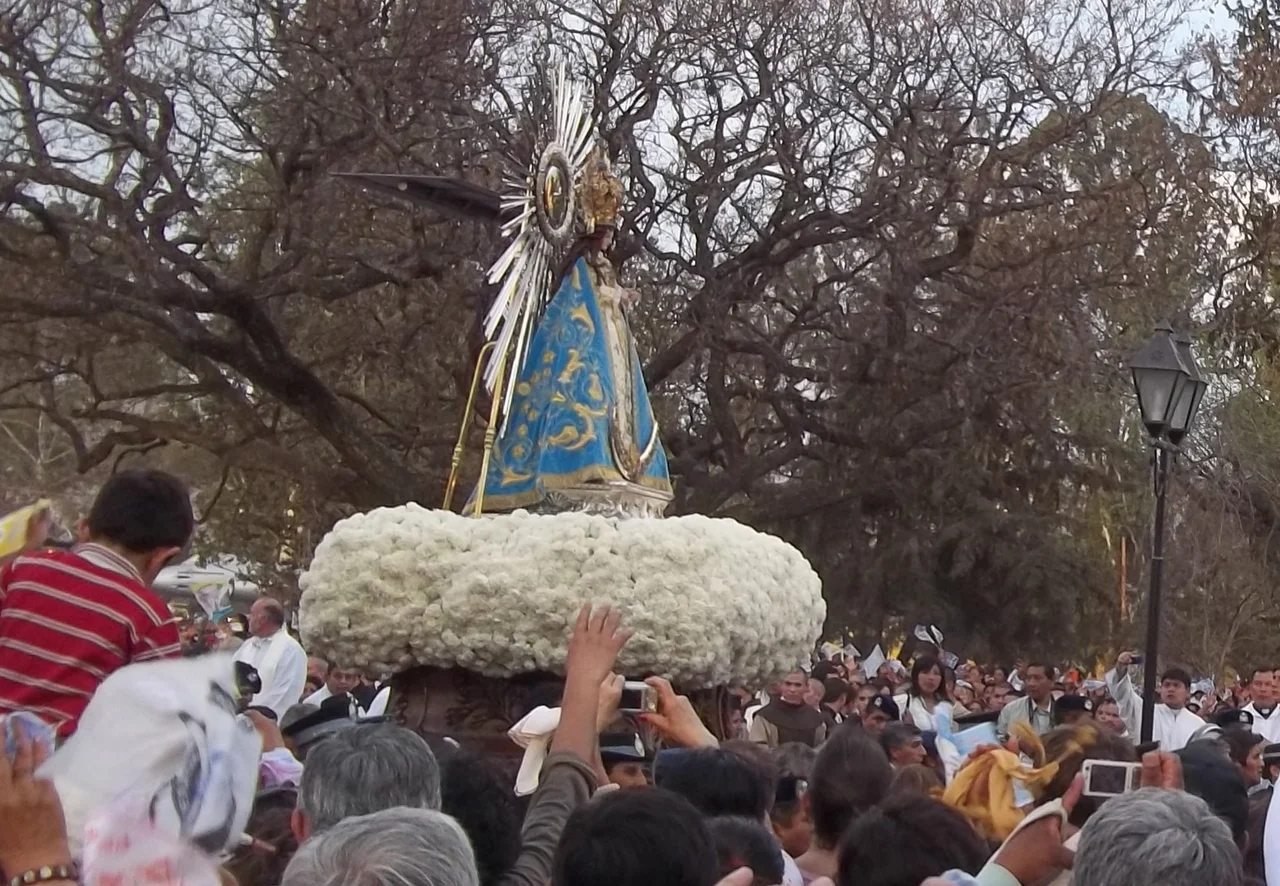
In the city of Salta, terror turned quickly toward heaven. As the cathedral shook, an image of the Virgin fell some three meters to the floor - and, the people said, came to rest unharmed at the feet of a figure of the crucified Christ. A Jesuit priest, José Carrión, reported hearing a voice during those desperate days: while the image of the Holy Christ remained forgotten in the sacristy, where it had sat since arriving in 1592, the earth would not be still. The crucifix was brought out and carried in procession. The shaking, in time, ceased. To a community that had just buried its dead and watched a neighboring town disappear, that ending was not coincidence. It was deliverance.
A Promise Renewed Each September
On the 8th of October 1692, the Salta town council formally declared the events of those three days miraculous. The Virgin was named advocate of the city; the 13th of September was set apart, and within weeks she was recognized as the city's Patroness under the title Nuestra Señora del Milagro - Our Lady of the Miracle. What began as a terrified vow has endured for more than three centuries. Each year the Fiesta del Milagro builds from early September and culminates in mid-month, when the images of Christ and the Virgin are carried through the streets in an immense procession. It has become the most important religious festival in Salta and one of the largest in all of Argentina, drawing hundreds of thousands of pilgrims who renew, in the words of the tradition, a covenant of faith.
Living on a Restless Fault
The fault that ruptured in 1692 has never been firmly identified, though geologists have looked hard at the Mojotoro fault east of the city as the likely culprit. The puzzle is more than academic. The northern Lerma Valley remains tectonically active, its surrounding ranges still rising, its ground still capable of the kind of violence Salta knew in 1692 - and felt again in lesser quakes across the centuries that followed. The city that grew up here lives knowingly on restless ground. Its grandest annual gathering is, in the end, a memory of the day that ground betrayed it, and of the thirteen who did not survive.
From the Air
The epicentral region lies in the Lerma Valley of Salta Province, in the vicinity of 25.40°S, 64.80°W, with the destroyed town of Esteco northeast near the Río Piedras in Metán department. The valley sits at roughly 1,200 meters, ringed by the Cordillera Oriental of the Andes - look for the broad agricultural basin hemmed by steep, fault-bounded ridges including the Mojotoro range east of the city of Salta. The nearest major airport is Martín Miguel de Güemes International (ICAO: SASA) at Salta. Visibility in the valley is generally excellent; the surrounding sub-Andean ranges trace the very faults that make this a seismically live landscape.
Nearby Stories
- Museum of High Altitude Archaeology 39 km away
- 1844 Salta Earthquake 41 km away
- San Carlos, Salta 60 km away
- Salta 68 km away
- Cafayate 121 km away
- Santiago del Estero 236 km away
- Mailín 359 km away
- Rincón Bomba massacre 380 km away