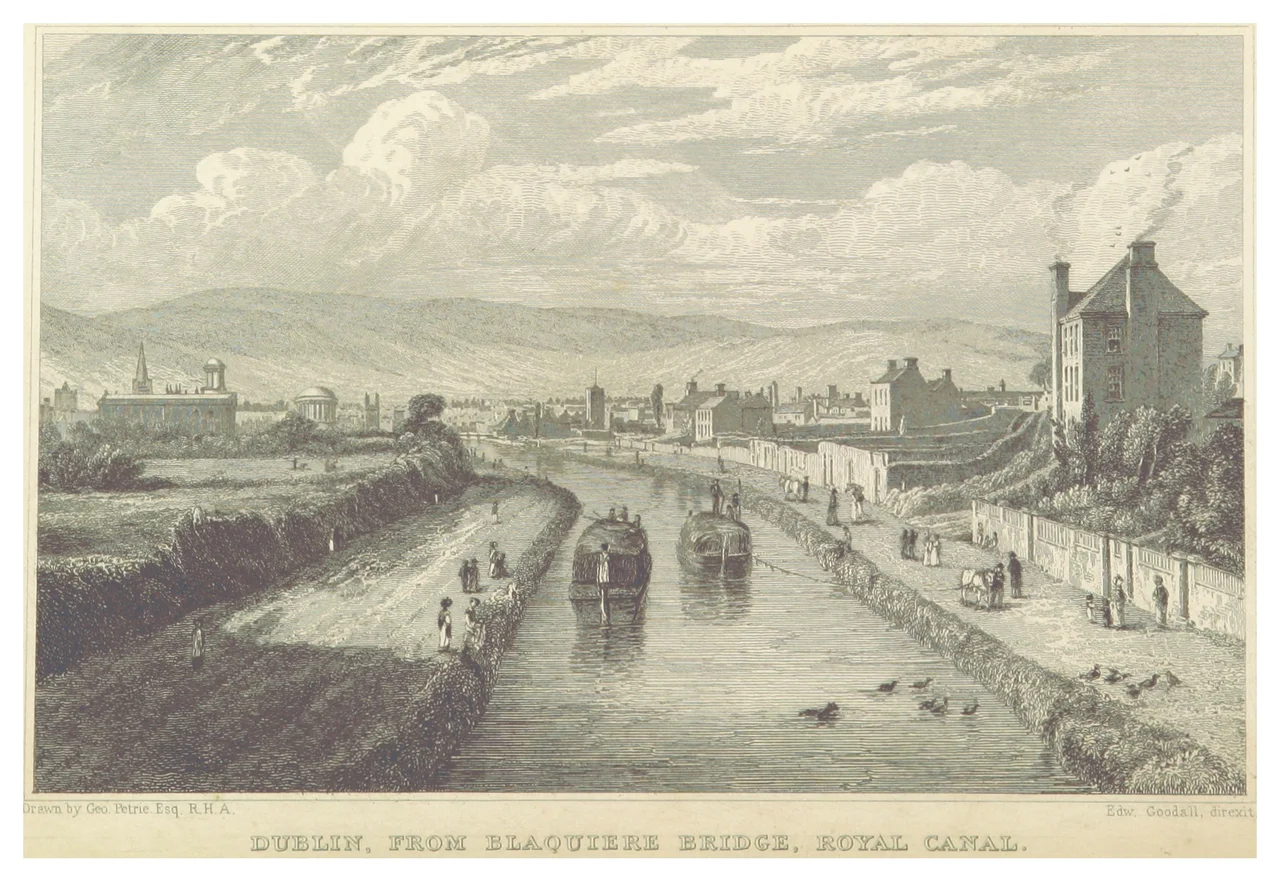
_p113_ROYAL_CANAL,_FROM_BLAQUIERE_BRIDGE.jpg)
1845 Royal Canal Disaster
Fifteen people drowned in the dark, in shallow canal water, just outside Dublin. On the evening of 25 November 1845, the night boat Longford was making its scheduled run from the Broadstone harbour in Dublin to the town of Longford. The boat carried 48 paying passengers - 10 in first cabin, 38 in second cabin, including two children - plus six crew. Somewhere between Kennan Bridge and Callaghan Bridge, in the area of Clonsilla, the bow struck either the rocky bank or a submerged stone, and the boat heeled hard to one side. Water poured in through the gunwales. The windows were barred. The deck did not go under, but the cabins filled too fast. Fifteen of those aboard could not get out.
A Canal Through Limestone
Construction on the Royal Canal began in May 1790 and ended in 1817, joining Dublin with the River Shannon at Cloondara in County Longford. A spur to Longford town was completed in 1831. The 'Deep Sinking' section that runs through Clonsilla was a known problem of the route. Eighteenth-century engineers had been advised to avoid the limestone outcrop here, but the canal company chose to blast through it instead. As historian Rob Goodbody put it, the Deep Sinking 'caused the canal company great trouble and expense.' To save money, the channel was cut narrow - too narrow for two boats to pass - with a high towpath above. The accident on 25 November happened just past the steep-sided Deep Sinking, in the slightly less dramatic stretch where the banks still consist of rock. The boat may have been overloaded; it is also possible that the rocky nature of the bank, where a sudden impact concentrated the shock, caused the passengers' weight to shift unexpectedly and the boat to capsize.
The Sinking
Robert Jessop was a private in the 8th King's Royal Irish Hussars, based at the Cavalry Barracks in Longford, returning to his post on the night boat. He was one of a small number of passengers on deck when the boat struck. 'The boat, when she struck, fell upon one side, then upon the other,' he later testified. 'She rebounded, and went down as far as she could. The bow of the boat struck first; it pointed in an angle from the middle of the canal.' Captain Christopher O'Connor was at the steering. He gave his own account to The Morning Post: the shock was not violent, but the boat heeled so that the gunwale went under. Passengers rushed to the door. O'Connor rushed to the companionway and managed to pull one woman through a window. The stern was filling fast. The deck stayed above water, but the windows below were submerged - and all the windows were barred. There was no way out for those trapped in the cabins. Thomas Savage, the governor of Roscommon Gaol who had been travelling first class, helped Captain O'Connor break open a hole in the roof and pull another woman through it. Before darkness fell completely, the crew and the surviving passengers had rescued everyone they thought might still be alive. Fifteen were gone.
Inquest and Remembrance
The inquest was held by Henry Davis, county coroner, assisted by an MP, J Hamilton, and a county magistrate, Alexander Kirkpatrick. The Freeman's Journal initially reported sixteen dead; the inquest established the number as fifteen. Other safety failures of the Royal Canal Company were raised in evidence - the drowning of six people at Longford earlier that same year when a boat capsized and sank; the drowning of a four-year-old child at Ballynacargy when a heavily laden boat turned over. The canal's barred windows were never modernised in any meaningful way; the company would lose its passenger traffic to the railways within a generation anyway. On 25 November 1995, the 150th anniversary of the sinking, the Royal Canal Amenity Group set a memorial plaque into the wall of Kennan Bridge. It carries the incorrect figure of sixteen victims, replicating the first night's misreporting that the inquest had later corrected. Local history groups in Blanchardstown and Castleknock still occasionally give talks about the disaster. The names of most of the fifteen who died are lost to ordinary record.
Canal, Famine, Forgetting
The disaster came one month into the Great Irish Famine - the autumn of 1845, when the potato blight was first being identified in Irish fields. Within a year the country would face the worst calamity of its modern history. The fifteen drowned on the Longford were not famine victims, but they were caught in the same winter. The canal that took them was the same canal along which Bianconi's coaches would soon stop competing, and which the railways would soon make obsolete altogether. The first passenger boats on the Royal Canal began running in 1796. By the 1830s the average annual passenger count was 40,000 a year. The Longford night boat reduced the Dublin-Mullingar journey by four hours when fly boats came in during 1833. None of this could compete with steam on rails. The disaster at Kennan Bridge sits, quietly now, behind a memorial plaque on a quiet stretch of the Royal Canal just west of Dublin's modern suburbs. The water there is still rocky-bottomed. The towpath still runs high above the canal.
From the Air
The disaster site sits at 53.38N, 6.41W along the Royal Canal near Clonsilla, in modern Dublin 15. Cruise 1,500-3,000 ft to take in the line of the Royal Canal running west-northwest from central Dublin and the suburbs of Castleknock and Clonsilla. The Deep Sinking section is visible as a steep-sided cutting through limestone bedrock. Nearest commercial airport is Dublin (EIDW), about 10 km northeast. The site lies under the EIDW approach and departure zones, so check approach charts before low-level overflight.
Nearby Stories
- Athcarne Castle 4.2 km away
- Wicklow Mountains National Park 10 km away
- Castlepollard 12 km away
- Portlaoise 19 km away
- Edward Pakenham 20 km away
- German submarine U-1051 39 km away
- HMS Manners (K568) 52 km away
- HMS Tyler 61 km away