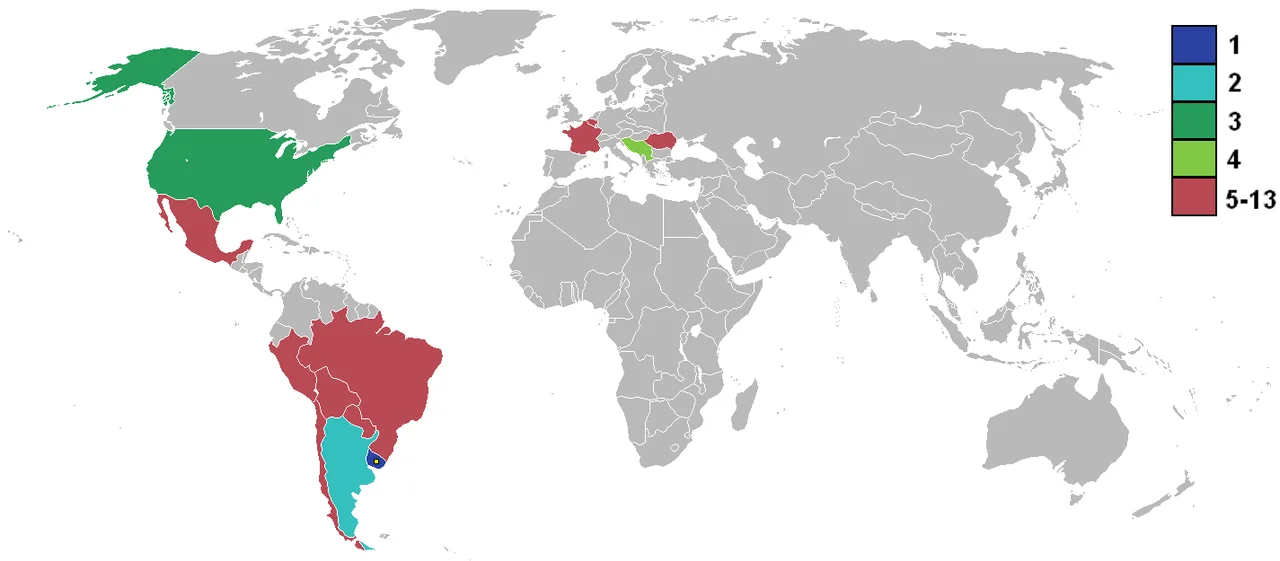

1930 FIFA World Cup
The final used two balls. The teams could not agree on whose ball to play with, so FIFA ruled that Argentina's would be used in the first half and Uruguay's in the second. It was that kind of tournament: improvised, unprecedented, and held in a stadium that was not finished when the games began. This was the first World Cup, played in Montevideo in July 1930, and almost everything about it was happening for the first time in history. By the end, a new champion held a new trophy, and a sport had a new center of gravity.
An Ocean to Cross
Uruguay won the right to host for good reasons. The little nation was about to celebrate the centenary of its first constitution, and its footballers had just defended their Olympic title at the 1928 Games, making them the unofficial champions of the world. But hosting on the far side of the Atlantic nearly emptied the field. With the Great Depression squeezing budgets and a sea voyage of weeks separating Europe from South America, no European team had even entered by two months before kickoff. FIFA president Jules Rimet had to intervene personally. In the end just four European sides made the journey by ship: France, Belgium, Romania, and Yugoslavia. Romania's squad was hand-picked by the country's newly crowned King Carol II, who personally arranged for the players to keep their jobs while away.
The Stadium That Wasn't Ready
Uruguay built the Estadio Centenario specifically for the tournament and for the centenary of its independence. Designed by architect Juan Scasso with a capacity of 90,000, it was the largest football stadium outside the British Isles. There was just one problem: heavy rains delayed construction, and the stadium was not ready when the World Cup kicked off on July 13. For the first five days, matches were squeezed into two smaller grounds borrowed from Montevideo's club giants, the Pocitos and the Gran Parque Central. The Centenario finally opened on July 18, the constitutional anniversary itself, with Uruguay beating Peru 1–0. From then on it hosted the matches that mattered, including both semi-finals and the final.
First Goals, First Records
Because there were no qualifying rounds, the two opening matches on July 13 were the first World Cup games ever played, kicking off simultaneously. France beat Mexico 4–1 at the Pocitos, and the United States defeated Belgium 3–0 at the Gran Parque Central. In the nineteenth minute of the France match, Lucien Laurent volleyed home the first goal in World Cup history, a moment no one yet understood would be remembered forever. Thirteen teams competed in all, seven of them South American, more than at any World Cup since. The records set that fortnight, the first goal, the first clean sheet, the first hat-trick, became the founding milestones of the sport's greatest competition.
Two Balls, One Champion
On July 30, hosts and favorites Uruguay met neighbors Argentina in the final, before 68,346 people packed into the new Centenario. Pablo Dorado put Uruguay ahead early, the first goal in any World Cup final, but Argentina struck back to lead 2–1 at the break, the half played with their ball. After the change of ball and ends, Uruguay surged. Pedro Cea equalized, Santos Iriarte gave Uruguay the lead, and Héctor Castro sealed it in the final minute for a 4–2 win. Uruguay became the first nation to lift the World Cup, in the first tournament, on home soil. Francisco Varallo of Argentina, who played that day, would be the last survivor of the whole World Cup, living until 2010 and reaching the age of 100. In 2030, a century on, the Centenario will host the opening match of the World Cup again, where it all began.
From the Air
The 1930 World Cup was played entirely in Montevideo, with the Estadio Centenario at roughly 34.89°S, 56.15°W in the Parque Batlle district, a short distance inland from the Río de la Plata coast. From the air the stadium's round bowl and its distinctive Tower of Homage are clear landmarks within the green expanse of the surrounding park. The broad estuary lies to the south, and central Montevideo with the Palacio Salvo tower sits to the west. Carrasco International Airport (ICAO SUMU) is about 15 km east. Coastal visibility is usually good over the flat terrain; estuary haze is the main factor. A low pass over Parque Batlle reveals the historic stadium where world football began, still in use nearly a century later.
Nearby Stories
- Piriápolis 24 km away
- Minas 40 km away
- Tronador (rocket) 67 km away
- Nueva Helvecia 69 km away
- La Plata Museum 122 km away
- Battle of Sarandí 126 km away
- Mundo Marino 145 km away
- South Georgia Island 2584 km away