.JPG)
1969 Northern Ireland riots
On the morning of 15 August 1969, a fifteen-year-old named Gerald McAuley was running through the streets of west Belfast trying to help families on Bombay Street load whatever they could carry into vans before the loyalist mob came back. A loyalist sniper shot him dead. He was a member of the Fianna, the youth wing of the IRA, but he was also a child. By the time British troops moved onto the Falls Road that evening, almost every house on Bombay Street had been burned, nearly fifteen hundred Catholic families had been driven from their homes in Belfast alone, and Northern Ireland had crossed a line it could not uncross. The five days from 12 to 16 August 1969 are usually called the beginning of the Troubles. They were also the beginning of three decades of grief.
How the Heat Built
The 1969 riots did not erupt from nothing. They were the explosion at the end of a long fuse lit by the civil rights movement of 1968, by gerrymandered electoral wards in Derry, by the systematic denial of public housing to Catholic families, and by a police force, the Royal Ulster Constabulary, that was nearly ninety per cent Protestant. In January 1969 a People's Democracy march from Belfast to Derry was ambushed by loyalists at Burntollet Bridge while RUC officers stood by. In March and April loyalist bombers blew up electricity and water infrastructure and blamed the IRA. The summer of 1969 brought a report from the International Commission of Jurists accusing the Northern Ireland government of religious discrimination and gerrymandering. The ICJ secretary general noted that South Africa was citing Northern Ireland's laws to justify apartheid. Everyone could feel the storm coming. The Apprentice Boys' march on 12 August lit the match.
The Battle of the Bogside
In Derry, three days of clashes between the Bogside's Catholic residents and the RUC turned a working-class neighbourhood into a small free state. Residents built barricades, set up first aid posts, and made petrol bombs in workshops. The RUC fired CS gas at British civilians for the first time in UK history; the chemical drifted through living-room windows along with the smoke. Bernadette Devlin, twenty-two years old and the youngest MP at Westminster, walked the barricades urging people on. Sealed off behind the slogan You Are Now Entering Free Derry, the Bogside held. To draw RUC pressure off the city, civil rights organisers called for protests across Northern Ireland on 13 August. In Belfast, where Catholics lived as a minority surrounded by Protestant streets, drawing pressure off Derry would mean drawing it onto Catholic families with no walls to hide behind.
Belfast Burns
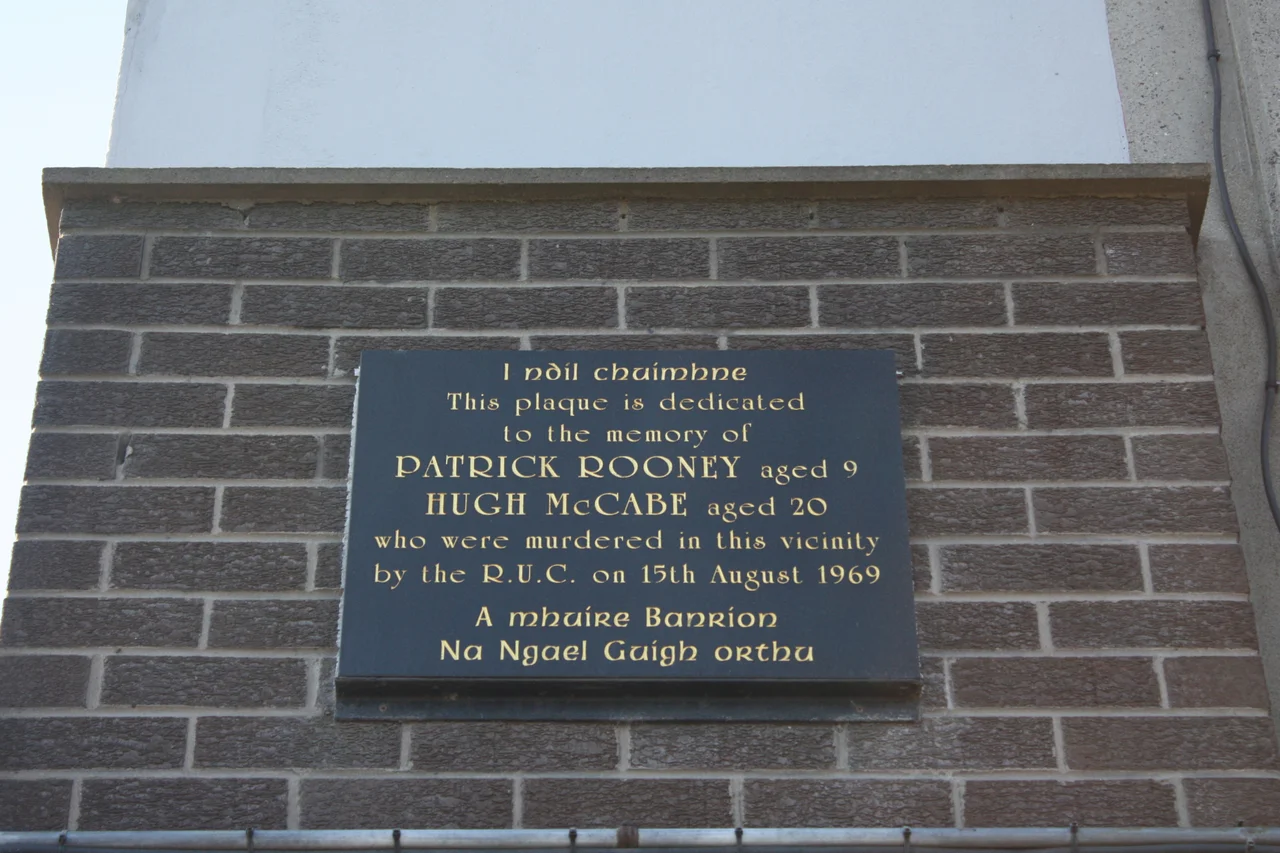
The Falls and the Shankill in west Belfast are separated by a few hundred metres of brick and a thin geography of hate. Beginning on the night of 14 August, loyalist crowds armed with bricks, sharpened poles, and petrol bombs moved down Dover and Percy Streets into Catholic homes. Catholic residents threw up barricades. Police marksmen on the roof of Hastings Street station fired eighteen rifle rounds at the roof of the Whitehall flats and killed Hugh McCabe, a twenty-year-old Catholic soldier home on leave from the British Army. A nine-year-old boy, Patrick Rooney, was killed in his bedroom in the Divis flats when a Browning machine gun mounted on an RUC Shorland armoured car raked the building. Samuel McLarnon, twenty-seven, was killed sitting in his own front room by a Sterling submachine gun. By the time it was over, seven people had died in Belfast, hundreds were wounded, more than 275 businesses were destroyed, and 83 per cent of the buildings burned were Catholic-owned.
The Army Arrives
At about 6:30 pm on 15 August, soldiers of the Royal Regiment of Wales took up positions on the Falls Road. They were initially welcomed in Catholic areas as protection from the loyalist mobs and the RUC; Catholic women carried out tea and sandwiches to teenagers in uniform. The deployment was called Operation Banner. It was supposed to last a few weeks. It lasted thirty-seven years. The Republic of Ireland's Taoiseach, Jack Lynch, made a televised address on 13 August saying the Irish government could no longer stand by; he ordered field hospitals to the border and called for UN intervention. The rumour that Irish troops were about to cross the frontier swept through Catholic Belfast and was wrong. The UK held an inquiry; the Scarman Report later faulted the RUC on at least six occasions and led to the disbandment of the B-Specials, the all-Protestant reserve police force. But by then it was much too late.
What Came Next
The riots split the IRA. In December 1969, men in Belfast led by Billy McKee and Joe Cahill broke from the Dublin leadership, accusing it of leaving Catholic areas defenceless. They formed the Provisional Irish Republican Army and promised never again. The loyalist Ulster Volunteer Force, already responsible for the spring bombing campaign, was galvanised. In 1971 the Ulster Defence Association would be born out of the same loyalist street groupings that had attacked the Falls. Five days of riots produced, in five months, the two paramilitary forces that would dominate Northern Ireland for the next thirty years. Bombay Street was rebuilt, then walled off behind the first of the peace lines that still divide Belfast in 2026. A small memorial garden on the corner remembers Gerald McAuley. The bricks of new houses meet the bricks of older houses where the burned ones used to stand.
From the Air
The riots affected multiple cities, but the most concentrated violence took place in Derry's Bogside (around 54.99 degrees north, 7.32 degrees west) and west Belfast (around 54.60 degrees north, 5.95 degrees west). Approaching Derry, look for the bend of the Foyle and the city walls rising above the Bogside on the west side of the river; the Free Derry Corner mural is still painted on a gable at the lower end of the neighbourhood. The nearest controlled airport to Derry is City of Derry (EGAE); Belfast's main events centred on the Falls-Shankill interface in the west, with Belfast International (EGAA) and Belfast City (EGAC) the nearest airports. Donegal Airport (EIDL) lies west across the border. From cruise the long stretch of Lough Foyle north of Derry and the dense urban grid of Belfast wedged between Cave Hill and the lough are unmistakable.
Nearby Stories
- Portrush Lifeboat Station 1.9 km away
- Main Street, Letterkenny 2.1 km away
- Inishowen 6 km away
- Rosguill 6.3 km away
- County Tyrone 7.1 km away
- St Patrick's College, Maghera 9.6 km away
- St Patrick's Purgatory 11 km away
- Coalisland Canal 17 km away