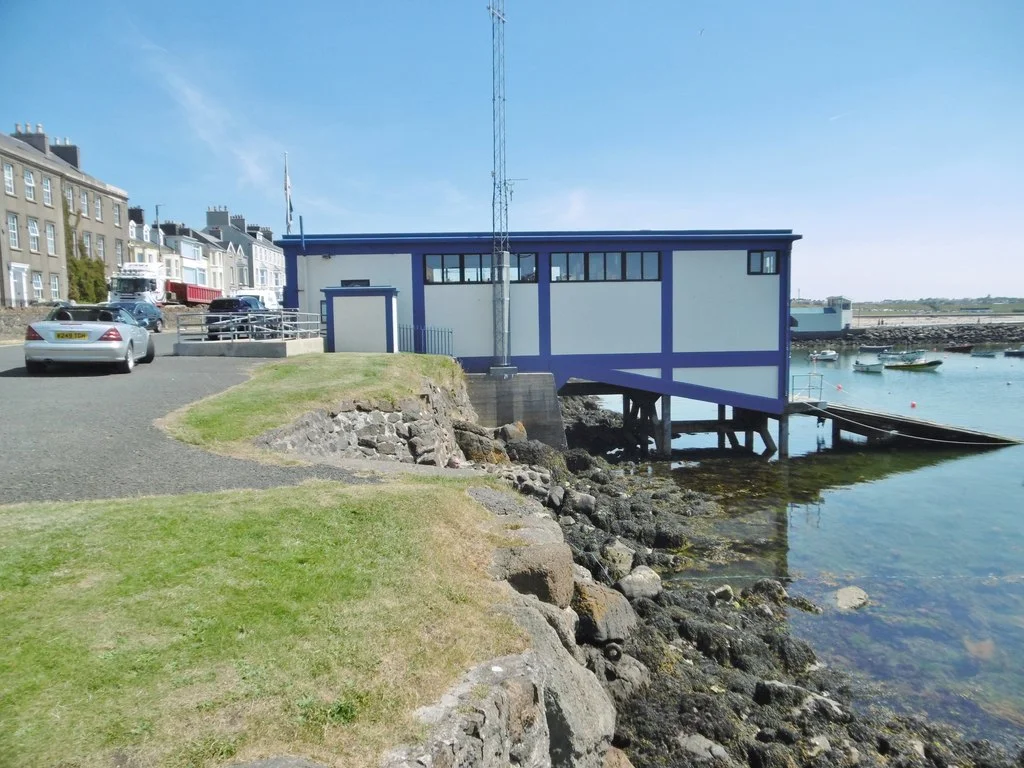

Portrush Lifeboat Station
On 1 November 1889, the Portrush lifeboat Robert and Agnes Blair launched for the first time in service. She had been on station less than a month. The call was to a French schooner, the Dryad, which turned out not to need help. On the way home in heavy seas, on the run back to Bushfoot Strand, the Robert and Agnes Blair capsized three times. She was washed up at Portballintrae. Three of her crew did not come home. The men who pull out of Portrush Harbour today work in better boats and better weather forecasts, but they pull out into the same Atlantic that took their predecessors that night.
A Silver Medal for a Drowned Boat
The station began in 1842, before it formally existed. In January of that year, three fishermen drowned when their small boat sank off Portrush. A man named William Richardson saved the life of a fourth. The Royal National Institution for the Preservation of Life from Shipwreck - it would become the Royal National Lifeboat Institution in 1854 - awarded medals for gallantry at sea whether or not a lifeboat had been involved. Richardson received the Silver Medal. The lesson was clear: this coast needed a boat. Eighteen years later, with Lady Laura Cecilia Parker, Countess of Antrim, pushing the cause, the RNLI established a Portrush station. A boathouse and slipway cost £140. The first lifeboat - a thirty-foot self-righting type with six oars and sails - arrived on 26 December 1860, transported free of charge by the London and Belfast Steam Packet Company. It had been funded by Lady Cotton-Sheppard of Crakemarsh Hall, who also paid for a second boat elsewhere. The Portrush boat was originally called Zelinda; in 1870, with Lady Cotton-Sheppard's permission, it was renamed Laura, Countess of Antrim in recognition of the campaign that had brought it there.
Ellen Myvanwy
Two years after the disaster of 1889, the Robert and Agnes Blair launched again into a north-westerly gale on 2 March 1891 - to the schooner Ellen Myvanwy, anchored in the Skerries Roads with three men aboard. The lifeboat was beaten back for two days. On the third attempt the crew reached the schooner and brought the three men off. Two lifeboatmen were washed overboard during the rescue and both were saved - William McAllister had jumped in and swum through the rough water to bring one of them back. McAllister was awarded the RNLI Silver Medal. So were master mariner Frederick Watt and coxswain John Hopkins. A station that had lost three men in 1889 had refused to stop sailing, and in 1891 it brought everyone home.
The Move to Ramore Head
In 1900 the RNLI decided to relocate the station to the eastern side of Ramore Head, the long peninsula on which Portrush sits. A new boathouse and slipway were built at Lansdowne to take a thirty-five-foot lifeboat called Hopwood, which arrived in 1902. The station moved again in time, but the move of 1900 marks the moment when Portrush as a lifeboat town settled into the shape it still has - one boat working out of one harbour, on a coast that has not stopped throwing weather at it.
The Katie Hannan and the Rocks
On 29 January 2008, the Portrush lifeboat 17-23 Katie Hannan, on station since 15 June 2000, was attempting to rescue three men in a rigid inflatable boat in extremely rough conditions near Rathlin Harbour. The lifeboat was swept onto the rocks and grounded. The coastguard took off the three men in the RIB. The crew of the Katie Hannan all got ashore. It took eighteen days for the lifeboat to be floated off the rocks, by which time the hull was beyond repair. A permanent replacement, 17-30 William Gordon Burr, went into service on 8 May 2008. She is still there. The inshore lifeboat, The Ken Blair (D-871), has been on station since 2022. On 5 August 2009, mechanic Anthony Chambers, after the inshore lifeboat could not enter a sea cave where two boys had been cut off by the tide, swam into the cave and brought them out. He was awarded the RNLI Bronze Medal.
What the Wall Holds
The current station sits on Kerr Street. Inside, the roll of honour remembers, by name, the crew lost in the 1889 capsize and the others who have died in service of the Portrush boats. The medals - silver, bronze - hang on the wall, an institution's quiet way of saying that some debts are not paid in money. The RNLI is a charity. Every shilling that funded the first boat in 1860, every legacy that paid for the next ones, every coin in a collection box on a Portrush street today belongs to a tradition that began with three fishermen and one man swimming out to save the fourth.
From the Air
Portrush Lifeboat Station sits at 55.21°N, 6.66°W on Kerr Street, near Ramore Head on the north Antrim coast. From altitude, look for the small harbour at the base of the peninsula on the west side of the town. Nearest airport is City of Derry (EGAE), about 14 nautical miles west; Belfast International (EGAA) is 45 nautical miles southeast. North Atlantic gales drive the station's work.
Nearby Stories
- River Bann 5.2 km away
- Glenarm Castle 6.1 km away
- Ballygroll Prehistoric Landscape 11 km away
- Mull of Kintyre 11 km away
- Attacks on Shipping in Lough Foyle (1981-82) 12 km away
- Achamore House 20 km away
- Port Ellen Distillery 22 km away
- German submarine U-155 (1941) 39 km away