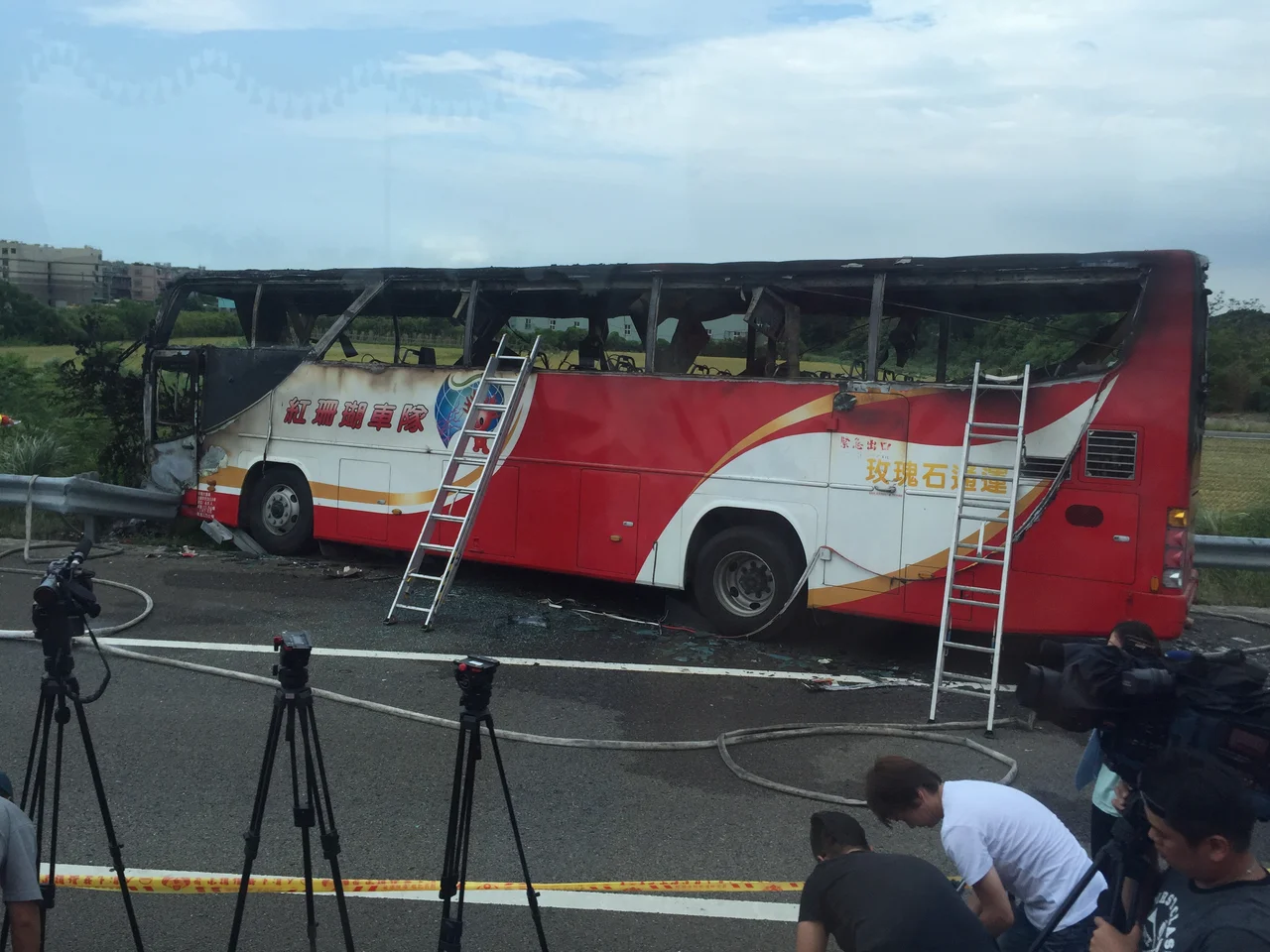

2016 Taoyuan Bus Fire
The rear door could only open ten centimeters. The guardrail, sheared loose by the crash, had wedged against it from the outside. Inside the burning bus on National Road No. 2, four kilometers from Taoyuan International Airport, 24 tourists from Dalian and their tour guide pressed toward the back, searching for a way out that did not exist. Despite eight emergency exits built into the vehicle, none opened. The passengers did not know how to operate the built-in locks. By the time the fire was extinguished at 1:21 p.m. on July 19, 2016, all 26 people aboard were dead.
Twelve Minutes of Fire
At 12:57 p.m., fire appeared at the front of the bus as it traveled west along the highway. The vehicle swerved along the left lane for nearly three kilometers before crashing into the left guardrail, then careening right into the opposite railing. A gravel truck driver spotted the flames and alerted a nearby policeman. Together, they attempted to break windows with handheld fire extinguishers, trying to reach the people trapped inside. Heavy smoke filled the bus within minutes, and the confined space became lethal. The 24 mainland Chinese tourists, their Taiwanese tour guide Zheng Kun Wen, and the driver Su Mingcheng all perished -- from burns, extreme heat exposure, or suffocation. Multiple bodies were found stacked together near the rear emergency door, evidence of a final, desperate attempt to escape.
Locked Doors
Initial investigations focused on the escape exits. Every one of the eight emergency doors had a built-in lock, and the passengers had not been shown how to open them. The rear door, the most obvious escape route, was pinned shut by the guardrail damaged in the crash and could open only ten centimeters. Investigators also found that the bus's transformer voltage had been illegally boosted from 24 to 110 volts to power a water dispenser, refrigerator, and electrical sockets. Questions swirled about whether the low-cost tour company, which relied on shopping commissions to cover expenses, could afford to maintain proper safety standards. The deaths exposed systemic failures in Taiwan's tour bus industry.
Arson and Self-Destruction
The investigation took a darker turn on July 29, when test results suggested the driver had been drinking before the incident and the possibility of deliberate self-immolation could not be ruled out. On September 10, 2016, the Taoyuan District Prosecutors' Office concluded its investigation: Su Mingcheng had committed premeditated arson. He had doused the bus with gasoline and set it on fire, then deliberately crashed the vehicle. His family, prosecutors found, had long been aware of his desire to take his own life. Su had also been convicted in 2013 of sexually assaulting a female tourist during a tour in Hualien City and was sentenced to five years in prison. His appeal had its second hearing just weeks before the fire, on June 24, 2016.
Twenty-Six Lives
The people who died were not abstractions. They were tourists from Dalian who had come to Taiwan to see the island, a tour guide doing his job, and a driver whose personal desperation consumed everyone around him. The families of the mainland Chinese victims were among the first to suspect deliberate arson. A total of 59 relatives traveled to Taiwan for one week to attend to cremations, compensation procedures, and settlements. Each victim's family received approximately NT$9.04 million in insurance compensation, raised from an initial estimate of NT$5.65 million. Twenty-three families signed settlement agreements. One family chose to pursue legal proceedings. On July 29, a public memorial was held in Dalian for those from northeastern China.
After the Fire
The 2016 Taoyuan bus fire was the deadliest bus accident in Taiwan that year and the worst since the 2010 Suhua Highway disaster. It drew international coverage from the BBC, the Guardian, the Wall Street Journal, CNN, and NHK, among others. The incident exposed critical safety gaps: inadequate passenger briefings on emergency exits, illegal electrical modifications, and an industry structure where cost-cutting was built into the business model. Taiwan's tour bus regulations were subsequently tightened. But the fundamental horror of the event -- 26 people locked inside a burning vehicle, unable to open a single door -- resists any regulatory remedy. Some failures are too complete for reform alone to answer.
From the Air
Coordinates: 25.04N, 121.22E. The incident occurred on National Road No. 2 in the Dayuan District section, approximately 4 km from Taoyuan International Airport (RCTP). From the air, this is a major highway section visible as a straight road corridor running east-west near the airport. Nearby airports: RCTP (Taoyuan International Airport, immediately adjacent). The highway is clearly visible at any altitude.
Nearby Stories
- Jingtong Mining Industry Museum 8.9 km away
- Kavalan Distillery 9.5 km away
- Hsinchu Science Park 10 km away
- 2022 Chinese Military Exercises Around Taiwan 25 km away
- Gaomei Lighthouse 53 km away
- North Jiangsu Main Irrigation Canal 978 km away
- General Cliff Rock Paintings 1043 km away
- Sinking of MV Sewol 1073 km away